
Share This Article
India is the largest single source of buyer inquiries in our records — and Indian buyers ask differently from everyone else: application first, specification second, price per unit always. This page is written the way Indian distributors, pack assemblers and EV workshops actually buy: what gets ordered, which standard series match, and how to compare quotes before you commit. For customs duty, IGST and BIS registration detail, see our dedicated India import duty & compliance guide — this page covers the market and the products; that one covers landed cost and compliance. Research date: November 2026.
Why India Buys LiFePO4 Batteries
Three structural forces drive Indian demand. First, electric three-wheelers are already mass transport: electric models took about 60% of all three-wheeler retail sales in FY2026 — over 830,000 units (FADA retail data) — and every passenger and cargo e-rickshaw runs on a replaceable traction battery. Second, rooftop solar is scaling under subsidy: the PM Surya Ghar programme targets 10 million households and 30 GW of residential rooftop capacity by March 2027, and had passed 17.5 GW by September 2026 (JMK Research) — solar homes are the natural next buyers of storage and inverter batteries. Third, India assembles locally: more than 500 companies manufacture electric three-wheelers alone (Vahan registry), and most of them build battery packs from purchased cells rather than importing finished packs — which is why cell demand from India is unlike any other market we serve.
What Indian Buyers Actually Order
The table below is drawn from real inquiries received from Indian buyers. Treat each line as a documented demand pattern, not a market standard — specifications, pricing, MOQ and lead time are always confirmed per project.
| Segment | Documented requests from Indian buyers | Who asks |
|---|---|---|
| E-rickshaw & e-3W packs | 48V 30–40Ah three-wheeler packs; 60V and 73.6V 80–100Ah higher-capacity packs | Rickshaw assemblers, fleet workshops, regional dealers |
| Cells for local assembly | 32650 cylindrical cells (3.2V 5–5.5Ah); prismatic cells for ESS and pack building | Pack assemblers, battery workshops |
| Solar & home storage | 12.8V 100Ah with BMS; 24V solar packs; 51.2V wall-mount and rack storage; single inquiries up to thousands of sets of 12.8V packs | Solar distributors, EPC installers, wholesalers |
| Inverter backup systems | Complete battery + inverter backup for 230V AC output, 6–8 hours runtime | Backup-power dealers, small commercial buyers |
| Telecom & UPS | 48V telecom battery series, often combined with ESS in one RFQ | Telecom suppliers, UPS dealers |
| EV & bus packs | 72V 100Ah EV car packs; 72–96V bus packs; 540V 450–600Ah bus packs with charger and BMS | EV converters, bus fleet projects |
E-rickshaw packs — the volume segment
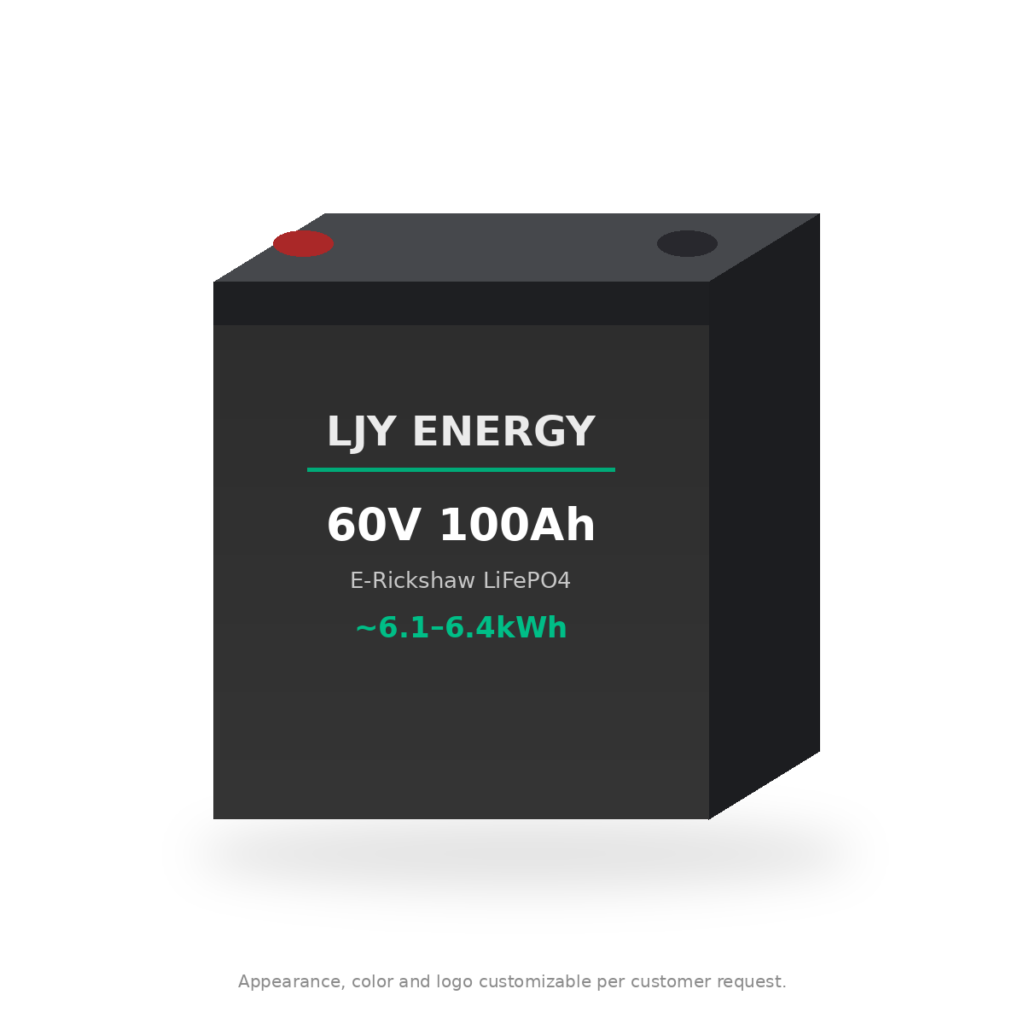
Passenger e-rickshaws typically run L3-class packs of roughly 2–7 kWh and larger L5 vehicles 7–12 kWh, and the replacement cycle is relentless: a working rickshaw earns per day, so operators and fleet workshops buy on cost per kilometre, not headline price. Our standard range covers the documented formats — see the 48V–60V e-rickshaw battery series, the 48V 100Ah e-rickshaw battery and the 60V 100Ah e-rickshaw battery. Pack voltage, connector and casing are matched to the vehicle platform per order.
Cells for local pack assembly
India is the one market where cell-only inquiries rival pack inquiries. The 32650 cylindrical format (3.2V, 5–5.5Ah) is the workshop standard for rickshaw and small-pack assembly, and prismatic formats serve ESS and larger pack builders. When you buy cells, the grade paperwork matters more than the price line — see LiFePO4 battery cells wholesale, prismatic cells wholesale and our guide on choosing cells for pack assembly.
Solar, home ESS and inverter batteries
Rooftop-solar households and the dealers who serve them buy three formats: 12.8V drop-in batteries for small systems and backup (see the 12V battery series), 51.2V wall-mount and rack batteries for whole-home storage (see the 51.2V rack series and home energy storage solutions), and complete inverter-backup sets where the battery must communicate with the inverter — our inverter communication guide explains the compatibility checks before you order.
Telecom, UPS and project packs
48V telecom batteries are a steady documented line — see the 48V 50Ah telecom battery and telecom backup power solutions. At the other extreme, bus and EV conversion packs (72V up to 540V class) are engineered per project against a written specification; if you are preparing a project RFQ, our C&I BESS RFQ checklist lists the information a supplier needs to quote accurately.
How to Compare Quotes (the ₹/kWh discipline)
Indian buyers lead with price — fairly. But a ₹-per-piece comparison across suppliers misleads unless the quotes are normalised. Before comparing, align these five things:
- Cost per usable kWh, not per piece: divide the price by (nominal voltage × Ah × allowed depth of discharge). A cheaper pack with an 80% DoD limit can cost more per usable kWh than a pricier 90–100% DoD pack.
- Cell identity and grade: cell brand or source, grade, and capacity test basis in writing. In the 32650 segment especially, recycled and re-wrapped cells circulate — ask for batch and date codes.
- Cycle-life conditions: the C-rate, DoD and temperature behind any cycle claim. A claim without conditions is marketing, not a specification.
- What is inside the price: BMS rating and protections, charger included or not, connectors, casing, and whether the price is EXW, FOB or landed. Compare like with like.
- Compliance and landed cost: the exact model’s BIS registration status, plus duty and IGST for your classification — worked through step by step in our India import duty & compliance guide. A low FOB quote can lose to a higher one after landed cost and a failed BIS check are counted.
Then do what experienced Indian importers do: sample first, verify capacity and BMS behaviour on your own bench, and scale to container volume only after the sample passes.
Importing to India: the Short Version
- Gateways: Nhava Sheva and Mundra serve most western-India volume; Chennai covers the south. Lithium batteries move as Class 9 dangerous goods — use DG-accepting lines and keep UN38.3 and MSDS documents ready.
- BIS registration: lithium-ion cells and battery packs fall under the Bureau of Indian Standards Compulsory Registration Scheme — the exact model being sold in India needs registration in place before commercial import and sale. This is the single most common avoidable delay for first-time importers.
- Duty and taxes: basic customs duty, social welfare surcharge and IGST stack on the FOB value and vary by classification and end-use notification — the full breakdown and a worked landed-cost example are in the India import duty & compliance guide.
Wholesale and OEM/ODM for the Indian Market
LJY Energy is a China-based LiFePO4 battery supplier and OEM/ODM coordination partner. For India we supply the documented standard series — e-rickshaw packs, 12V and 51.2V storage batteries, 48V telecom batteries — plus cell-level supply (32650 and prismatic) for local assemblers, and project packs engineered per specification. Private-label and OEM/ODM coordination is available for distributors building their own brand.
We are asked often, so plainly: we do not operate an office in India. We supply from China, ship to Indian ports, and provide the export documentation package your broker needs — commercial invoice, packing list, UN38.3 test summary, MSDS and certificate of origin. Specifications, pricing, MOQ and lead times are confirmed per project. Contact us with your application, target specification, quantity and destination port for an India-market quotation.
Frequently Asked Questions
Do you have an office or warehouse in India?
No. LJY Energy is based in China and supplies Indian buyers by export shipment to ports including Nhava Sheva, Mundra and Chennai, with the full documentation set for your customs broker. Many of our Indian customers are assemblers and distributors who import on their own IEC.
Which battery fits an e-rickshaw?
Most passenger e-rickshaws run 48V or 60V packs; capacity follows the vehicle class — roughly 2–7 kWh for L3 vehicles and 7–12 kWh for L5. Share your vehicle model or existing battery dimensions and we will match voltage, capacity, connector and casing. See the 48V–60V e-rickshaw series.
Can I buy cells only, without finished packs?
Yes — cell supply for local assembly is one of the most common India order types we handle, in 32650 cylindrical and prismatic formats. See cells wholesale. Tell us the format, target capacity and monthly volume for a quotation.
Who handles BIS registration?
Registration under the BIS Compulsory Registration Scheme attaches to the exact cell or pack model. Confirm the registration status of the specific model in your RFQ before ordering — our India import duty & compliance guide walks through the CRS section in detail.
How do I get a price?
Send the application, specification (voltage, capacity, dimensions if a retrofit), estimated quantity and destination port via our contact page. Quotations are issued per project with specification, MOQ and lead time confirmed in writing.
Sri Lankan solar dealers and ESS buyers can use our Sri Lanka supplier page for the checks specific to that market.
Share This Article