
Share This Article
Container projects do not start with a catalogue model — they start with a load curve. This page is for commercial and industrial buyers, EPCs and energy companies sourcing a containerized LiFePO4 energy storage system from China: how to size the system before you ask for a price, which configuration decisions actually move the quotation, and how container format compares with cabinet systems. LJY Energy is a China-based LiFePO4 battery supplier and OEM/ODM coordination partner: we confirm project specifications in writing, coordinate supply and integration through qualified manufacturing partners, and support the export process. Every configuration figure on this page is a dimension to be confirmed per project — not a fixed catalogue specification.
Who Asks for Containerized Storage — Documented Inquiry Patterns
Container-scale requests reach us less often than cabinet or pack inquiries, but they arrive with real projects behind them. Documented patterns from our inquiry records include a US buyer asking us to price a container system for a site using about 22,000 kWh per month (roughly 1 MWh per day), an Australian energy company inquiring about a 20FT system in the 500kWh–1MWh class, and an Indian project RFQ that combined 48V telecom batteries with a 1–4 MWh storage system. Treat each inquiry as one documented signal, not a market standard — but together they show how C&I buyers actually frame these projects: a load to serve, a container class in mind, and a request for a priced, written specification.
What a Containerized ESS Configuration Covers
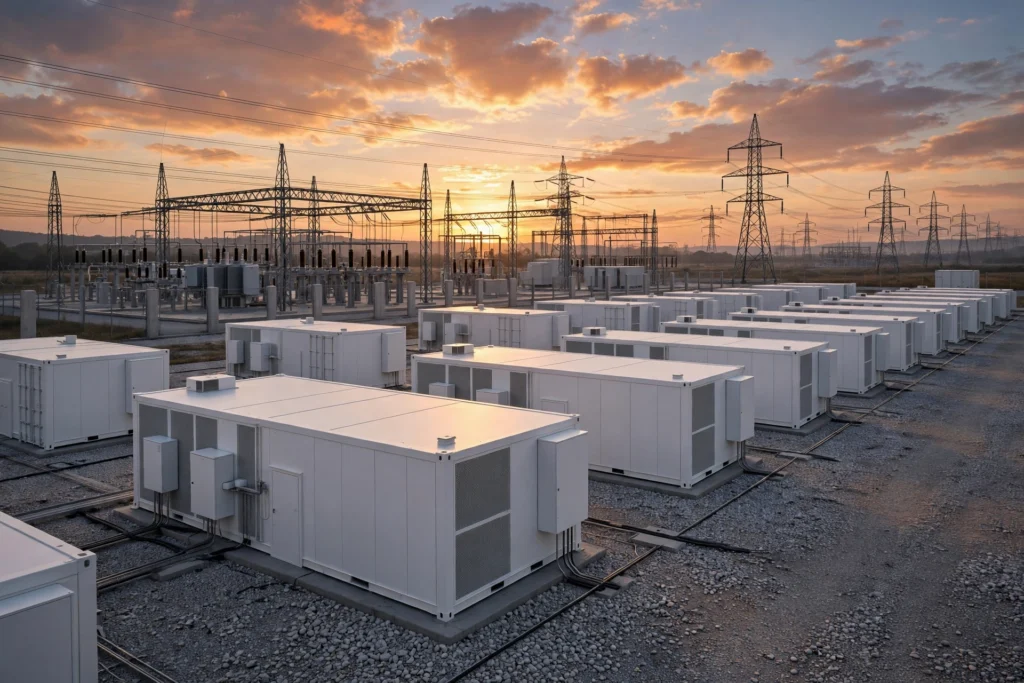
A containerized system is an integrated scope — battery racks, PCS, thermal management, fire protection and controls in one transportable enclosure — so the quotation depends on decisions across all of them. The dimensions below are the ones that must be settled and confirmed in writing for each project:
| Configuration dimension | Options / range | How it is settled |
|---|---|---|
| Nominal capacity class | 500kWh–1MWh per 20FT unit is the most frequently requested class; smaller, larger and multi-container layouts are possible | Confirmed per project after sizing (next section) |
| Container format | 20ft or 40ft high-cube enclosure | Confirmed per project against site and transport limits |
| DC voltage platform | High-voltage battery architecture; exact bus voltage follows the system design | Confirmed per project in the written specification |
| PCS (inverter) | Power rating matched to the peak you intend to serve or shave; grid-following or grid-forming operation | Rating and model confirmed per project |
| Thermal management | Forced-air HVAC or liquid cooling | Confirmed per project against climate and duty cycle |
| Fire protection | Detection and suppression options sized to the enclosure | Confirmed per project against destination fire code |
| Operating mode | Grid-tied peak shaving, PV hybrid / self-consumption shifting, or off-grid | Confirmed per project; drives PCS and EMS scope |
| Monitoring & EMS | Local controller with remote monitoring and dispatch interface options | Confirmed per project |
| Compliance documents | Certificates and test reports are bound to the exact model, configuration and producing facility | Confirmed in writing per project and destination — never assumed from a brochure |
How to Size a C&I System Before You Ask for a Price
The most common sizing mistake is converting a monthly electricity bill directly into battery capacity. A monthly total tells you energy throughput, not the storage you need. Work through the job the battery has to do:
Step 1 — Get the load shape, not just the bill
Ask your utility or meter provider for 12 months of interval data (15- or 30-minute readings). If that is unavailable, collect monthly bills plus the highest recorded demand peaks. The shape of the curve — when peaks occur and how long they last — decides both capacity (kWh) and PCS power (kW).
Step 2 — Name the job: shaving, backup, or shifting
- Peak shaving: the battery discharges during your demand peaks to cut demand charges. Size from the energy above your target demand line during peak windows, not from total daily use.
- Backup: size from critical loads only: usable kWh = critical load (kW) × required backup hours, divided by the usable depth of discharge you plan for (a conservative planning figure for LiFePO4 is around 90% usable — confirmed against the actual system design).
- Solar self-consumption shifting: size from the surplus PV energy you currently export or curtail, and the evening load you want it to serve.
Step 3 — Worked example: a site using ~22,000 kWh per month
One documented inquiry came from a site using about 22,000 kWh a month — roughly 730 kWh per day on average. That average alone does not make a 1 MWh battery right or wrong. If the goal is backup for a 100 kW critical load over 4 hours, the usable energy needed is about 400 kWh — a system in the 500kWh class. If the goal is shaving a 250 kW midday peak that lasts 2 hours, the discharge energy is about 500 kWh and the PCS must be rated at or above the shaved power. If the goal is shifting a full day of surplus solar, the number moves again. Same site, three different systems — which is why a serious quotation starts from the load curve and the job, and why we ask for them in the RFQ.
Step 4 — Let capacity and PCS follow the job
Once usable kWh and PCS kW are fixed, the container class follows: the 500kWh–1MWh per 20FT class covers most single-site C&I projects we are asked about, and larger sites scale by adding units. Fixing the container size first and the engineering second is how projects end up with a system that is cheap to buy and wrong to run.
Container or Cabinet? Choosing the Format
Below container scale, cabinet systems are usually the simpler tool. Our 215kWh C&I cabinet (100kW class) suits single-site commercial users who need indoor or sheltered installation and want to expand cabinet by cabinet; the 51.2V floor-standing cabinet covers smaller commercial and large residential storage. Choose the container format when:
- usable capacity per site is in the 500kWh class or above;
- the installation is an outdoor pad, an industrial site or a remote location where one integrated, factory-assembled enclosure reduces site work;
- PCS power runs to several hundred kW, or future expansion by additional units is planned;
- shipping as a single integrated unit to the destination port simplifies your project logistics.
As a working rule: below roughly 200–300 kWh per site, start with cabinets; at 500kWh class and above, or on harsh outdoor sites, evaluate the container first. The crossover is project-specific — send us the site details and we will say plainly which format fits, including when the answer is the cabinet.
Compliance: Confirmed per Project and Destination
Container systems are permitted, insured and interconnected under destination rules, so the compliance pack is part of the specification — not an afterthought. Depending on the destination, the documents to settle can include cell and system safety standards (for example IEC 62619 or the UL 9540 / UL 9540A route in North America), fire-code siting expectations such as NFPA 855, CE marking scope for Europe, and the local grid-interconnection code for the PCS. Two disciplines protect you here. First, certificates and test reports are bound to an exact model, configuration and producing facility — a certificate shown for a different configuration does not cover your system. Second, everything agreed is confirmed in writing before the order, so the delivered documents match the delivered hardware. For EU projects, our EU battery regulation guide explains the documentation direction of travel.
How a Container Project Runs With LJY
Our role is coordination, and we keep it distinct from production: manufacturing, assembly and testing are performed by the qualified manufacturing partners who build the system; LJY Energy confirms your requirements as a written specification, coordinates supply and integration against it, aligns the agreed checkpoints and documents with you, and supports packing, shipping and export documentation. The sequence:
- Requirements and sizing: you send the load data and the job (shaving, backup, shifting); we work through sizing with you before any price is discussed.
- Written specification: capacity class, container format, PCS, cooling, fire protection, EMS and the compliance document list are fixed in a written specification and quotation — this document, not a chat thread, is what both sides build to.
- Production coordination: we coordinate the build with the manufacturing partner against the specification, with checkpoints and documents agreed in advance.
- Export and delivery: container systems ship as integrated units; we support export packing and documentation to the destination port.
What to Send for a Quotation
A complete RFQ gets you an accurate, comparable quotation instead of a placeholder number. In short: 12 months of interval load data (or bills plus peak demand), the job the battery must do, required backup hours for critical loads, site and climate details, destination port and the compliance or grid requirements you already know. Our C&I BESS RFQ checklist lists every field with the reason it matters — work through it before you send any supplier an inquiry, us included.
FAQ
What capacity do most buyers start with?
The documented pattern is the 500kWh–1MWh class in a 20FT container for single-site commercial and industrial projects. Whether that class fits your site depends on the load curve and the job — sizing comes before capacity, as the worked example above shows.
Can the scope be battery-only, without your PCS?
The scope — battery container only, or battery plus PCS and EMS — is defined in the written specification and confirmed per project. Tell us which PCS you plan to use so compatibility is checked against the specification before the order, not on site.
Which certifications will the system carry?
Certificates and test reports are bound to the exact model, configuration and producing facility, and destinations differ. The applicable documents for your configuration and destination are confirmed in writing before the order; we do not ask you to rely on a brochure certificate issued for a different build.
How long will delivery take?
Container systems are project builds, not stock items: the schedule is confirmed in the written quotation once the specification is frozen. Send the RFQ early if your project has a fixed commissioning date, and we will tell you plainly whether the date is workable.
Start a Container Project Conversation
Send your load data and the job the battery has to do via our contact page — the closer your RFQ is to the RFQ checklist, the faster you get a specification you can compare against any other supplier’s. For cabinet-scale projects, start from the 215kWh C&I cabinet; for configurable options across our range, see OEM & ODM battery solutions.
Share This Article