
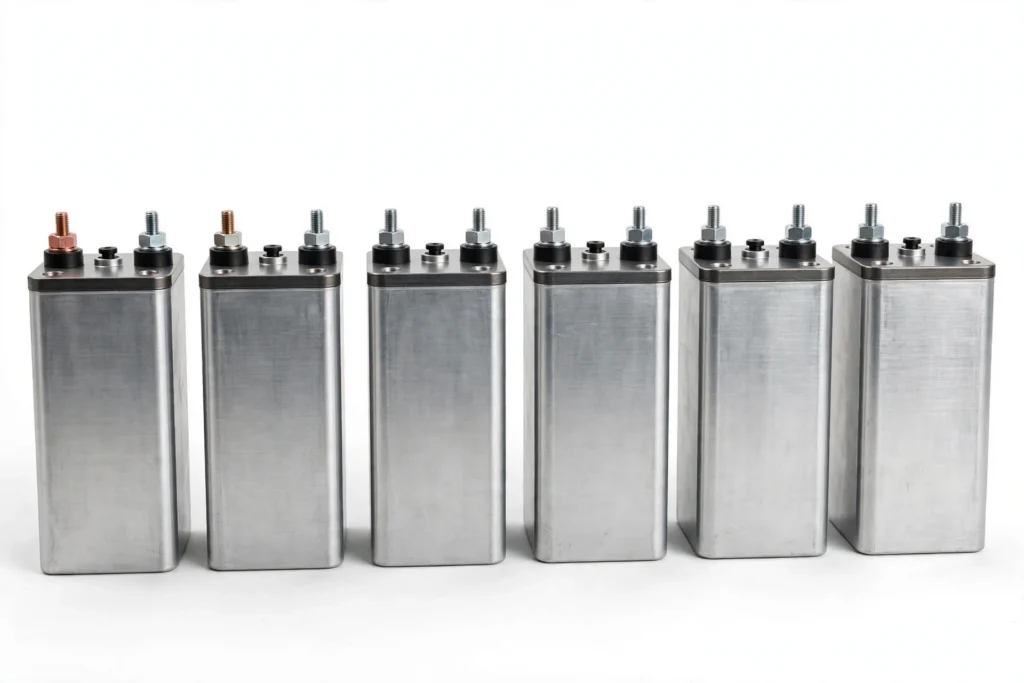
Product Overview
LJY Energy supplies LiFePO4 prismatic battery cells for wholesale buyers, pack manufacturers, and system integrators. Orders are specified as Grade A — with the grade definition (maker grade, capacity tolerance, internal-resistance range) confirmed in writing per order, as set out in the checklist below. Available capacities range from 100Ah to 314Ah.
For buyers building their own battery packs, we also support BMS selection, cell matching, and technical support. See our finished battery products for complete pack solutions.
- Grade A grading — grade definition confirmed per order; consistent capacity and internal resistance
- 100Ah to 314Ah range — covers most pack designs
- Cell matching service — voltage and IR matched for pack assembly
- Technical support — BMS pairing guidance and pack design consultation
WhatsApp RFQ starter: +86 159 8945 0735 — opens a short message that already names LiFePO4 cells wholesale and leaves blanks for company type, market, cell form factor/capacity, qty, matching need, and documents or certifications asked for (confirmed per project — we do not list holdings here). Or Request Wholesale Quote on the form.
Available Cell Models
| Group | Parameter | Value | Status |
|---|---|---|---|
| Cell | Chemistry | LiFePO4 (LFP) | Typical |
| Cell | Nominal voltage | 3.2V | Typical |
| Cell | Capacity options | 100Ah / 280Ah / 304Ah / 314Ah | Typical |
| Cell | Cycle life | 6000+ cycles at 80% DOD (cell level) | Typical |
| Supply | Minimum order | Contact for MOQ | To Be Confirmed |
| Supply | Cell grading | Grade A (definition confirmed per order), matched available | Confirm Before Ordering |
Cell specifications vary by manufacturer batch. Detailed datasheets provided upon inquiry.
Wholesale Applications
- Battery pack manufacturers
- Solar energy storage system integrators
- RV and marine battery builders
- Golf cart battery assemblers
OEM/ODM Support
Beyond cells, complete pack solutions are available per project: custom BMS, housing design, and assembly. Contact us for your project requirements.
Who We Serve
We work with pack manufacturers, system integrators, distributors, and OEM brands who need consistent, verifiable cell supply:
- Pack assemblers: Matched cells (voltage + IR sorted) for 12V/24V/48V/51.2V pack production
- Solar & ESS integrators: 280Ah/304Ah/314Ah cells for residential and commercial storage
- RV/marine/golf cart builders: 100Ah–200Ah cells with application-specific BMS coordination
- Distributors: Volume supply with consistent grading and documentation
Customization & Supply Chain Support
As a China-based LiFePO4 battery supplier, we support:
- Cell matching: Voltage and internal resistance sorting for pack consistency
- BMS coordination: Work with your BMS spec or recommend compatible options (CAN/RS485/UART)
- Documentation: UN38.3 test summary, MSDS, and specification sheets for the exact cells shipped — the documentation set is confirmed per order
- Flexible MOQ: Trial orders to container loads — confirmed per project requirements
- Export handling: DG freight coordination, customs documentation support
Specifications, pricing, MOQ, and lead times are confirmed per project based on your requirements. Contact us with your specs for a detailed quotation.
Related Technical Guides
Buying cells in volume? These guides help you specify, verify, and assemble with confidence:
- OEM/ODM LiFePO4 RFQ checklist (finished packs)
- Wholesale & distributor program
- How to Choose LiFePO4 Cells for Battery Pack Assembly — capacity matching, IR sorting, and assembly best practices
- Grade A vs Grade B LiFePO4 Cells: How to Verify Quality — don’t pay Grade A prices for Grade B cells
- How to Test LiFePO4 Battery Capacity and Internal Resistance — verify what you receive
- How Are LiFePO4 Battery Cells Manufactured? — understand the supply chain you’re buying into
Order Evidence Checklist: What to Confirm Before You Pay
Bulk cell orders fail in predictable ways: the grade is not what the quote implied, the batch that ships is not the batch that was tested, or the transport documents do not match the goods. The checklist below is how experienced pack manufacturers protect a cell order. Items described on this page — Grade A grading with consistent capacity and internal resistance, voltage/IR cell matching, and the documentation set for the exact cells shipped (UN38.3 test summary, MSDS and specification sheets) — form the starting point; the grade definition and the documentation set for your order, like everything else, are confirmed in writing in your quotation or contract before payment.
Use this as a buyer checklist of documents and checks to request — not a claim that every batch already includes every item. Cross-check with the China supplier verification guide and Grade A vs Grade B guide. When you are ready, send a cells wholesale RFQ.
Before Payment: Identity, Grade and Traceability
- Exact cell model, manufacturer, and production month — named in the quotation, not just a capacity class. A “314Ah cell” from two different makers, or two different production runs, is not the same product.
- Grade definition — what “Grade A” means for this order (maker grade, or a reseller’s test-based grade; capacity tolerance, internal-resistance range, appearance standard), stated numerically where possible.
- Photos of the actual lot — sample photos showing intact maker QR codes, no sanding or relabelling, requested before payment, not after shipment.
- Datasheet test conditions — the conditions behind the rated capacity (for example, EVE’s 314Ah rating is specified at 0.5P, 25°C, 2.5–3.65V) recorded with the order, so your incoming inspection can retest like-for-like.
- Batch traceability — request that the shipment’s cell QR codes and batch/lot identifiers be recorded with your order, so any later claim can be tied to the exact cells delivered.
- Sample consistency — if you qualified samples first, confirm the bulk order ships the same cell model, grade, and matching standard as the samples — and say so in the contract, not just in chat.
Before Shipment: The Serial-Matched Evidence Pack
The deliverable that protects a bulk order is a single evidence pack whose parts all reference the same serial numbers. The fraud pattern it defeats is documented in buyer communities: a test report whose serials do not match the delivered cells, hiding an older production date or lower real capacity. Confirm at quotation stage that your shipment’s pack will contain:
- QR / serial list — every cell in the shipment, in a usable file format.
- Per-serial test data — capacity (Ah), internal resistance (mΩ), and open-circuit voltage for the same serials as the QR list, with test conditions stated (discharge rate, temperature). Figures without conditions cannot be compared against your incoming inspection.
- Matching criteria and grouping — the ΔV, ΔIR, and ΔAh windows used, and how cells were grouped for your order.
- Packing photos — the packed cells with QR codes visible, tying the physical shipment to the list.
- Pre-shipment inspection terms — whether a buyer-side or third-party inspection is included, available at cost, or not offered is a contract item: agree it, its scope (sampling rate, measurements, photo/video evidence), and who pays, before production. If you need a formal outbound inspection report for your own records or your customer, specify its contents at quotation stage; report formats are agreed per order, not improvised at the dock.
Transport and Delivery: UN3480 Documentation
- Shipping classification — loose cells ship as UN3480, Class 9 dangerous goods. Air freight requires state of charge at or below 30% (IATA rule); sea freight follows IMDG dangerous-goods declaration, where the 30% level is common carrier practice rather than a mandate. Confirm the packing instruction and carrier requirements for your route before the goods leave.
- Document set — UN38.3 test summary and MSDS for the exact cells shipped (part of the documentation set confirmed per order, above), plus the specification sheet; check that model names on the documents match the cells in the boxes.
- On arrival — sample-check QR/batch identity, voltage, and internal resistance against the pre-shipment data within your inspection window, and report discrepancies with batch identifiers attached.
If you are preparing a first bulk order, send your cell model, quantity, and destination via the inquiry form, and tell us which checklist items your own quality process requires — we will confirm each one in the quotation.
Sourcing prismatic LFP cells for ESS: what to verify before you order
The checklist above covers grade, traceability and the evidence pack for a single order. This section covers the regulatory documents behind the cells: what a UN 38.3 test summary must contain, why cell testing does not cover a finished pack, and what EU-bound packs will need. LJY Energy is a Shenzhen-based supplier and OEM/ODM coordinator, not a cell manufacturer. Cells come from the makers named in your quotation, and the documents below are requested for the exact cells quoted and confirmed per order.
Cell testing does not cover the finished pack
UN 38.3 applies to cells and to batteries built from them. 49 CFR 173.185(a)(1): “Each lithium cell or battery must be of the type proven to meet the criteria in part III, sub-section 38.3 of the UN Manual of Tests and Criteria”, and “Lithium cells and batteries are subject to these tests regardless of whether the cells used to construct the battery are of a tested type.” A test summary for the cells you buy is the starting point; if you assemble them into packs, the pack design needs its own test basis. Settle this before you commit to a cell model, because changing cells later can mean retesting the pack.
What the UN 38.3 test summary must contain
Under 49 CFR 173.185(a)(3), “Each manufacturer and subsequent distributor of lithium cells or batteries … must make a test summary available.” The regulation lists the elements the summary must include. Use them as a checklist when you receive the summary for the cells quoted:
- Name of the cell manufacturer — (a)(3)(i)
- Manufacturer contact information: address, telephone number, email address and website — (ii)
- Name of the test laboratory, with the same contact details — (iii)
- A unique test report identification number — (iv)
- Date of the test report — (v)
- Description of the cell: lithium ion or lithium metal, mass, watt-hour rating, physical description, and the cell model number — (vi)
- List of tests conducted and results (pass/fail) — (vii)
- Reference to assembled battery testing requirements, if applicable — (viii)
- Reference to the revised edition of the UN Manual of Tests and Criteria used, and any amendments — (ix)
- Name and title of a responsible person — (x)
Two checks matter most on a cell order. The model number on the summary must be the exact model in your quotation, and the watt-hour rating, mass and description must agree with the datasheet for that model. A summary for a different model or capacity variant does not cover your cells. Report numbers are not published on this page; the summary for your cells is part of the documentation set confirmed per order.
IEC 62619 for industrial and ESS cells
For cells going into stationary storage, the relevant IEC safety standard is IEC 62619. The IEC webstore describes IEC 62619:2022 as specifying “requirements and tests for the safe operation of secondary lithium cells and batteries used in industrial applications, including stationary applications”, with examples including “electrical energy storage system”. Ask whether IEC 62619 documentation exists for the exact cell model, who issued it, and whether it covers the cell itself or only a pack built from it.
Grade and batch identity are checked separately
A test summary records the UN 38.3 results for a cell type. It does not tell you the grade or condition of the cells in your shipment. Grade definition and batch identity are verified through the checklist above and on arrival: see Grade A vs Grade B cells, the incoming inspection guide and how to test capacity and internal resistance.
EU-bound packs: plan for the battery passport
The European Commission states: “18 February 2027: The battery passport becomes mandatory for relevant battery categories placed on the EU market.” If your packs will be placed on the EU market, agree early which cell-level information the cell maker will provide for your passport data, and record it in the order. Overview in the EU Battery Regulation guide.
Shipping cells: UN3480
LiFePO4 cells are lithium ion, so their UN number is UN3480. The lithium battery mark rule in 49 CFR 173.185(c)(3)(i) puts it this way: “The mark must indicate the UN number: “UN3090” for lithium metal cells or batteries, or “UN3480” for lithium ion cells or batteries.” Check that cartons and transport documents show UN3480 and name the same cell model as the test summary. Route-specific packing and state-of-charge rules are covered in the transport checklist above.
Request cell grading and test-summary samples →
LiFePO4 cells wholesale — RFQ path for pack makers
Search intent around LiFePO4 cells wholesale, prismatic LiFePO4 cell wholesale, and LiFePO4 battery importers is procurement, not a blog topic. Use this page with the on-page Order Evidence Checklist (or the section titled that way above): grade definition, matching, batch/traceability and document scope are confirmed in writing per quotation. This update does not add brand or grade claims beyond what this page already states.
- OEM/ODM pack RFQ checklist — when you need finished packs, not only cells
- Wholesale & distributor program · Custom battery solutions
- Pack platforms often built after cell RFQ: 10.24kWh 51.2V 200Ah · 51.2V 314Ah cabinet
- Sourcing hygiene: LiFePO4 import checklist (12 mistakes) · Grade A vs B verification guide (existing)
WhatsApp cells wholesale RFQ (+86 159 8945 0735) · Contact form
Frequently Asked Questions
What is the difference between Grade A and Grade B cells?
Grade A cells meet full manufacturer specifications for capacity, internal resistance, and cycle life. We supply cells specified as Grade A — with the grade definition confirmed per order — for applications requiring reliable long-term performance.
Can you match cells for pack assembly?
Yes, we provide voltage and internal resistance matching to ensure balanced pack performance.
How can I trace the cells in my order back to batch and test data?
Ask for traceability at quotation stage, not after shipment. Request that the exact cell model, maker and production month are named in the quotation, and that the shipment’s cell QR codes and batch or lot identifiers are recorded with your order. You can also specify a serial-matched evidence pack: a QR/serial list plus per-serial capacity, internal resistance and voltage data with test conditions, and packing photos with the QR codes visible. Which items your order includes, and any pre-shipment inspection, are confirmed in writing in the quotation or contract before payment.
Tell us which traceability items your quality process needs: send a cells wholesale RFQ and each item will be confirmed in the quotation.