
Share This Article
Content type: Technical Explanation / Industry Research — this article explains publicly documented industry processes. It is not a description of LJY Energy’s own cell factory.
A LiFePO4 battery cell — the basic building block inside every lithium battery pack — goes through a precise, multi-stage manufacturing process before it ever stores a single watt-hour. Understanding how cells are made helps buyers judge quality claims, understand why cell consistency matters, and see what separates a reliable cell from a cheap one.
This article walks through each stage of LiFePO4 cell manufacturing, from raw electrode materials to the finished, graded cell. Note the important distinction used throughout: cell manufacturing (making the individual electrochemical cell) is a different business from battery pack assembly (connecting cells with a BMS into a finished battery). Learn the difference between cells and packs here.
Active material, binder, solvent blended uniformly
Slurry on foil, dried, pressed to density
Electrode rolls cut to cell width
Electrodes + separator assembled in case
Electrolyte added in dry room, cell sealed
First charge builds the SEI layer
Cells tested and matched by capacity/IR
Stage 1: Electrode Slurry Mixing
Everything starts with a slurry — a carefully formulated paste containing three main ingredients:
- Active material: lithium iron phosphate (LiFePO4) powder for the cathode; graphite powder for the anode
- Conductive additive: typically carbon black, which helps electrons move through the electrode
- Binder: a polymer (commonly PVDF) that holds everything together
These are mixed with a solvent into a uniform slurry. Mixing quality matters enormously: an uneven slurry produces electrodes with inconsistent thickness and conductivity, which later shows up as capacity variation between cells. This is one reason reputable manufacturers invest heavily in precision mixing equipment and in-process quality checks.
Stage 2: Coating, Drying, and Calendering
The slurry is coated onto thin metal foil — aluminum foil for the cathode and copper foil for the anode — in a continuous roll-to-roll process. The coated foil then passes through drying ovens to remove the solvent, and through calendering rollers that compress the electrode to a precise thickness and density.
Calendering is more than a finishing step: electrode density directly affects energy density, conductivity, and how well the electrode absorbs electrolyte later. Too loose, and the cell underperforms; too dense, and electrolyte cannot penetrate properly.
Stage 3: Slitting
The wide coated electrode rolls are slit into narrower strips matched to the target cell size. Precision here is critical — burrs or uneven edges on the slit electrode can later cause internal short circuits. Clean, straight cuts are a basic quality indicator that is easy to overlook but hard to fix downstream.
Stage 4: Cell Assembly — Winding or Stacking
Now the cathode, separator, and anode are assembled into the cell’s internal structure. The separator is a thin porous membrane that keeps the electrodes apart electrically while letting lithium ions pass through. There are two main assembly methods:
- Winding: the electrode-separator sandwich is wound into a roll (“jelly roll”) and inserted into a cylindrical can. This is how cylindrical cells (such as 18650, 21700, and 32700 formats) are built.
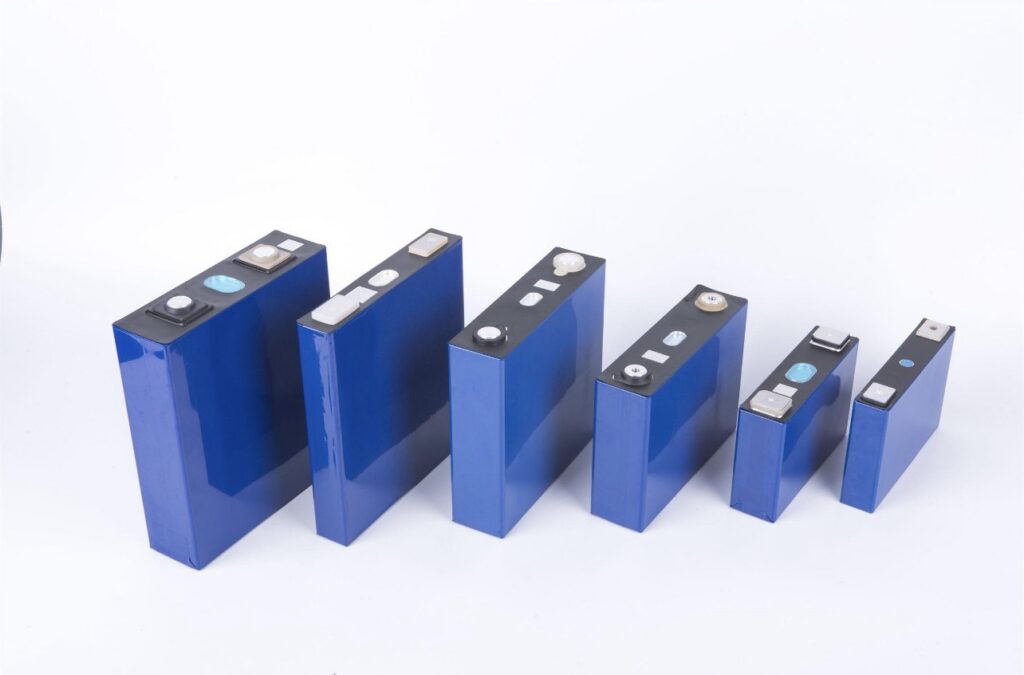
- Stacking: cut electrode sheets are stacked alternately with separator layers, then placed into a prismatic (rectangular) aluminum case. Most large-format LiFePO4 cells used in energy storage and RV batteries are prismatic.
Tabs are welded to the current collectors to create the cell’s positive and negative terminals, and the assembly is placed into its case.
Stage 5: Electrolyte Filling and Sealing
The cell case is filled with electrolyte — typically a lithium salt (LiPF6) dissolved in organic solvents — under vacuum or in a dry-room environment. Moisture is the enemy at this stage: even trace water reacts with the electrolyte to form corrosive compounds that degrade the cell. This is why serious cell factories operate filling rooms with strictly controlled humidity.
After filling, the cell is sealed. From this point on, the cell is a complete electrochemical unit — but it is not yet a usable battery cell.
Stage 6: Formation — The Cell’s First Charge
Formation is the first controlled charge-discharge cycle of the cell’s life, and it is one of the most important steps in the entire process. During formation:
- A protective layer called the SEI (solid electrolyte interphase) forms on the anode surface
- The cell’s initial capacity is established
- Manufacturing defects reveal themselves — cells with internal shorts or contamination fail here rather than in a customer’s battery pack
Formation takes time (often many hours per cell) and requires precise charge equipment. It is also expensive in terms of factory floor space and energy — which is one reason formation is difficult to shortcut without consequences.
Stage 7: Aging and Grading
After formation, cells rest for a period (aging) so that voltage and self-discharge behavior stabilize. Then each cell is tested and graded — sorted by measured capacity, internal resistance, and voltage characteristics.
Grading is where cell consistency comes from. Cells with closely matched capacity and internal resistance are grouped together; these matched groups become the cell sets used in a single battery pack. This is exactly why professional pack builders insist on matched cells: a pack built from poorly graded cells will always underperform, no matter how good the BMS is.
Cells that fail grading — too low in capacity, too high in internal resistance, or unstable in voltage — are rejected from premium applications. Buyers should be aware that the market contains cells of widely varying grades, and a low price sometimes reflects a low grade rather than a good deal.
| Grading parameter | What it measures | Why it matters for pack building |
|---|---|---|
| Capacity (Ah) | Actual stored energy after formation | Cells in one pack must match, or the weakest cell limits the whole pack |
| Internal resistance (mΩ) | How easily current flows through the cell | Mismatched resistance causes uneven heating and faster aging |
| Voltage stability | Self-discharge behavior during aging rest | Unstable cells reveal defects before they reach a customer |
What This Means for Battery Buyers
A finished, graded cell is still only half the story — it must then be assembled into a pack with a properly matched BMS, structural protection, and quality testing. But knowing the cell manufacturing process gives buyers better questions to ask:
- Are the cells brand-new, or repurposed from another application?
- Are cells in the same pack matched for capacity and internal resistance?
- What grade of cell is being used, and can the supplier document it?
For a deeper look at what happens after the cell leaves the cell factory, see how reliable LiFePO4 battery packs are built.
Frequently Asked Questions
Where are most LiFePO4 cells manufactured?
The large majority of LiFePO4 cells are manufactured in China, which hosts the major cell producers and the associated supply chain for cathode materials, equipment, and components. Battery pack assembly, by contrast, can be done in many countries using imported cells.
What is the difference between a cell manufacturer and a battery pack supplier?
A cell manufacturer produces the individual electrochemical cells through the process described above. A battery pack supplier selects cells, matches them, adds a BMS and enclosure, and delivers a finished battery. LJY Energy focuses on lithium battery solutions, component selection, pack engineering, assembly coordination, and supply — battery cells are sourced from specialized cell manufacturers.
Why does formation take so long?
Formation must be done slowly and precisely to build a stable SEI layer on the anode. Rushing formation produces an uneven protective layer, which leads to faster capacity fade over the cell’s life. It is one of the steps where manufacturing shortcuts are most costly.
Need Help with Your Battery Project?
Tell us about your application, technical requirements, or sourcing challenges. Our team can help you explore suitable LiFePO4 battery solutions.
Sources: Process stages summarized from publicly documented lithium-ion cell manufacturing knowledge, including:
• PretaPower — From Raw Materials to Finished Product: The Lithium Batteries Manufacturing Process
• Aist Manufacturing — How Battery Cells Are Made (process walkthrough)
• CN114883632A — Lithium battery production process (coating → assembly → filling → formation → grading sequence)
• MDPI Materials — Preparation of LiFePO4/C Cathode Materials (electrode fabrication details)
Share This Article