
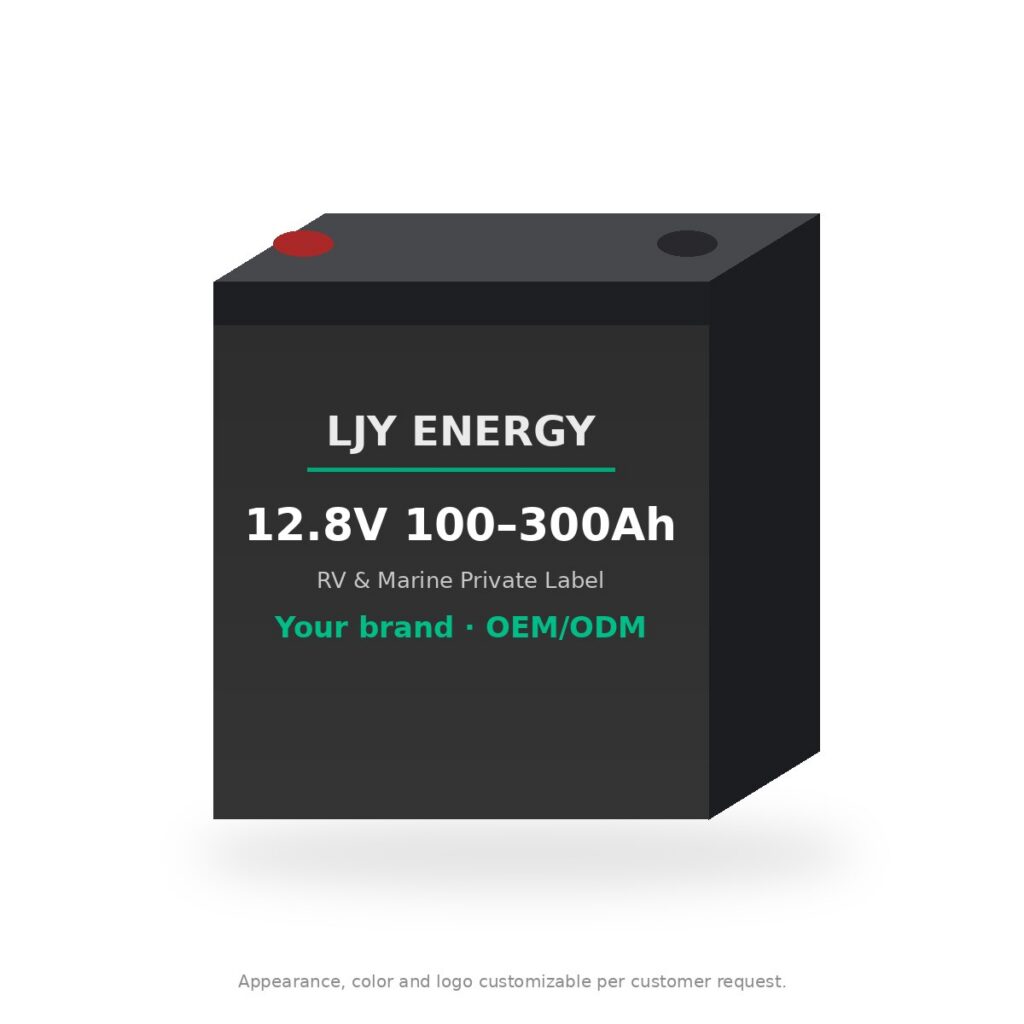
12.8V LiFePO4 Private-Label Program for RV & Marine Battery Brands (100–300Ah)
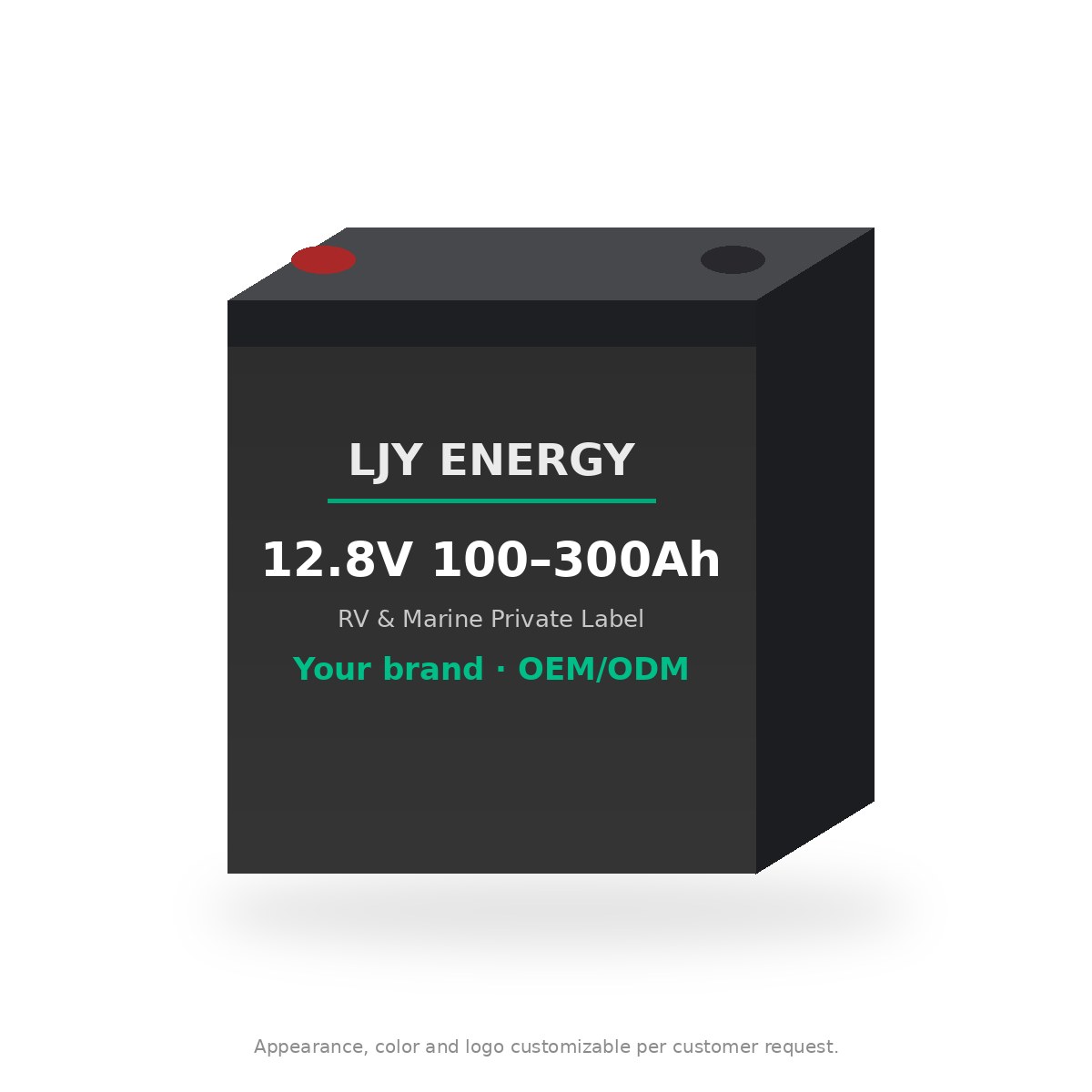
Product Overview
This page is for small and mid-sized battery brands — RV, caravan, camper-van and marine labels, wholesalers with their own brand, and pack assemblers — who want to launch or extend a 12.8V (12V class) LiFePO4 line under their own name. It focuses on the 100–300Ah range, where most RV house-bank and marine house/trolling demand sits, and on how a private-label SKU is specified and approved.
LJY Energy is a China-based LiFePO4 battery supplier and OEM/ODM solutions provider offering customization, project-confirmed specifications and export supply coordination. Every option below is configured per customer project; nothing on this page is a verified standard product unless stated in your project datasheet.
Appearance, color and logo customizable per customer request.
WhatsApp: +1 404 784 1946 (backup: +86 159 8945 0735)
Specifications
How to read Status: [LJY confirmed] = confirmed for LJY OEM/ODM supply (written). [Competitor public] = seen on competitor pages (structure/reference only — not LJY-verified). [Industry reference] = common industry practice. [To confirm] = fixed only in the datasheet issued with your quotation. Arithmetic: energy = nominal voltage × Ah.
| Group | Parameter | Value | Status |
|---|---|---|---|
| Electrical | Voltage class | 12.8V nominal (4S LiFePO4), sold as 12V class | [Industry reference] |
| Electrical | Capacity ladder (focus) | 100Ah · 135–150Ah · 200–230Ah · 300Ah class; smaller and larger sizes on the model pages | [Industry reference] · per-model pages |
| Electrical | Energy check | 12.8V × Ah (e.g. 100Ah ≈ 1.28kWh, 200Ah ≈ 2.56kWh, 300Ah ≈ 3.84kWh) | [Industry reference] — arithmetic |
| BMS & protection | BMS current & protections | Sized to inverter / trolling-motor load; standard protections and balancing | [LJY confirmed] — BMS configurable for OEM/ODM |
| BMS & protection | Communication | Bluetooth app, RS485 or CAN — optional configuration | [LJY confirmed] configurable · per project |
| BMS & protection | Self-heating | Available on request | [To confirm] per project |
| Mechanical | Enclosure format | Optional DIN (EN)-style or BCI Group-style formats (e.g. Group 24/27/31 class) or custom case — to be confirmed against your application and product design | [Optional configuration] · [Confirmed per project] — see the form-factor matrix under Size, handling & fitment; reference envelopes only, no LJY dimensions stated |
| Mechanical | Terminals / IP / vibration | Per application (RV bay, boat compartment) | [To confirm] |
| Cell & chemistry | Cell brand / traceability | Stated per order; traceability documents on request | [To confirm] |
| Commercial & documents | Certificates / shipping files | Scope confirmed per model (e.g. UN38.3 / MSDS for shipping) | [To confirm] |
| Commercial & documents | MOQ / lead time / warranty | Confirmed per project stage (sample → pilot → production) | [To confirm] |
Optional configurations (OEM/ODM)
LJY Energy supplies this model as an OEM/ODM configurable build. The items below are configured per customer project — they are not fixed catalog defaults.
- Branding: case colour, logo, rating labels, carton print, manuals, retail packaging.
- Enclosure format: DIN-style, BCI Group-style or custom case as an option — fit and dimensions confirmed against your application and product design.
- BMS: current rating and communication (Bluetooth/RS485/CAN) — optional configuration.
- Self-heating: available on request, to be confirmed per project (cold-climate RV/marine markets).
- Displays & switches: SOC display, power switch — to be confirmed.
- Terminals: stud size and terminal covers per application.
BMS, communication & protection
RV and marine loads differ: inverters, windlasses and trolling motors create short high peaks. Size the BMS to the real load, not only the Ah rating.
BMS sizing guide
| Load / use case | Suggested BMS rating |
|---|---|
| RV house bank with 1–2kW inverter | BMS ≥ inverter continuous current + margin |
| Marine trolling motor | BMS sized to motor max current |
| Windlass / thruster on the same bank | Confirm peak and duration with your design |
Bluetooth and CAN are optional configurations. Send the inverter, charger, DC-DC and alternator setup with your RFQ.
Size, handling & fitment
Buyers in the UK, Germany and Canada often choose the case format first and the capacity second. The matrix lists the common formats with their published reference envelopes. Every row is a project option: no LJY dimensions, stock or measured fit are stated, and the capacity that fits a given envelope is confirmed per project.
| Group | Parameter | Value | Status |
|---|---|---|---|
| DIN (EN) | LN3 / H6 case envelope | 278 × 175 × 190 mm (length × width × height). Reference: EN 50342-2 / IEC 60095-2 size table; the envelope of a lead-acid starter battery that a lithium pack is built to fit | [Industry reference] (envelope) · [Optional configuration] · [Confirmed per project] (capacity and dimensions) |
| DIN (EN) | LN4 / H7 | 315 × 175 × 190 mm | [Industry reference] (envelope) · [Optional configuration] · [Confirmed per project] |
| DIN (EN) | LN5 / H8 | 353 × 175 × 190 mm. Public competitor listings show this case at 172Ah (Fogstar Drift H8 DIN fit) and 180Ah (Powerkönig PK12180DIN); these are competitor figures, not LJY data | [Industry reference] (envelope) · [Optional configuration] · [Confirmed per project] |
| DIN (EN) | LN6 / H9 | 394 × 175 × 190 mm | [Industry reference] (envelope) · [Optional configuration] · [Confirmed per project] |
| BCI Group | Group 24 | Maximum overall 260 × 173 × 225 mm (10¼ × 6 13/16 × 8 7/8 in). Reference: Battery Council International group-size chart | [Industry reference] (envelope) · [Optional configuration] · [Confirmed per project] |
| BCI Group | Group 27 | Maximum overall 306 × 173 × 225 mm (12 1/16 × 6 13/16 × 8 7/8 in) | [Industry reference] (envelope) · [Optional configuration] · [Confirmed per project] |
| BCI Group | Group 31 | Maximum overall 330 × 173 × 240 mm (13 × 6 13/16 × 9 7/16 in) | [Industry reference] (envelope) · [Optional configuration] · [Confirmed per project] |
| Under-seat / seat-base | Camper-van seat box (Untersitz) | No common standard: the box is set by the vehicle or conversion kit. A public German competitor example is a 230Ah under-seat pack at 360 × 160 × 330 mm (Powerkönig PK12230US). Send the free internal space, terminal side and hold-down method with your RFQ. For low-profile 12V formats, see the slim LiFePO4 battery page | [Industry reference] (market practice) · [Optional configuration] · [Confirmed per project] |
| Custom case | Own mould or marked-up drawing | Any other envelope, colour and label layout, for brands that want a case of their own | [Optional configuration] · [Confirmed per project] |
| What LJY fixes per project | Capacity that fits an envelope, final dimensions, weight, terminal type and position, hold-down method | Set against your drawing and the cell format; the quotation lists them. The envelopes above are references for matching a replacement size, not LJY product dimensions, and a case size does not by itself decide the Ah | [Confirmed per project] |
Sources for the reference envelopes: Battery Council International group-size chart; EN 50342-2 and IEC 60095-2 (LN size series). Competitor examples: Fogstar Drift and Powerkönig, public pages checked 15 October 2026.
Heated and low-temperature options are set the same way. LiFePO4 cells should not be charged below about 0 °C unless they are warmed, so the BMS can block charging below a set temperature and an optional self-heating function can warm the cells first. The cut-off temperature, heater trigger, heater power source (the battery itself or an external source) and the resulting charge time in the cold are confirmed per project and are not stated as fixed values here.
Documents for a UK, EU or Canada brand launch are agreed in the quotation: transport test summary and safety data sheet, the conformity documentation scope for your market (CE or UKCA, and the obligations of the brand owner or importer under Regulation (EU) 2023/1542, see the EU Battery Regulation guide), and, if a German vehicle-builder or dealer asks for an EMC report such as ECE R10, whether a report exists for the exact model. A document is listed only if it exists; none is implied by this page.
For marine use, confirm compartment ventilation, vibration and terminal protection requirements in the project specification.
Spec, compliance & configuration fields
Fields to settle for a 12.8V private-label RV / marine SKU. Nothing below is a measured result or a certificate claim.
| Group | Parameter | Value | Status |
|---|---|---|---|
| Energy | Nominal energy ladder | 12.8V × 100Ah = 1,280Wh · × 200Ah = 2,560Wh · × 300Ah = 3,840Wh | [Industry reference] — arithmetic |
| Enclosure | IP rating options | IP20 / IP21 (indoor) or IP65-class (outdoor enclosure) offered as options by project; rating and test basis confirmed per order. Some import markets use enclosure IP class in customs or tender classification — check with your broker | [Optional configuration] · [Confirmed per project] |
| Thermal | Operating temperature and heat derating | Charge / discharge temperature windows and the derating curve are set in the BMS and confirmed per project (see the climate guidance on this page where present) | [Confirmed per project] |
| Life | Cycle life — test-condition fields | Quote cycle life only with: DoD, charge / discharge C-rate, ambient temperature, end-of-life capacity %, cell type. Values are confirmed per project; no figure is claimed here | [Confirmed per project] |
| Commercial | Warranty structure | Structure to confirm per order: years vs cycles vs energy throughput, conditions (DoD, temperature, installation), who handles service | [Confirmed per project] |
| Documents | Certificate / test-report documents | Provided per order if available — confirm at inquiry. This page does not state that LJY holds any certificate or report | [Confirmed per project] |
| Documents | Importer-held certificates (OEM note) | Where an importer or brand owner holds or obtains certificates in its own name, scope, labeling and supporting documents are agreed in the OEM/ODM project | [Optional configuration] · [Confirmed per project] |
| Communication | Ports | CAN and RS485 as typical BMS ports; dry-contact or other ports on request | [Optional configuration] |
| Communication | Protocol profiles | Optional profiles for inverter families such as Deye, Growatt, Luxpower, Victron-type, Pylontech-style: to be confirmed per project against the exact inverter model and firmware. This is not a compatibility claim and no compatibility list is published | [Optional configuration] · [Confirmed per project] |
| Supply options | Supply scope (pack, enclosure, components) | Complete finished 12.8V (12V class) packs; enclosures and components (cells, BMS, modules, harness) for customers who assemble locally; and OEM/ODM pack programs, coordinated per project. The quotation separates existing standard configuration, customizable options and items still to be confirmed. Cell-level supply: see LiFePO4 prismatic cells wholesale | [Optional configuration] · [Confirmed per project] |
| Branding | Private label | Logo, colour, labels and packaging; Appearance, color and logo customizable per customer request | [Optional configuration] |
| Logistics | Weight and shipping data | Net / gross weight, carton or crate size and pallet data are confirmed per model before quoting | [Confirmed per project] |
Rows labelled [Industry reference] are arithmetic or market norms, not LJY measurements. [Optional configuration] items are available by project; [Confirmed per project] items are stated per order. Send your target market, inverter model and documents needed with your inquiry.
EU brand owners: who is the “manufacturer”, and when do label, QR code and passport apply?
For a 12.8V (12V class) private-label RV or marine battery sold in the EU, the duties of Regulation (EU) 2023/1542 sit with the EU party that places the finished battery on the market, not with the supplier of components. This section sets out what the official texts say so you can brief your compliance adviser. It is not legal advice, and LJY makes no statement that it is an EU manufacturer, importer or authorised representative or that any model is compliant. The regulation itself is in the EUR-Lex text; our general guide is the EU Battery Regulation buyer’s guide.
| Group | Parameter | Value | Status |
|---|---|---|---|
| Roles | Definition of “manufacturer” (Art. 3(33)) | “any natural or legal person who manufactures a battery or has a battery designed or manufactured, and markets that battery under its own name or trademark or puts it into service for its own purposes”. A brand owner that markets a private-label battery under its own name falls within this wording; confirm with your adviser. | [Official text, EUR-Lex] |
| Roles | Finished private-label packs | The economic operator placing the finished battery on the EU market is responsible for the passport and the data in it. A non-EU supplier can be authorised in writing to create or update the passport, which does not make it the EU manufacturer or importer (FAQ 2.1, 2.4). LJY supplies the data and documents agreed per project. | [Commission guidance] · [Confirmed per project] |
| Roles | Cells, modules, BMS or enclosures for EU assembly | Imported cells or modules that are only components are not the finished battery; “the EU entity that completes the battery becomes the manufacturer” (FAQ 3.4). Imported packs plus a BMS assembled in the EU: the EU entity completing and placing the battery on the market is responsible (FAQ 2.5). Components for later assembly may be imported without a passport (FAQ 4.3). A limited exception applies to do-it-yourself kits. | [Commission guidance] · [Optional configuration] |
| Roles | Duty of the cell or module supplier (Art. 39) | “Suppliers of battery cells and battery modules shall provide the information and documentation necessary to comply with the requirements of this Regulation when supplying battery cells or modules to a manufacturer.” What LJY provides is listed per project in the quotation. | [Official text, EUR-Lex] · [Confirmed per project] |
| Roles | Two or more units | Packs sharing a common BMS or components that form one working battery count as one battery; complete, independently functioning units below 2 kWh are assessed individually (FAQ 3.2, 3.3). The assessment is made case by case. | [Commission guidance] |
| Group | Parameter | Value | Status |
|---|---|---|---|
| Dates | Separate-collection symbol | From 18 August 2025 all batteries carry the separate-collection symbol (Art. 13(4)). | [Official text, EUR-Lex] |
| Dates | General-information label (Annex VI Part A) | Art. 13(1): from “18 August 2026 or 18 months after the date of entry into force of the implementing act referred to in paragraph 10, whichever is the latest”. The labelling implementing act was due by 18 August 2025. We found a draft notified to the WTO on 22 December 2025 (G/TBT/N/EU/1181) and no adopted act, so the label date is not yet fixed. Check before you print labels. | [Official text] · [Partly verified: act status] |
| Dates | QR code on every battery | From 18 February 2027 all batteries carry a QR code (Art. 13(6)). For industrial batteries with a capacity greater than 2 kWh it gives access to the battery passport. | [Official text, EUR-Lex] |
| Dates | Battery passport | From 18 February 2027 each industrial battery “with a capacity greater than 2 kWh” placed on the market or put into service needs a passport (Art. 77(1)). The economic operator placing the battery on the market attributes the unique identifier (Art. 77(3)). | [Official text, EUR-Lex] |
| Dates | Passport content in 2027 | Carbon-footprint, recycled-content and due-diligence data are not required in passports created from February 2027 (FAQ 7.2); due-diligence reports are required from August 2027 (FAQ 7.3). | [Commission guidance] |
| Classification | Industrial vs portable (Art. 3(13), 3(9)) | “Industrial battery” includes “any other battery that weighs more than 5 kg” that is not an EV, LMT or SLI battery; a portable battery is sealed and weighs 5 kg or less and is not designed specifically for industrial use. Pack weight is confirmed per project and decides the category. | [Official text, EUR-Lex] · [Confirmed per project] |
The 2 kWh line for a 12.8V pack falls at 156.25Ah (12.8V x 156.25Ah = 2,000Wh). Art. 77 says “greater than 2 kWh”, so exactly 2,000Wh is not above it; 157Ah is the first whole-Ah size above. These rows are arithmetic, not product claims: capacity options are confirmed per project. For scale, the 12.8V 314Ah format on the 12.8V 314Ah model page (12.8V x 314Ah = 4,019Wh) is well above the 2 kWh line.
| Group | Parameter | Value | Status |
|---|---|---|---|
| Energy | 12.8V (12V class) x 100Ah | 1,280Wh — below 2 kWh | [Industry reference] — arithmetic (Wh = V x Ah) |
| Energy | 12.8V (12V class) x 150Ah | 1,920Wh — below 2 kWh | [Industry reference] — arithmetic (Wh = V x Ah) |
| Energy | 12.8V (12V class) x 156.25Ah | 2,000Wh — exactly 2,000Wh: not “greater than 2 kWh” | [Industry reference] — arithmetic (Wh = V x Ah) |
| Energy | 12.8V (12V class) x 157Ah | 2,009.6Wh — above 2 kWh | [Industry reference] — arithmetic (Wh = V x Ah) |
| Energy | 12.8V (12V class) x 172Ah | 2,201.6Wh — above 2 kWh | [Industry reference] — arithmetic (Wh = V x Ah) |
| Energy | 12.8V (12V class) x 200Ah | 2,560Wh — above 2 kWh | [Industry reference] — arithmetic (Wh = V x Ah) |
| Energy | 12.8V (12V class) x 230Ah | 2,944Wh — above 2 kWh | [Industry reference] — arithmetic (Wh = V x Ah) |
| Energy | 12.8V (12V class) x 300Ah | 3,840Wh — above 2 kWh | [Industry reference] — arithmetic (Wh = V x Ah) |
Sources checked 15–16 October 2026: Regulation (EU) 2023/1542, OJ L 191, 28.7.2023 (Art. 3, 13, 38, 39, 77); European Commission, EU Digital Product Passport FAQ for Batteries (guidance, not binding law); WTO TBT notification G/TBT/N/EU/1181. Dates and guidance change: verify with your adviser before you decide label or passport timing.
Applications
- RV, caravan and camper-van house batteries
- Marine house banks and trolling motors
- Overland and off-grid cabins
- Private-label retail and dealer ranges
Application limits
- Not an engine-start battery unless specified.
- Classification-society or insurer approvals are not claimed.
- Enclosure fit is confirmed per application.
See also: RV Battery Solutions · Marine Battery Solutions · 12V LiFePO4 Battery Series · OEM & Private Label Batteries · Product catalog.
OEM / ODM & wholesale
LJY Energy is a China-based LiFePO4 battery supplier and OEM/ODM solutions provider offering customization, project-confirmed specifications and export supply coordination. Appearance, color and logo customizable per customer request. Documentation for shipping (e.g. UN38.3 / MSDS / CE) is coordinated per order and target market — request the current document package. See the product catalog and wholesale & distributor program.
What to include in your inquiry
- Application (RV house bank, marine house, trolling, off-grid)
- Voltage / Ah for each SKU
- Inverter or charger model and firmware
- Climate (lowest charge temperature, highest ambient)
- Annual volume per SKU
- Logo / appearance / packaging needs; preferred enclosure format
- Target market (documentation scope)
WhatsApp: +1 404 784 1946 (backup: +86 159 8945 0735)
Related products & guides
- 12V 7Ah (SLA replacement)
- 12V 9Ah
- 12V 12Ah
- 12V 20Ah
- 12V 50Ah
- 12V 135Ah
- 12V 150Ah
- 12V 200Ah self-heating
- 12V 230Ah
- 12V 460Ah
- 12V 100Ah Deep Cycle
- 12V 100Ah Heated
- 12V 200Ah Dual Purpose
- 12V 300Ah RV & Caravan
- 12.8V 314Ah
- 12V 400Ah
- Warranty terms, cycles and RMA guide for importers and distributors
- Configuration guide by application: standard, optional and project-confirmed items
- Distributor cooperation routes: standard, OEM and ODM supply and the sample-to-repeat-order steps
RFQ fields — send these with your inquiry
- Target SKUs (Ah range) and DIN/Group case preference if any
- Application (RV / marine / both)
- Self-heating needed? (confirmed per project)
- Brand guidelines (logo, colour, labels, packaging)
- Estimated annual volume by SKU
- Target market (documentation scope)
- Sample vs pilot vs production stage
Send your RFQ for LJY-12V-PL-RVMARINE · WhatsApp: +1 404 784 1946 (backup: +86 159 8945 0735)
Frequently Asked Questions
Are DIN or Group 31 batteries standard products?
No. DIN-style and BCI Group-style cases are optional enclosure formats. Fit and dimensions are confirmed against your application and the product design before sampling.
How is MOQ set for a private label?
MOQ is confirmed per project stage (sample, pilot, production). Logo-and-label changes and new enclosure tooling are scoped differently.
Which certificates come with my private-label SKU?
Certificate scope is confirmed per model and per order. Custom changes can affect it, so we confirm before quotation.
Can I get self-heating and Bluetooth?
Both can be configured: Bluetooth/communication is an optional BMS configuration and self-heating is available on request, to be confirmed per project.
Can I get cell traceability documents?
Yes, on request, confirmed per project.
How is MOQ set?
MOQ is confirmed per project stage — sample, pilot and production — and depends on cells, tooling and branding scope. Logo-only changes usually differ from new-tooling projects.
Which certificates apply to this model?
Certificate scope is confirmed per model and per order. Custom changes can affect scope, so we confirm it before quotation. No certificates are claimed on this page.
Values marked [To confirm] or [Competitor public] are not LJY-verified defaults. Product images are product renders for illustration. Content as of October 2026.