
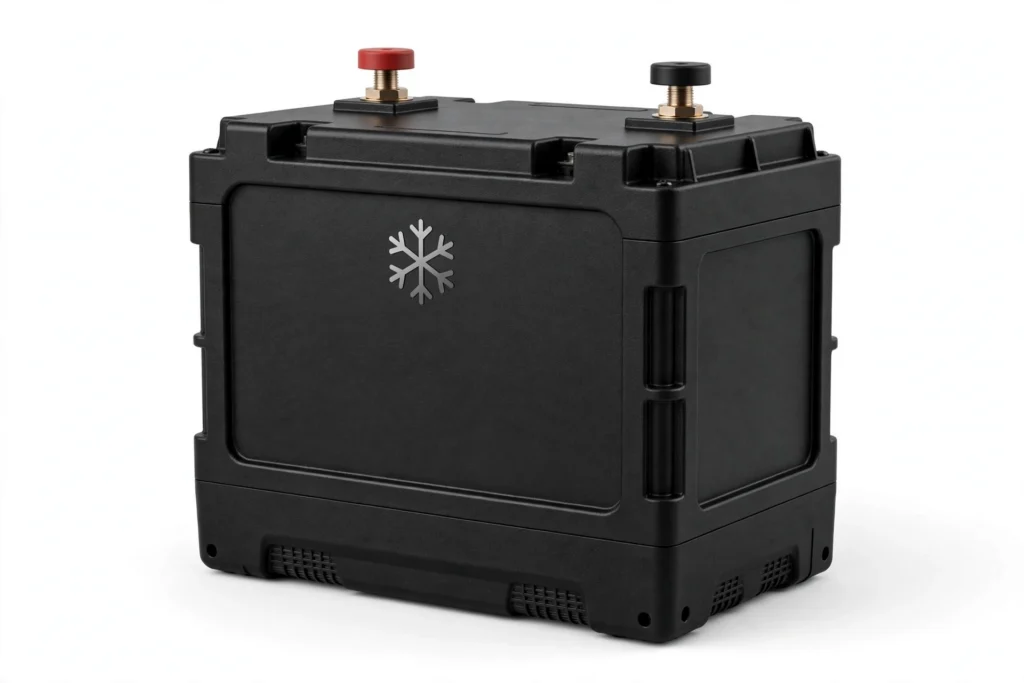
12V 100Ah Heated LiFePO4 Battery — Self-Heating for Cold-Climate RV & Marine Use
Product Overview
A 12V 100Ah LiFePO4 battery (12.8V, 1,280Wh) with built-in self-heating, built for the one situation standard lithium batteries handle badly: charging in sub-zero weather. LiFePO4 cells must not be charged below 0°C — doing so causes permanent lithium plating damage — so a standard pack’s BMS simply blocks charging and the battery sits unusable until it warms up. This model’s heating function warms the cells first, then charging proceeds, which keeps RVs, boats and off-grid systems working through northern winters instead of being winterized and parked.
As a China-based LiFePO4 battery supplier, LJY Energy supplies this model to RV and marine dealers, installers and distributors serving cold-climate markets. For the buying logic behind heated models, see our heated LiFePO4 battery buying guide.
Typical Specifications
Values below are typical configurations. “Optional” items can be specified per order; “To be confirmed” items depend on the final configuration and order — contact us for the datasheet of the exact build you need.
| Parameter | Value | Status |
|---|---|---|
| Battery chemistry | LiFePO4 (lithium iron phosphate) | Typical |
| Nominal voltage | 12.8V | Typical |
| Rated capacity | 100Ah | Typical |
| Energy | 1,280Wh | Typical |
| Built-in BMS | 100A continuous; over-charge / over-discharge / over-current / short-circuit / temperature protection | Typical |
| Self-heating function | Built-in heating warms cells before charging in sub-zero conditions; heating engagement temperature and power per final configuration | Typical — heating parameters to be confirmed per order |
| Low-temperature charging protection | Charging cut-off below 0°C as backstop protection | Typical |
| Charge voltage (bulk/absorption) | 14.2–14.6V | Typical |
| Bluetooth / app monitoring | Cell voltages, SOC, temperature on mobile app | Optional |
| Series / parallel expansion | Parallel for larger banks; series subject to configuration | Optional — subject to configuration |
| Battery short-circuit current | Test data provided per project — needed to choose a main fuse with enough interrupt rating (ABYC E-11); not the same as the BMS short-circuit trip setting | To be confirmed per order |
| Enclosure protection | Sealed enclosure; ingress rating per final configuration | To be confirmed per order |
| Certifications | UN38.3 / MSDS / CE and others per target market | To be confirmed per order |
| Warranty terms | Subject to configuration and order agreement | To be confirmed |
| Dimensions & weight | Per final enclosure design | To be confirmed — datasheet on request |
| Lead time | Subject to order quantity and configuration | To be confirmed |
Why Self-Heating Matters
Discharging works down to about −20°C, but charging below 0°C damages LiFePO4 cells through lithium plating. A proper BMS blocks charging in those conditions to protect the battery — safe, but it leaves a cold-soaked RV or boat unable to take charge from solar, shore power or a generator until ambient temperatures rise. Self-heating closes that gap: the pack uses charge energy to warm its own cells into the safe charging window first. For four-season users and northern dealers, that is the difference between a battery that works all winter and one that has to be removed and stored indoors. Warm-climate buyers do not need it — a standard model with low-temperature cut-off is the better-value choice there.
Charging & Compatibility
Typical charge profile: bulk/absorption at 14.2–14.6V, then termination — LiFePO4 needs no float stage and no equalization. Those figures are the 12V row of our charging voltage reference; see the complete charging guide for CC/CV operation.
- Shore-power and onboard chargers: select the lithium (LiFePO4) profile; on a custom profile, set absorption to 14.2–14.6V and disable equalization.
- Solar / MPPT: program the controller to the same setpoint; the heating function draws from incoming charge power to warm the pack before bulk charging begins.
- Alternator charging: use a DC-DC charger with a lithium profile.
- Upgrading from lead-acid: drop-in 12V replacement in most house-bank installations; verify charger profile and terminal fit at the selection stage.
Battery Lifespan
Cycle aging and calendar aging together determine real life. Typical reference for quality LiFePO4 cells: around 6,000 cycles at 80% depth of discharge (25°C, to 80% capacity retention) at cell level — pack results depend on BMS, thermal design and usage. Running at 80% DoD roughly doubles cycle life versus 100% DoD while sacrificing only 20% of per-cycle capacity. Cold-climate storage practice matters too: store partially charged and avoid charging a cold-soaked pack without the heating function active. Our DoD vs cycle life guide explains the throughput economics.
Applications
- Cold-climate RV and campervan house power — four-season travel where overnight temperatures stay below freezing for weeks at a time.
- Marine use in northern waters — early- and late-season boating where the pack must accept charge on cold mornings.
- Off-grid cabins and remote sites — unheated installations that cannot be visited to warm or swap batteries before charging.
- Ice-fishing, hunting and field equipment power — portable 12V power that has to recharge outdoors in winter.
Where This Battery Is Used
This model is part of our RV Battery Solutions, Marine & Boat Battery Solutions and Off-Grid Energy Storage Solutions — see those pages for system sizing and companion models.
Wholesale, OEM & ODM
Volume pricing is available for RV and marine dealers, installers, and distributors. As a China-based LiFePO4 battery supplier, we support flexible customization: capacity and voltage variants, BMS and heating configurations matched to the target climate, housing and terminal choices, and private-label packaging.
Export coordination is handled per order — share the destination market and order profile, and we confirm the workable shipping method, documentation, and compliance path before you commit.
Related Technical Guides
- Heated LiFePO4 Battery Buying Guide — when self-heating is worth paying for, and when a standard pack is enough
- RV Lithium Battery System Design Guide — capacity sizing, wiring, charging, and safety for RV house banks
- How to Choose the Right BMS for LiFePO4 Batteries — matching BMS ratings and low-temperature protection to the application
Frequently Asked Questions
Why can’t a normal LiFePO4 battery charge below 0°C?
Charging cold cells causes lithium plating — permanent damage that reduces capacity and can create safety risks. Standard packs block cold charging; this model warms its cells first so charging can proceed safely.
Does self-heating use up my battery capacity?
The heating function is powered from the incoming charge source while warming the pack, rather than draining stored energy for loads. Exact heating power and warm-up time depend on the final configuration — confirm per order.
Do I need the heated version in a mild climate?
Probably not. If the battery will rarely or never be charged below 0°C, a standard model with low-temperature cut-off protection is the better-value choice.
How much usable energy do I get from 100Ah?
At 80% depth of discharge, about 80Ah — roughly 1,024Wh — per cycle, while keeping cycle life in the range LiFePO4 is known for.
Request a Quote
Tell us your application, order volume, and destination market for a tailored quotation: Request a Quote or reach us directly on WhatsApp.