
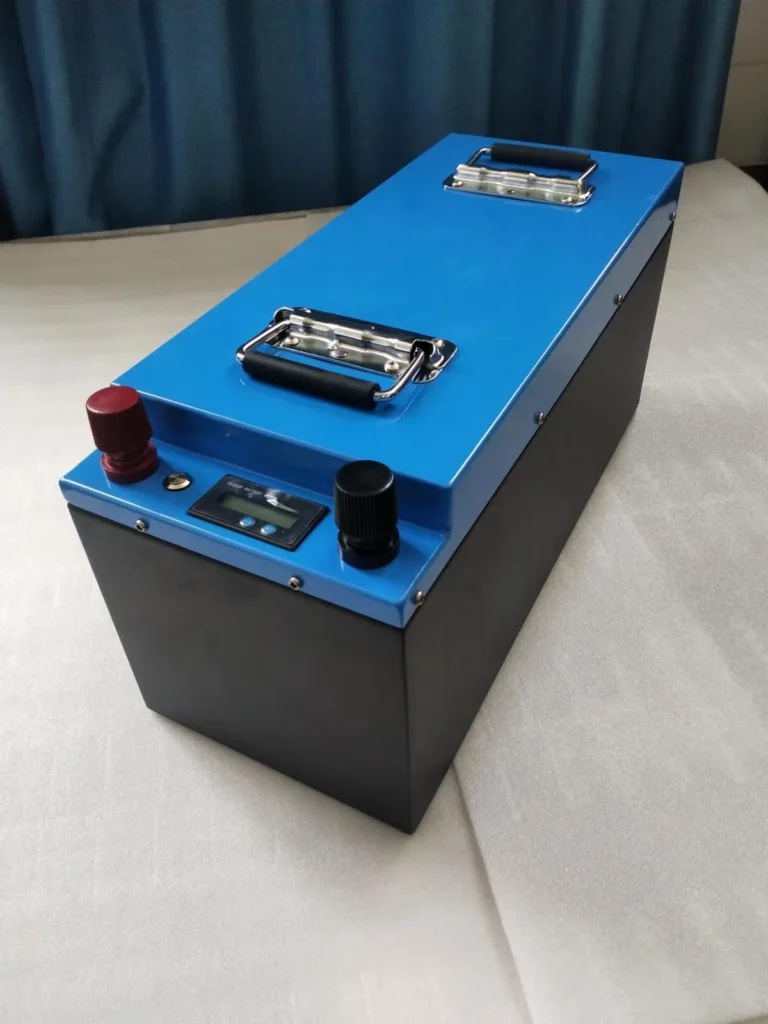
12V 300Ah LiFePO4 Battery — Deep Cycle Power for RV & Caravan
Product Images
Product Overview
The 12V 300Ah LiFePO4 battery delivers 3,840Wh from a single deep-cycle pack with a built-in battery management system (BMS), built to power RVs and caravans off-grid. One large-format unit replaces a bank of smaller batteries wired in parallel: fewer interconnect cables, one BMS watching the whole bank, and a simpler installation for extended travel, RV parks and mobile living — a drop-in upgrade from lead-acid with far more usable capacity per cycle.
As a China-based LiFePO4 battery supplier, LJY Energy supplies this model to RV and caravan dealers, installers and distributors who want a standardized high-capacity 12V SKU. Buyers who need even larger banks can step up to our 12V 400Ah deep-cycle model, or compare the full range on the 12V LiFePO4 battery series page.
Typical Specifications
Values below are typical configurations. “Optional” items can be specified per order; “To be confirmed” items depend on the final configuration and order — contact us for the datasheet of the exact build you need.
| Parameter | Value | Status |
|---|---|---|
| Battery chemistry | LiFePO4 (lithium iron phosphate) | Typical |
| Nominal voltage | 12.8V | Typical |
| Rated capacity | 300Ah | Typical |
| Energy | 3,840Wh | Typical |
| Built-in BMS | Over-charge / over-discharge / over-current / short-circuit / temperature protection; continuous discharge rating per final configuration | Rating to be confirmed per order |
| Charge voltage (bulk/absorption) | 14.2–14.6V | Typical |
| Low-temperature charging protection | Charging cut-off below 0°C | Typical |
| Bluetooth / app monitoring | Cell voltages, SOC, temperature on mobile app | Optional |
| Self-heating function | Available for cold-climate configurations | Optional |
| Series / parallel expansion | Parallel for larger banks; series subject to configuration | Optional — subject to configuration |
| Battery short-circuit current | Test data provided per project — needed to choose a main fuse with enough interrupt rating (ABYC E-11); not the same as the BMS short-circuit trip setting | To be confirmed per order |
| Enclosure protection | Sealed enclosure; ingress rating per final configuration | To be confirmed per order |
| Certifications | UN38.3 / MSDS / CE and others per target market | To be confirmed per order |
| Warranty terms | Subject to configuration and order agreement | To be confirmed |
| Dimensions & weight | Per final enclosure design | To be confirmed — datasheet on request |
| Lead time | Subject to order quantity and configuration | To be confirmed |
Why One 300Ah Pack
The alternative to a single 300Ah unit is three 100Ah batteries in parallel — workable, but it triples the terminal connections, and current sharing between paralleled packs is never perfectly even, so one unit can age faster than its neighbours. A single large pack keeps one BMS in charge of the whole capacity, simplifies wiring and monitoring, and removes the interconnect cables as failure points. The trade-off is handling: one large battery is a heavier single lift than three small ones, and a failure takes the whole bank offline instead of one third of it. For fixed RV and caravan installations that stay in place for seasons at a time, the single-pack layout is usually the cleaner engineering choice. At a sensible 80% depth of discharge, the 300Ah rating returns about 240Ah of working capacity per cycle — roughly 3,072Wh — about double the usable energy of a comparable lead-acid bank kept above 50%.
Charging & Compatibility
Typical charge profile: bulk/absorption at 14.2–14.6V, then termination — LiFePO4 needs no float stage and no equalization. Those figures are the 12V row of our charging voltage reference; see the complete charging guide for CC/CV operation. A 300Ah bank also rewards a properly sized charger: at a gentle 0.2C charge rate it already draws 60A, so undersized chargers mean long recharge times rather than damage — plan charger capacity with the bank, not after it.
- Shore-power and onboard chargers: select the lithium (LiFePO4) profile; on a custom profile, set absorption to 14.2–14.6V and disable equalization.
- Alternator charging: use a DC-DC charger with a lithium profile, sized so a deeply discharged 300Ah bank does not overload the alternator.
- Solar / MPPT: program the controller to the same 14.2–14.6V absorption setpoint; larger banks pair naturally with larger arrays for same-day recovery.
- Drop-in replacement: replaces lead-acid house banks in most RV and caravan installations; verify charger profile, cable gauge and terminal fit at the selection stage.
Battery Lifespan
Cycle aging and calendar aging together determine real life. Typical reference for quality LiFePO4 cells: around 6,000 cycles at 80% depth of discharge (25°C, to 80% capacity retention) at cell level — pack results depend on BMS, thermal design and usage. Running at 80% DoD roughly doubles cycle life versus 100% DoD while sacrificing only 20% of per-cycle capacity. Our DoD vs cycle life guide explains the throughput economics.
Sizing Notes
Start from daily consumption, not from the battery. Add up the watt-hours your RV or caravan actually uses in 24 hours — fridge, lights, water pump, fans, device charging, inverter loads — then divide by 0.8 to size for an 80% discharge limit. A 300Ah pack suits daily draws up to roughly 3,000Wh with a day of reserve; lighter users can step down to a 200Ah class, heavier users or multi-day autonomy targets point to the 400Ah class or a parallel pair. Our RV system design guide walks through the load calculation step by step.
Applications
- RV and motorhome house power — multi-day off-grid stays running fridge, lighting, pump, heating fans and entertainment from one bank.
- Caravan and travel trailer — extended touring and seasonal pitches where hookups are unavailable or unreliable.
- Off-grid cabins and mobile workshops — pairs with solar for weekend and seasonal properties on 12V systems.
- Marine house banks on smaller vessels — a single-unit house bank where space favours one large pack over several small ones.
Where This Battery Is Used
This model is part of our RV Battery Solutions and Off-Grid Energy Storage Solutions — see those pages for system sizing, companion models and dealer guidance.
Wholesale, OEM & ODM
Volume pricing is available for RV and caravan dealers, installers, and distributors. As a China-based LiFePO4 battery supplier, we support flexible customization: capacity and voltage variants, BMS configurations matched to the application (discharge ratings, low-temperature protection, communication options where inverter or display integration is required), housing and terminal choices, and private-label packaging.
Export coordination is handled per order — share the destination market and order profile, and we confirm the workable shipping method, documentation, and compliance path before you commit.
For distributors / wholesale buyers
Procurement (confirm at inquiry): MOQ, sample path, lead time, Incoterms and payment are confirmed in the formal quotation for your configuration — we do not publish fixed commercial figures on this page.
Start here: Wholesale & distributor program · Distributors · MOQ & sample order guide · How to verify a LiFePO4 supplier.
Request a distributor / wholesale quote for 12V 300Ah
Related Technical Guides
- RV Lithium Battery System Design Guide — capacity sizing, wiring, charging, and safety for RV house banks
- How to Choose the Right BMS for LiFePO4 Batteries — matching BMS ratings and protections to the application
- How to Verify a LiFePO4 Battery Supplier in China — due diligence checklist before placing an order
Frequently Asked Questions
Is one 300Ah battery better than three 100Ah batteries in parallel?
For fixed installations, usually yes: one BMS manages the whole bank, there are no interconnect cables, and no uneven current sharing between units. Parallel smaller units are easier to lift and give partial redundancy — the right choice depends on the installation.
How much usable energy do I get from 300Ah?
At 80% depth of discharge, about 240Ah — roughly 3,072Wh — per cycle, while keeping cycle life in the range LiFePO4 is known for.
What charger size does a 300Ah bank need?
Charging at 0.2C means 60A; a 40–60A lithium-profile charger is the practical range for overnight recovery. Smaller chargers work safely but recharge more slowly.
Can I add a second 300Ah unit later?
Parallel expansion for larger banks is supported subject to configuration; match age and configuration when expanding, and confirm at order time.
Request a Quote
Tell us your application, order volume, and destination market for a tailored quotation: Request a Quote or reach us directly on WhatsApp.