
Share This Article
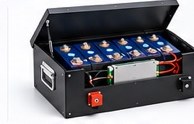
An 8S DIY battery kit for 314Ah-class cells: the same case family as our 280Ah kit — rated across 280–314Ah — with a smart BMS and the full accessory set for MB31-class prismatic LiFePO4 cells. Supplied as a kit, assembled by you, branded by you.
Does a 25.6V 314Ah DIY Kit Actually Exist? Yes — We Checked
This page exists because the question is legitimate. When we researched this format, the verification brief was blunt: is a 24V 314Ah kit a real market product, or only a 280Ah box with a 314Ah sticker? The answer, from makers’ own pages: it is real, and its mainstream form is a shared case. 314Ah cells (EVE MB31, CATL 314Ah, Hithium 314Ah, CALB 314Ah) kept the 280-class footprint — roughly 174 × 72 × 207 mm — so established kit makers rate one case across the range: a leading maker’s 24V kit is listed for 280/314Ah in its shop and for 280/302/304/306/314Ah in its manual, and the same maker has published a build video assembling eight CALB 314Ah cells into that very case as a 24V 314Ah pack. Another maker’s pre-assembled 24V MB31 box lists EVE 280/304/306/314, CATL 302 and Hithium 280/314 as its supported cells.
Truly dedicated “314Ah-only” cases are the exception, not the rule — a handful exist (one metal case sold specifically as a 24V 314Ah kit measures about 465 × 450 × 270 mm), but the volume of the market is the shared case. So the honest selling point of this kit is same-case 314Ah compatibility: one case platform, one accessory set, one mounting footprint — and the choice of 280Ah or 314Ah cells inside it. Four extra points of capacity class buy about 12% more energy (≈8.0 kWh against ≈7.2 kWh) without re-engineering anything around the pack. Any listing implying you must pay a premium for a special 314Ah box should be asked what physically differs.
The kit is supplied in three tiers. The market uses loose words like “complete kit” for all three, so we define each tier by what is physically in the box:
| Tier | What is in the box | What you supply |
|---|---|---|
| 1 — Case-only kit | Steel case plus accessory set: series busbars, sampling boards or balance harness, insulation set, main terminals, protection hardware, fasteners | Your cells and your own BMS |
| 2 — Case + BMS kit (standard offer) | Everything in Tier 1, plus a fitted 8S smart BMS. This is the configuration meant when a listing says “Battery Case + BMS + Accessories (Cells Not Included)” | Your cells |
| 3 — Complete kit with cells | Everything in Tier 2, plus 8 matched Grade A 314Ah cells of the model confirmed in your order | Assembly only |
If you only need the protection board itself, see our standalone smart BMS boards. If you would rather not assemble at all, finished units are in our 24V LiFePO4 battery range and surveyed in the 24V LiFePO4 battery series guide.
Reference Standard Configuration
The table below is the reference build most buyers start from. Dimensions are the shared 280/314 double-row case range — the same range as the 25.6V 280Ah kit, deliberately, with the small number of dedicated-314 cases noted separately rather than blended in.
| Item | Reference configuration | Basis |
|---|---|---|
| Pack format | 8S (8 × 3.2V cells), 25.6V nominal; ≈8.0 kWh with 314Ah cells | Fixed by the kit design |
| Case format | Steel case, 4×2 double-row layout, from the case family rated across 280–314Ah | Option — see matrix below |
| Case size, reference range | Shared-case double-row ≈ 396–465 × 402–450 × 246–273 mm (the few dedicated-314 cases sit inside the top of this band) | Reference range — exact drawing and layout confirmed per order |
| Cell layout | 4 × 2 double-row with compression plates | Fixed by the kit design |
| BMS (Tier 2/3) | 8S smart BMS, 200A continuous class, Bluetooth monitoring; CAN / RS485 where the system needs it | Brand family and model confirmed per order |
| Main protection | Fuse or breaker sized to the BMS class | Rating and type per kit — confirmed per configuration |
| Display | LCD on some with-BMS configurations; not included in the case-only tier | Per kit — confirmed per order |
| Main terminals | P+ / P− terminal pair sized to the current class | Confirmed per configuration |
Configuration Options — Nothing Is Locked
| Dimension | Options | Notes |
|---|---|---|
| Supply tier | Case-only / Case + BMS / Case + BMS + cells | See tier table above |
| Case basis | Shared 280/314 case family (the market mainstream) / the few dedicated-314 case designs where a project specifies one | State any preference in the enquiry; the drawing is confirmed per order either way |
| Case layout | 4×2 double-row as the reference; flat single-row where the 280Ah-family flat case is used | Choose by the space the pack must occupy |
| Cells fitted (Tier 3) | EVE MB31, CATL 314Ah, Hithium 314Ah, CALB 314Ah | Terminal form confirmed against the physical batch |
| 280Ah fallback | The same kit accepts the full 280Ah-class family (LF280K and equivalents) | One case platform covers both variants of your product line — see the 280Ah kit page |
| BMS family | JK (3–8S platform, active balancing, Bluetooth built in) / JBD (8–24S platform, passive balancing, UART / RS485 / CAN options) / Daly (classic passive 7–17S lines, or the active-balance line) | Category options — the brand and model in your kit are confirmed in writing per order, never assumed |
| BMS continuous current | 100A / 150A / 200A class | Size from your inverter, motor controller and load profile, not from the cell label |
| Balancing | Active 1A or 2A, or passive balancing depending on BMS family | Active balancing earns its cost on large-format cells |
| Communication | Bluetooth app monitoring; RS485 and CAN as BMS-platform options | Name any inverter or controller that must talk to the pack, so the protocol match is confirmed, not hoped for |
| Display | LCD / none | “None” applies to the case-only tier |
| Heating pads | Optional add-on | Not standard fit. Add them if the pack will charge below 0 °C; this is separate from BMS low-temperature charge protection |
| OEM appearance | Case colour, your logo and labels, rating plate, manual and packaging | See the OEM / ODM section |
Cell Compatibility: The 314Ah Models, Verified Against the Footprint
314Ah is a capacity class, not a mechanical standard — what makes these cells fit the 280Ah case family is that the major makers kept the envelope when they raised capacity. The widely available 314Ah models:
| Cell | Capacity | Size (L × T × H, mm) | Terminals |
|---|---|---|---|
| EVE MB31 | 314Ah | 173.7 × 71.7 × 207.2 (incl. terminals) | Factory flat terminals for laser welding; DIY-market versions with M6 or double-thread M6 welded studs |
| CATL 314Ah | 314Ah | 174.26 × 71.65 × 207.2 (incl. terminals) | M6 laser-welded stud |
| Hithium 314Ah | 314Ah | 174.7 × 71.65 × 207.11 | M6 stud (DIY-market version) |
| CALB 314Ah | 314Ah | Same footprint family (≈173.9 × 71.7 × ≈207) | Confirmed against the physical batch |
| 280Ah-class family (for reference) | 280Ah | 173.7–174.7 × 71.55–72.0 × 207.1–207.5 | M6 stud versions; REPT terminal form varies by source |
The compatibility rule is mechanical, not commercial: a cell fits if its footprint falls inside the family above and its terminal form matches the busbar drilling. Note the EVE MB31 line in particular — the same cell reaches the DIY market with plain flat terminals or with welded M6 studs depending on channel, and those need different busbar hardware. Send the exact cell model and its terminal version with your enquiry and the match is confirmed in writing. If you are still choosing cells, our guide on choosing LiFePO4 cells for pack assembly and the 280Ah / 314Ah prismatic cell range are the right starting points; cells are also listed on our cell wholesale page.
What Is in the Accessory Set
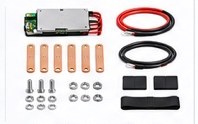
- 7 copper series busbars — an 8S pack needs one link per cell junction, i.e. series count minus one; in the 4×2 layout one link runs between the rows, and its form is part of the layout confirmation
- BMS connection busbar set — the main-path links between cell block, BMS and terminals (a separate set from the series links)
- Sampling boards, or a balance-wire harness — the two market forms of the same job: routing the 9 sense taps (B0–B8) to the BMS in order
- P+ / P− main terminals, sized to the current class
- Fuse or breaker for the main path, rating per kit configuration
- Display where the confirmed kit includes one
- Insulation set — epoxy / fibre sheets between cells and case, EVA pads between cells
- Fastener pack — terminal bolts, case and lid screws
Exact counts of insulation pieces and fasteners follow the bill of materials of the case in your order and are listed in the order confirmation — makers vary these counts widely, and we would rather confirm ours in writing than copy a competitor’s packing list.
Assembly: Eight 314Ah Cells Into a Working 25.6V Pack
- Check the cells before anything is bolted. Compare resting voltage and internal resistance across all 8 cells, and bring them to a common state of charge. On MB31-class cells, also verify which terminal version you actually received — flat or stud — before the busbars come out of the bag.
- Insulate first. Epoxy or fibre sheets between the cell block and the steel case, separators between cells. Steel cases and prismatic cell cans must never rely on the cell’s own film alone.
- Set the layout under even compression. Build each row of four as a compressed unit first, then join the rows. Prismatic LFP cells want moderate, uniform compression, not maximum force. Torque values come from the cell maker’s manual for your exact cell model and are stated in the kit documentation; there is no universal number.
- Land the sampling connections before the power path. Fit the sampling boards or balance harness from B0 upward and verify every tap reads in sequence — in the double-row layout, double-check the taps that cross between rows before any busbar carries current.
- Bolt the series busbars in order — 7 links, polarity checked twice. Work cell 1 negative to cell 2 positive and onward, checking polarity at every step with a meter, not by eye. The inter-row link is the step where polarity mistakes happen; meter it twice.
- Wire the BMS main path and protection. B− to the first cell’s negative, P− out to the load terminal, fuse or breaker in the main line, then the P+ terminal. Confirm the BMS wakes and reads all 8 cell voltages before the lid goes on.
- Supervise the first full cycle. Watch per-cell voltages on the app or display through the first charge — an 8.0 kWh first cycle is a long one, and a cell that runs away here is cheap to fix on the bench and expensive to find inside a customer’s boat or warehouse truck.
- Close up and record the build. Note the cell batch, BMS model, settings and layout on the build sheet. That record is what makes warranty discussions and repeat orders simple.
A necessary word on who should do this: a 25.6V 314Ah pack stores about 8 kWh and can deliver very high fault currents. Assembly belongs with trained technicians using insulated tools. If your operation does not have them, buy the finished battery instead — it is the honest recommendation.
Where an 8.0 kWh DIY Pack Earns Its Keep
- Marine 24V systems at the top of the range — house banks on larger vessels where the extra 0.8 kWh over a 280Ah build is another evening of autonomy without a second pack; see our marine power page
- Material handling conversions — 24V traction equipment where longer shifts between charges price the 314Ah variant by themselves; see material handling
- Expedition and commercial vehicles — truck campers and service vehicles whose 24V inverter loads run long hours
- Assembler product lines — one case platform, two capacity variants: case inventory stays single while the catalogue offers both 280Ah and 314Ah finished packs
OEM / ODM: Your Brand, Your Specification
The kit format exists for buyers who sell under their own name. OEM options cover case colour, logo and rating labels, manuals and packaging; configuration options cover the case layout, BMS family and current class, terminal arrangement, display, and — on Tier 3 — the cell model the kit is built around. For volume programmes, case dimensions can be produced to a project specification rather than taken from the standard range.
Our role in that process is coordination: requirements are confirmed in a written specification, matched against manufacturing partners’ production, and the agreed checkpoints and documents are handled on the export side. The specification confirmed in your order document is what binds the shipment — not this web page, which is why every variable item above is marked “confirmed per order”. Start from our OEM & ODM coordination page or the OEM / ODM RFQ checklist if you want the full document list.
What to Send Us for a Quotation
- Tier — case-only, case + BMS, or complete with cells
- Cell model and terminal version — the exact 314Ah cells you will fit, flat-terminal or stud version (or ask us to supply them under Tier 3)
- Layout and installation space — with the length × width × height the pack must fit
- BMS current class and system partners — inverter or motor-controller model, so current class and any CAN / RS485 protocol are confirmed against your actual equipment
- Quantity and destination — a sample kit for evaluation, or your expected regular volume, plus the destination port
One logistics advantage worth planning around: Tiers 1 and 2 contain no cells, so they ship as general cargo — no lithium-battery dangerous-goods freight. Many buyers ship kits by standard freight and source cells on a separate, optimised route; Tier 3 ships as regulated lithium cargo like any cell shipment. Exact packing dimensions and weights for your configuration are stated in the quotation.
Related reading before you enquire: the BMS selection guide for sizing the board, and the rest of this series below.
Frequently Asked Questions
Is the 314Ah kit just a 280Ah box with a different label?
The case is shared — that part is true, and it is true across the whole market, not just here. 314Ah cells were designed into the 280-class footprint, so makers rate one case for both and say so on their own pages. What is not shared is the pack you build: 314Ah cells deliver about 8.0 kWh in this format against 7.2 kWh, with different cell models, terminal versions and price points. The kit’s job is to be specified around the cells you actually fit — which is why the cell model and terminal version are order-confirmation items.
Do dedicated 314Ah cases exist at all?
A few. We found a small number of cases sold specifically as 24V 314Ah kits (one measures about 465 × 450 × 270 mm) alongside the shared-case mainstream, and at least one listing prints its dimensions in a different axis order (270 × 465 × 450), which is a reminder to confirm the drawing, not just the numbers. If your project specifies a dedicated case, name it in the enquiry and it is quoted as such; otherwise the shared case family is the value choice.
Can I mix 280Ah and 314Ah cells in one pack?
No. Cells in a series string must be the same model and batch class; mixing capacities guarantees the smaller cells are over-worked at both ends of every cycle while the BMS sees only per-tap voltages. Build 280Ah packs or 314Ah packs — the kit supports both, the string must not.
Does the MB31’s terminal version matter?
Yes, more than any other detail on this page. EVE MB31 reaches the market as a flat-terminal cell for laser welding and as a DIY version with welded M6 (single or double-thread) studs. The busbars, torque and hardware differ. State which version your cells are when you enquire; if you are buying cells and kit together under Tier 3, we confirm the pairing in the order specification.
Do I have to buy the BMS from you?
No. Tier 1 is case-only precisely for buyers with their own BMS platform. What we would ask is which board you plan to fit: the case’s BMS mounting position and display cut-out are arranged around a board class, and it is cheaper to confirm that fit on paper than to discover it on the bench.
Is a heating pad included?
No — heating pads are an optional add-on, confirmed per order, and we say so plainly because some listings imply otherwise. Add them if the finished pack will be charged below 0 °C. They are a different thing from the BMS’s low-temperature charge cut-off, which is a protection setting on the board itself.
The DIY Kit Series
This page is the 25.6V 314Ah model in an eight-model DIY kit series: 12.8V 100Ah / 280Ah / 314Ah (4S), 25.6V 280Ah / 314Ah (8S), and 51.2V 100Ah / 280Ah / 314Ah (16S). Each model gets its own page because the cases, cell families and assembly details genuinely differ. The other seven models in the series: the 25.6V 280Ah DIY kit, the 12.8V 314Ah DIY kit, the 12.8V 280Ah DIY kit, the 12.8V 100Ah DIY kit, the 51.2V 314Ah DIY kit, the 51.2V 280Ah DIY kit and the 51.2V 100Ah DIY kit. The full product range is on Products.
Request a quotation for this kit: Start a DIY-Kit-24V314 inquiry · WhatsApp: +86 159 8945 0735
Share This Article