
Share This Article
Smart BMS boards supplied as standalone SKUs — for assemblers, integrators, and repair channels who buy the board separately from the cells.
Why Buyers Source the BMS Board Separately
Not every buyer wants a finished battery. Local assemblers in many markets buy cells and BMS boards as components and build packs in their own workshops — sized to local enclosures, local price points, and the applications their customers actually run. Repair channels need the same board again when a pack comes back with a failed protection board. And some integrators design the pack around the board: one recent buyer, for example, needed very high discharge current from a pack with no spare internal space, which made the board’s footprint and current path the deciding constraint — not the cells.
This is a real, recurring procurement pattern, not an edge case. An East African solar installer recently took a quotation from us for standalone 4S 200A smart BMS boards as a separate line item alongside 12V 100Ah batteries, because their workshop assembles and services packs locally. A South African builder specified a 48V 200Ah pack project explicitly around smart BMS technology. Buyers like these are not asking for integration services — they are asking to buy the board. This page is the SKU page for that purchase.
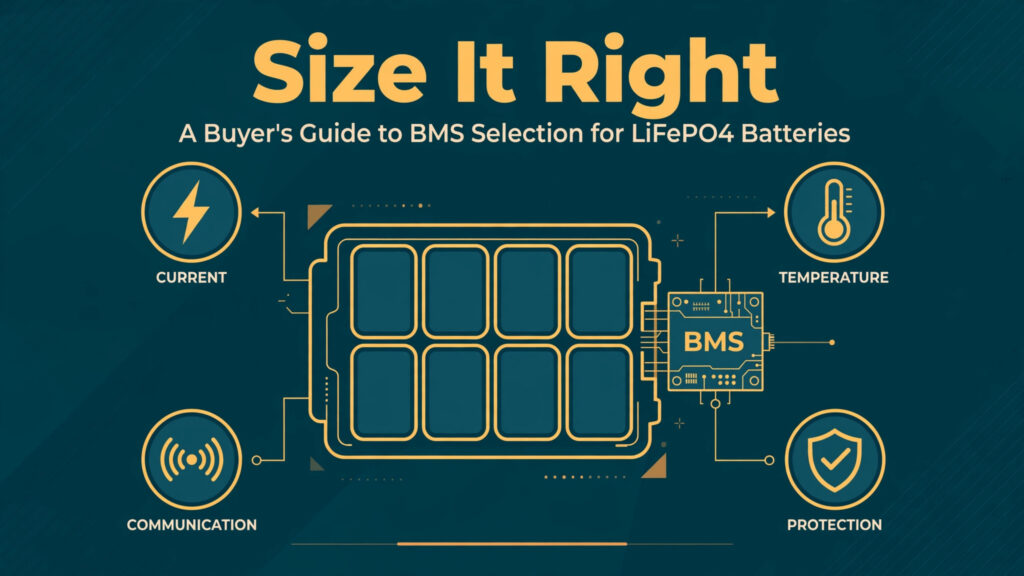
If you are still deciding what specification you need, start with our BMS selection guide. If you want the BMS integrated and warranted together with a finished pack, see BMS supply & OEM integration instead. This page is only for the board itself.
What the Board Does
A smart BMS board is the protection and monitoring layer of a LiFePO4 pack. The configurations we supply cover the standard protection set:
- Cell-level protection — over-charge, over-discharge, over-current, short-circuit, and temperature cut-offs, with per-cell voltage monitoring through the balance lead harness.
- Balancing — passive balancing as the standard configuration; higher balancing current or active balancing as an option, confirmed per project.
- Monitoring — smart models report pack voltage, current, temperature, and state of charge to a phone app over Bluetooth, so an assembler can verify a finished pack before it ships to their customer.
- Communication options — UART, RS485, or CAN as configurable options when the board must report to an inverter, charger, or vehicle controller. Protocol details are confirmed per project against the host equipment.
Configuration Range
Boards are supplied to a written configuration, not picked off a shelf blind. The working range below is the configuration space; the exact build for your order is confirmed in writing before production.
| Dimension | Options | Basis |
|---|---|---|
| Pack configuration | 4S (12V), 8S (24V), 16S (48V/51.2V); other series counts on request | Confirmed per project |
| Continuous discharge current | 100A / 150A / 200A class builds | Confirmed per project against your load profile |
| Charge current | Matched to the discharge build or specified separately | Confirmed per project |
| Balancing | Passive balancing standard; active balancing optional | Optional |
| Monitoring | Bluetooth app monitoring on smart models | Configuration-dependent |
| Communication | UART / RS485 / CAN | Optional, confirmed against host equipment |
| Low-temperature charging protection | Available on specified builds | Optional |
| Harness & connectors | Balance lead harness supplied with the board; main terminal arrangement per build | Confirmed per project |
How to Specify a Board in Five Steps
- Fix the series count from the pack, not the label. A “48V” LiFePO4 pack is normally 16 cells in series (51.2V nominal). The board’s series count must match the actual cell count, or its per-cell protection thresholds are meaningless.
- Size continuous current from the sustained load, with headroom. Take the highest load the pack must hold for minutes at a time — not the one-second peak — and choose a board whose continuous rating sits comfortably above it. A board run at its limit all day runs hot and ages fast; the peak rating only covers starting surges.
- Check the cells can match the board. The board cannot make cells deliver current they are not rated for. If your cells are rated 1C continuous, a 200A board on a 100Ah pack buys you nothing — the cells become the limit and the protection thresholds must be set to them.
- Decide the charge path. State the charger or inverter’s maximum charge current and whether charging runs through the same port. This sets the charge-current configuration and whether a common-port or separate-port build fits.
- Decide communication last — and only if something listens. Bluetooth monitoring is useful to almost every assembler. RS485 or CAN only earns its cost when a specific inverter, display, or controller will actually read it; name that device when you enquire.
Standalone Board vs. Complete Pack: The Honest Trade-Off
| Question | Buy the board (this page) | Buy the complete pack |
|---|---|---|
| Who owns the cell–BMS match? | You do. Protection settings must be right for your cells. | The pack supplier does, under one specification. |
| Design freedom | Full: your enclosure, your geometry, your price point. | Limited to the supplier’s existing models. |
| Assembly & test burden | Yours: wiring, first-cycle verification, and QC happen in your workshop. | Done before shipment. |
| Logistics | Boards are compact electronics — cheaper and simpler to ship and stock than finished packs. | Finished packs ship as regulated lithium battery cargo. |
| Warranty boundary | The board is warranted as a component; pack performance depends on your cells and assembly. | The whole pack is covered as one product. |
| Best fit | Assemblers, private-label builders, repair and service channels. | Distributors and installers who resell or install finished product. |
Assembly Notes That Decide Whether the Board Survives
Most board failures we hear about from assemblers are wiring events, not defective boards. Three habits prevent nearly all of them:
- Balance leads land in order, every time. Connect the sense harness from the lowest cell upward and verify each tap voltage before the main terminals carry load. A single swapped lead can put full pack voltage across a sense input.
- Respect the B- / P- path. On common-port boards, charge and discharge share the board’s negative path. Loads with large input capacitors can hit the board with a hard inrush at first connection — if your load is an inverter, ask about precharge handling when you specify the board.
- Supervise the first cycle. Watch per-cell voltages through the app during the first full charge. A pack that reaches balance cleanly on cycle one rarely gives trouble later; a cell that runs away on cycle one is telling you something cheap to fix now.
What to Send Us for a Quotation
Four things are enough to confirm a configuration and quote:
- Pack series count and cell capacity (for example, 4S with 100Ah cells)
- Continuous and peak discharge current of your application
- Charger or inverter model, if the board must communicate or share the charge path
- Quantity — a sample batch for evaluation, or your expected regular volume
Building packs at volume? Boards pair naturally with our LiFePO4 cells supply, and private-label programmes are covered under OEM & ODM coordination.
Frequently Asked Questions
Can I use these boards with cells I did not buy from LJY?
Yes — that is the normal case for this page. Send the cell specification (chemistry, capacity, continuous C-rating) with your enquiry so the protection configuration is confirmed against your cells, not assumed.
What quantity do I need to order?
Sample quantities for evaluation can be discussed on any configuration. Send the quantity you are evaluating and your expected regular volume; pricing and availability are confirmed per configuration in the quotation.
Can the board talk to my inverter?
RS485 and CAN configurations exist for host communication, but “the inverter speaks CAN” is not a complete specification — protocol dialects differ by brand and model. Name the inverter when you enquire and the match is confirmed in writing before you order. If nothing will read the data, Bluetooth monitoring alone is usually the better spend.
Who is responsible if a pack built on your board fails?
The board is supplied and warranted as a component, configured to the specification confirmed in writing. Pack-level performance also depends on the cells and the assembly, which sit with the assembler. This boundary is exactly why the configuration is written down before production — so both sides know which part each is standing behind.
Start a Standalone BMS Board Inquiry
Share This Article