
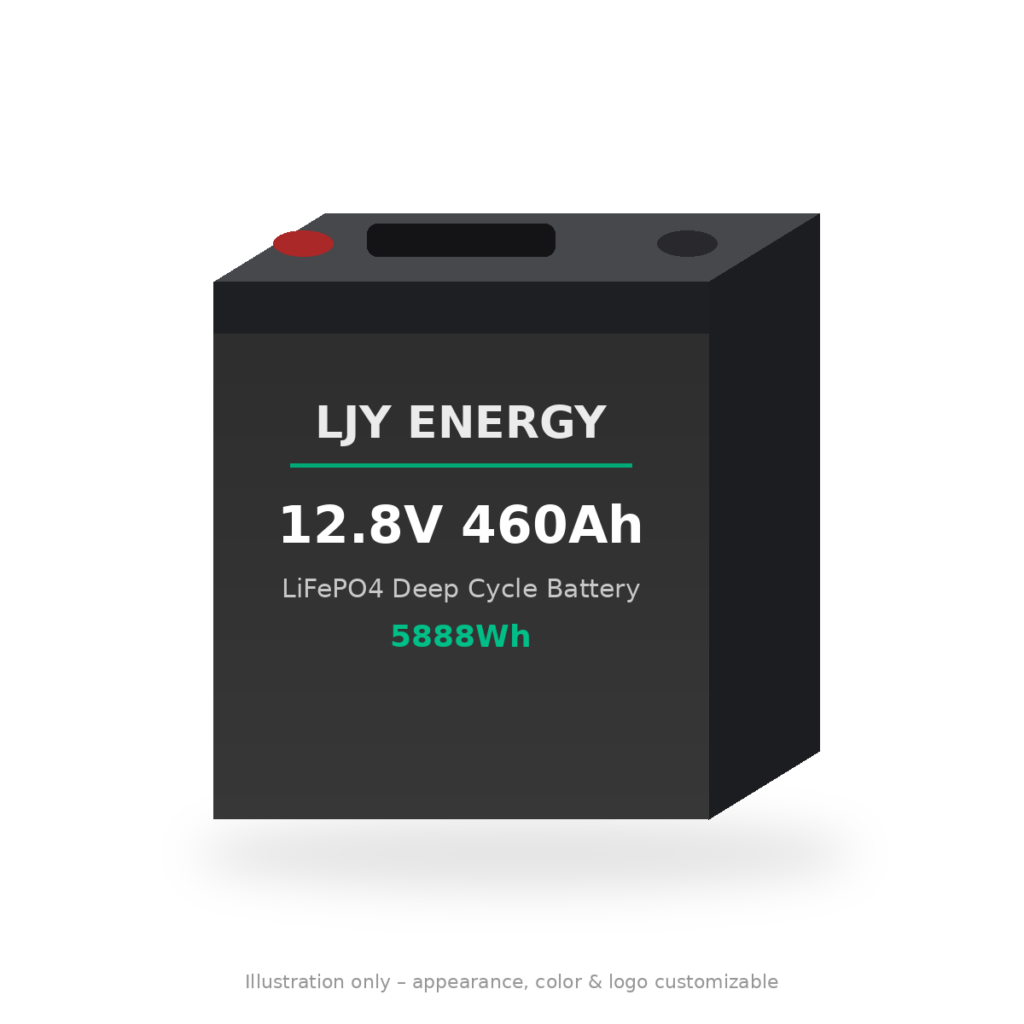
12V 460Ah LiFePO4 Battery
Product Overview
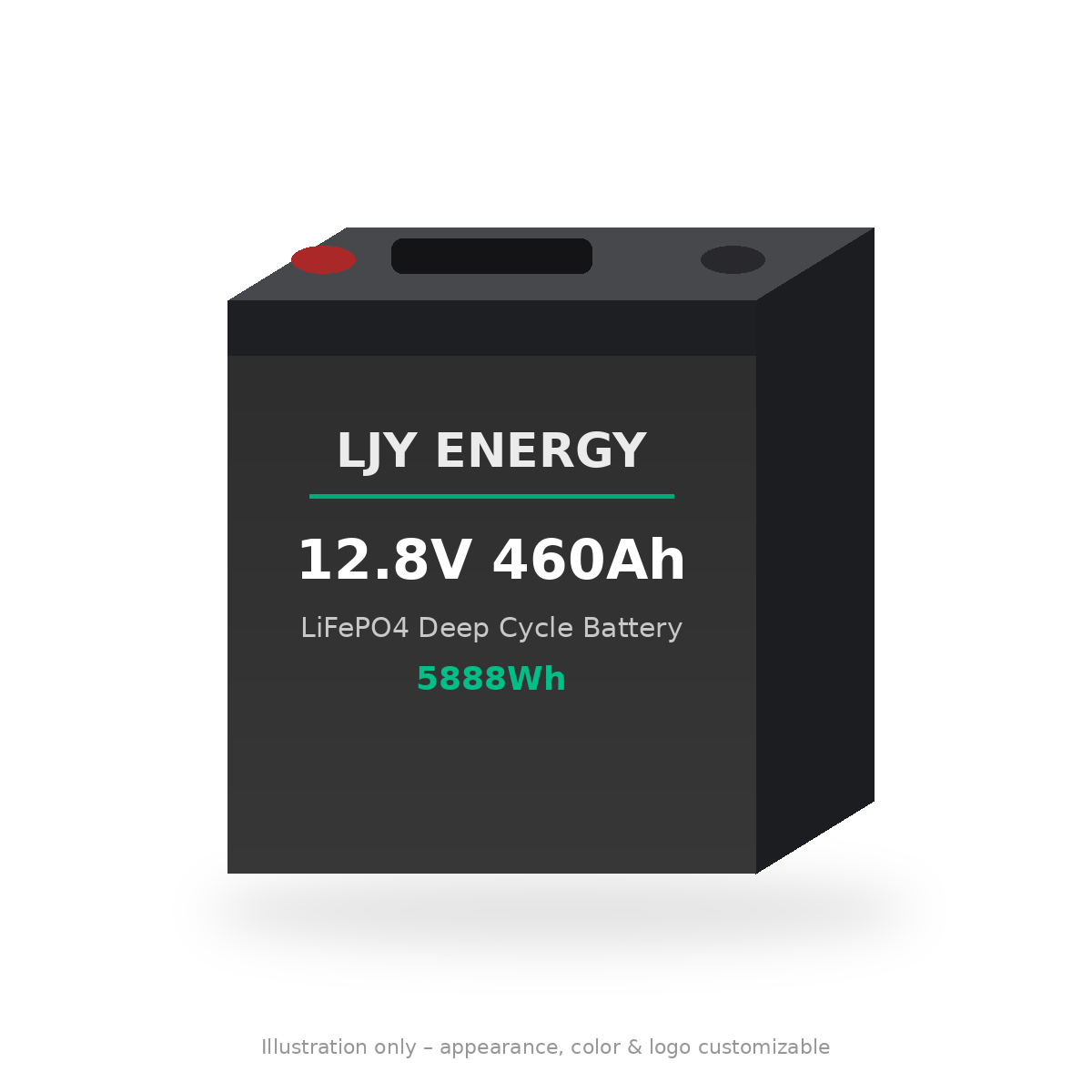
A 5.89kWh LiFePO4 battery (12V class, 12.8V nominal, 460Ah) that can replace a bank of several 12V batteries with one unit. It targets large RV and marine house banks and off-grid systems that must stay at 12V.
It is the top of the 12V range above the 12V 400Ah. LJY Energy supports cell option, BMS rating, communication, enclosure and branding for your market.
WhatsApp: +1 404 784 1946 (backup: +86 159 8945 0735)
Specifications
Status key: [Industry reference] = the base definition of this model class or an arithmetic value, not an LJY test result. [Optional configuration] = available by OEM/ODM project. [Confirmed per project] = fixed only in the datasheet issued with your quotation (cell option, BMS rating, dimensions, weight, terminals, documents). We do not publish unverified values — request the datasheet.
| Group | Parameter | Value | Status |
|---|---|---|---|
| Cell & chemistry | Battery chemistry | LiFePO4 (lithium iron phosphate) | [Industry reference] |
| Electrical | Nominal voltage | 12V class — 12.8V (4S) | [Industry reference] |
| Electrical | Rated capacity | 460Ah | [Industry reference] |
| Electrical | Energy | 5.89kWh | [Industry reference] |
| Electrical | Charge voltage (bulk/absorption) | 14.2–14.6V (no float required) | [Industry reference] |
| Electrical | Discharge cut-off voltage | Confirmed per project (datasheet issued with quotation) | [Confirmed per project] |
| Electrical | Continuous discharge current | Confirmed per project (datasheet issued with quotation) | [Confirmed per project] |
| Cell & chemistry | Cell type | Confirmed per project (datasheet issued with quotation) | [Confirmed per project] |
| Mechanical | Dimensions (L×W×H) | Confirmed per project (datasheet issued with quotation) | [Confirmed per project] |
| Mechanical | Weight | Confirmed per project (datasheet issued with quotation) | [Confirmed per project] |
| Mechanical | Terminals | Confirmed per project (datasheet issued with quotation) | [Confirmed per project] |
| BMS & protection | Built-in BMS | Over-charge / over-discharge / over-current / short-circuit / temperature protection, balancing | [Industry reference] |
| Optional configuration | Bluetooth app monitoring | Cell voltages, SOC, temperature, cycle count | [Optional configuration] |
| Optional configuration | Low-temperature protection / self-heating | Charge cut-off below 0°C; heating pad version | [Optional configuration] |
| Optional configuration | LCD / SOC display | On-case state-of-charge display | [Optional configuration] |
| Optional configuration | Higher-current BMS | See BMS selection guide below | [Optional configuration] |
| Optional configuration | Enclosure / branding | Custom case color, logo, labels, packaging | [Optional configuration] |
| Optional configuration | Series / parallel expansion | Up to 4S (48V) and parallel banks — max count confirmed per BMS | [Optional configuration] |
| Optional configuration | CAN / RS485 communication | For inverter/charger and system monitor integration (protocol confirmed per project) | [Optional configuration] |
| Commercial & documents | Certifications / test documents | Per order and target market | [Confirmed per project] |
| Commercial & documents | Warranty terms | Per order agreement | [Confirmed per project] |
| Commercial & documents | Lead time | Per order quantity and configuration | [Confirmed per project] |
| Commercial & documents | Pricing | Quoted per inquiry | [Confirmed per project] |
BMS, Communication & Protection
Every pack uses a built-in battery management system with over-charge, over-discharge, over-current, short-circuit and temperature protection plus cell balancing. The BMS current rating sets what the battery can actually deliver, so it should be chosen from the load — not from the capacity. The guide below is general engineering guidance; the BMS rating offered for your order is confirmed in the quotation.
BMS sizing guide
| Load / use case | Suggested BMS rating |
|---|---|
| House loads, fridge, lighting, inverter up to ~1,500W | 150A BMS |
| Inverter up to ~2,500W | 250A BMS |
| Inverter ~3,000W | 300A BMS + Class T fuse and heavy cabling |
| Above ~3,000W | Move to 24V/48V system |
At this size the BMS, fuse and cable — not the cells — limit output. Pair high-current builds with a properly rated Class T fuse close to the battery. Charging sources: use a LiFePO4 charge profile (14.2–14.6V absorption, equalization off); a DC-DC charger for alternator charging. See the charging voltage chart.
Size & Fitment
This capacity is usually housed in an 8D-class or larger enclosure. When replacing an 8D lead-acid or a bank of smaller batteries, check tray size, hold-down, lid clearance and terminal spacing against the quotation drawing. Final dimensions, weight and terminal layout are confirmed per project in the datasheet issued with your quotation.
A battery of this size is heavy — plan for two-person handling or a lift; handle design is an OEM option.
Applications
- Large RV and motorhome house banks
- Yachts and marine house banks
- Off-grid cabins and solar systems staying at 12V
- Expedition and overland vehicles
- Mobile medical, broadcast and workshop vehicles
Application limits
- Not an engine starting battery.
- Heavy: confirm mounting strength and handling.
- Standard version should not be charged below 0°C without low-temperature protection or heating.
See also: Marine Battery Solutions · Home Energy Storage Solutions · Product catalog.
OEM / ODM Options
- Branding: case color, logo printing, labels, user manual and retail packaging.
- Electrical: capacity variant, BMS continuous/peak current, charge limits.
- Monitoring & communication: Bluetooth app, SOC display, RS485 / CAN where the system needs it.
- Environment: low-temperature charge protection or self-heating.
- Mechanical: enclosure size, terminals, handles, mounting and connector type.
How we help new battery brands configure this model
- 1. Define the use case: application, largest load / inverter or controller, charging sources and climate.
- 2. Pick the configuration: we map that to cell option, BMS rating, monitoring and enclosure, and flag trade-offs.
- 3. Sample stage: evaluate samples against your own tests and documentation needs.
- 4. Pilot order: confirm labeling, packaging and document package.
- 5. Repeat supply: lock the specification so reorders stay consistent.
Wholesale & Supply Chain
LJY Energy is a China-based LiFePO4 battery supplier and OEM/ODM solutions provider offering customization, project-confirmed specifications and export supply coordination. We support configuration, project-confirmed inspection and documentation arrangements, and export logistics for importers, distributors, brands and installers. Lithium batteries ship as dangerous goods (UN3480, Class 9); the document package for your order is confirmed per inquiry. See the product catalog, our sample order guide and the wholesale & distributor program.
What to include in your inquiry
- Inverter/charger brand and size (for communication compatibility)
- Available space and terminal orientation
- Cold-climate use (heating option)
- Target market (for documents/labels), estimated quantity and branding needs
WhatsApp: +1 404 784 1946 (backup: +86 159 8945 0735)
OEM / Private-Label Options
For private-label brands and distributors, this 12.8V (12V class) model can be adapted to your market. Appearance, color and logo customizable per customer request; electrical options are confirmed in the project specification.
| Option | What can be configured | Status |
|---|---|---|
| Appearance & colour | Case colour, finish, front panel layout | Configurable per project |
| Logo, labels & packaging | Your logo, rating labels, carton print, manuals, retail box | Configurable per project |
| Enclosure / size fit | Custom enclosure or 8D-class / multi-unit layout | To be confirmed per project |
| BMS communication (optional) | Bluetooth app, RS485 or CAN where the application needs it | Optional configuration — confirmed per project |
| Self-heating | Low-temperature charge heating for cold climates | Available on request, to be confirmed per project |
| Terminals | M6/M8 stud or other terminal type for the application | To be confirmed per project |
RFQ fields — send these with your inquiry
- Application (RV, marine, solar, mobility, backup, etc.)
- Voltage / Ah required (and series/parallel plan)
- Inverter or charger model and firmware version
- Climate (lowest charge temperature, highest ambient)
- Estimated annual volume
- Logo / appearance / packaging needs
- Target market (for documentation scope)
Send your RFQ for LJY-12V460-STD · WhatsApp: +1 404 784 1946 (backup: +86 159 8945 0735)
Other capacities in this 12V series
Same OEM/ODM platform, different capacity: 7Ah · 9Ah · 12Ah · 20Ah · 50Ah · 100Ah · 135Ah · 150Ah · 200Ah · 230Ah · 300Ah · 400Ah · 200Ah self-heating. Full ladder with energy values and scenarios: 12V 150Ah series section.
Compare with neighbouring capacities
12V-class models on this site next to this one. Nominal energy is nominal voltage × rated capacity (12.8V × Ah): an arithmetic reference, not a measured value. Usable energy depends on depth of discharge, BMS settings and temperature. Reference values reviewed 2026-10-15; final values are confirmed in the datasheet issued with your quotation.
| Model | Nominal energy (V × Ah) | Energy vs this model | Typical use class (industry reference) |
|---|---|---|---|
| 12V 314Ah | 4.019kWh (12.8V × 314Ah) | -1.87kWh (-32%) | High-capacity house bank |
| 12V 400Ah | 5.12kWh (12.8V × 400Ah) | -768Wh (-13%) | Off-grid and large house banks |
| 12V 460Ah (this page) | 5.888kWh (12.8V × 460Ah) | This model | Off-grid and large house banks |
Related Products
- 12V 100Ah Deep Cycle LiFePO4 Battery
- 12V 200Ah Deep Cycle LiFePO4 Battery
- 12V 300Ah LiFePO4 Battery
- 12V 400Ah Deep Cycle LiFePO4 Battery
- 12V 100Ah Heated LiFePO4 Battery
- 12V LiFePO4 Battery Series overview
Frequently Asked Questions
Can it replace a lead-acid battery directly?
Usually yes, once three things are checked: the charger has a LiFePO4 profile, alternator charging goes through a DC-DC charger, and the battery box fits the dimensions. See our LiFePO4 vs lead-acid guide.
Are the specifications on this page fixed?
No. The exact cell option, BMS rating, dimensions and documents for your build are confirmed in the datasheet issued with your quotation.
Can you supply it under my own brand?
Yes — case color, logo, labels, manual and packaging are standard OEM options; electrical and monitoring changes are handled as ODM configuration.
Why one 460Ah battery instead of four 100Ah batteries?
One BMS, fewer interconnections and simpler wiring and monitoring. The trade-off is weight and less redundancy; some customers prefer two 230Ah units.
Can it communicate with my inverter?
CAN or RS485 communication can be configured as an option. Protocol compatibility depends on the inverter brand and is confirmed per project.
How is MOQ set?
MOQ is confirmed per project stage — sample, pilot and production — and depends on cells, tooling and branding scope. Logo-only changes usually differ from new-tooling projects.
Which certificates apply to this model?
Certificate scope is confirmed per model and per order (e.g. shipping documents such as UN38.3 / MSDS). Custom changes can affect scope, so we confirm it before quotation.
Can I get cell traceability documents?
Cell traceability documents (cell brand/model, batch information, codes where available) are provided on request and confirmed per project.
Is self-heating standard?
No. Self-heating is available on request and is to be confirmed per project.
Values marked [Confirmed per project] are fixed in the order specification. Product images are illustrative renders, not photographs of production units. Content as of October 2026.