
Share This Article
Canada is one of the largest inquiry sources in our records — 158 Canadian buyers on file, 130 of them with a stated product need — and Canadian inquiries have a signature: cold-weather questions first, certification second, landed cost third. This page covers the market, the products Canadian distributors, installers and OEM buyers actually order, and how to qualify a shipment before it leaves China. For tariff classification, the 7% MFN duty position, GST/HST, TDG transport rules and provincial stewardship, see our dedicated Canada import duty & compliance guide — this page is about sourcing; that one is about importing. Research date: November 2026.
Why Canada Buys LiFePO4 Batteries
Three structural forces drive Canadian demand. First, storage is the fastest-growing part of the power mix: Canada ended 2025 with roughly 25 GW of wind, solar and energy storage installed, and grid battery storage nearly doubled in a single year to close to 1 GW, led by Ontario procurements (Canadian Renewable Energy Association, 2025 industry data). CanREA expects total capacity to grow by about a third by 2029 — every paired solar-plus-storage project behind that curve needs batteries at residential, commercial and utility scale. Second, Canada runs on off-grid: hundreds of thousands of cottages, cabins, hunting and fishing camps, and remote work sites sit beyond the grid, and lead-acid replacement in those systems is a standing annual purchase. Third, the RV and marine season is short and intense — Canadian RV owners and boaters compress a year’s use into a few months, which is exactly the duty cycle where a lighter, deeper-cycling lithium battery earns its cost back fastest.
What Canadian Buyers Actually Order
The table below is drawn from real inquiries received from Canadian buyers in our CRM records. Treat each line as a documented demand pattern — one inquiry is one signal, not a market standard — and note that specifications, pricing and lead time are always confirmed per project.
| Segment | Documented requests from Canadian buyers | Who asks |
|---|---|---|
| 12V deep-cycle | 12V 100Ah with BMS, asked repeatedly for RV and solar use; sample orders of 4 units “to build a prototype for RV conversion, lead acid to lithium” | RV converters, solar installers, dealers |
| Energy storage (ESS) | 51.2V rack and home storage systems; requests for “off-grid, grid connected and microgrid solutions” with specs and pricing | Installers, EPCs, off-grid system integrators |
| 48V packs | 48V 50Ah and 60Ah telecom/UPS backup batteries; 48V 200Ah packs with chargers, one buyer specifying IP67 weatherproofing | Telecom contractors, industrial buyers |
| 24V packs | 24V 200Ah packs ordered with matched chargers; 25.6V 50Ah modules | Marine, industrial and mobility buyers |
| Cells & modules | 32700 cylindrical cells and 3.2V 33Ah modules for local pack assembly | Pack assemblers, OEM buyers |
| Golf | 36V/48V cart batteries; a Montreal buyer asking for a 12V 30–40Ah lithium battery for a golf trolley, charger and case included | Cart dealers, golf retailers |
The matching standard series: 12V 100Ah deep-cycle for RV and solar, 51.2V rack-mount ESS for home and commercial storage, 48V and 24V pack series, prismatic and cylindrical cells for local assembly, and the golf cart battery range for cart applications.
Cold-Climate Reality: Charging LiFePO4 in a Canadian Winter
This is the section that separates a Canadian battery purchase from a generic one. Standard LiFePO4 cells discharge in deep cold, but charging a standard LiFePO4 cell below 0 °C damages it — and most of Canada spends months below that line. Before you order, confirm three things in writing for the exact model:
- Low-temperature charge cut-off — does the BMS block charging below 0 °C, or is charging merely “not recommended”? A written cut-off specification is the difference between a battery that survives a January cold snap in an unheated garage and one that silently degrades.
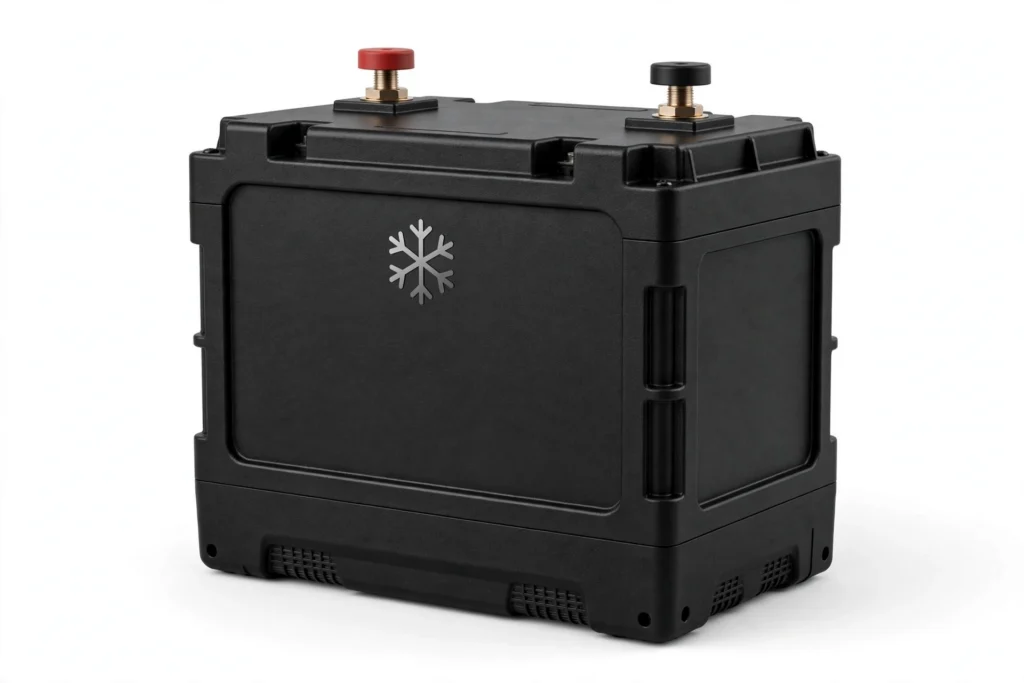
- Self-heating option — for RV, cabin and outdoor installations, a heated battery (see the 12V 100Ah heated LiFePO4 battery) warms the cells before accepting charge. Confirm the heating trigger temperature and power draw per model.
- Enclosure and siting — for fixed ESS, confirm the specified operating range against where the battery will actually sit (unheated outbuilding vs. conditioned space) and whether insulation or a heated enclosure is part of the quote.
None of these are marketing points; they are line items on the specification sheet. If a supplier cannot state them per model, the quote is not yet comparable — whatever the price.
Certification and Import: Confirm Per Model, Before Shipment
Electrical products sold and installed in Canada need recognised approval — CSA or cULus marks are the common routes — but approval attaches to a specific model, not to a chemistry or a brand. Our standing rule: the certification status of the exact model you are ordering is confirmed in writing before shipment, and no blanket “certified” claim is made for a range. Transport and import have their own layer: lithium batteries move as dangerous goods (UN38.3 test summary, TDG rules in Canada), MFN duty on tariff item 8507.60.90 is 7%, and GST/HST applies on import. Each of those is covered in depth — with the document checklist — in the Canada import duty & compliance guide; use it as the pre-shipment checklist alongside this page.
How to Compare Quotes in CAD and USD
Quotes from China are normally issued in USD (EXW or FOB), while your selling price sits in CAD — so two quotes are only comparable after the same conversion work. A five-point method:
- Same usable capacity — compare cost per usable kWh at the stated depth of discharge, not per nameplate Ah.
- Same delivery basis — an EXW price and a DDP-to-your-door price differ by ocean freight, the 7% duty, GST/HST treatment and brokerage; normalise before comparing.
- Cold-climate items included? — heating function, low-temperature BMS protection and matched charger in or out of the price.
- Certification documents for the exact model — requested and received before deposit, not promised after.
- Warranty terms in writing — years, capacity-retention threshold, and who handles a claim from Canada.
How Sourcing with LJY Energy Works
LJY Energy is a China-based LiFePO4 battery supplier and sourcing partner working with qualified manufacturing partners — we coordinate specification, production and export; we do not ask you to take factory claims on faith. The workflow for Canadian buyers: send your requirement (application, voltage platform, capacity, quantity, destination) via the contact form; we confirm the written specification — including low-temperature behaviour and the certification status of the exact model — before quotation; production runs through our manufacturing partners with checkpoints agreed per order; export documentation (UN38.3 test summary, packing and shipping documents) is prepared for your broker. For larger storage projects, the BESS RFQ checklist shows the fields a complete quote request should carry. Distributors and OEM buyers can ask about private-label and custom pack configurations on the same thread.
Frequently Asked Questions
Can a LiFePO4 battery be used through a Canadian winter?
Yes, with the right specification. Discharge in deep cold is generally workable within the cell’s rated range; the hard limit is charging below 0 °C, which requires a BMS low-temperature cut-off or a self-heating model. Confirm both numbers for the exact model before ordering — that confirmation is part of our written specification step.
Are your batteries CSA or UL certified for Canada?
Approval is model-specific. For the exact model you order, we confirm its certification status (for example CSA, cULus or the applicable test reports) in writing before shipment; where a model does not carry the approval your installation requires, we say so before you commit rather than after. The compliance guide explains the approval landscape in detail.
Do you quote in CAD or USD?
Quotations are issued in USD. Use the five-point comparison above to convert any quote — ours or a competitor’s — into a landed CAD cost per usable kWh before deciding; we are happy to walk through the duty and tax lines with your broker using the compliance guide.
What quantities can Canadian distributors start with?
It depends on the series: sample and small trial orders are the normal starting pattern for 12V and golf lines (one documented Canadian buyer began with 4 sample units for an RV conversion prototype), while ESS and OEM pack projects are quoted per project specification. State your target quantity in the inquiry and the quotation will be built on it — no catalogue MOQ is invented here.
Share This Article