
Product Overview
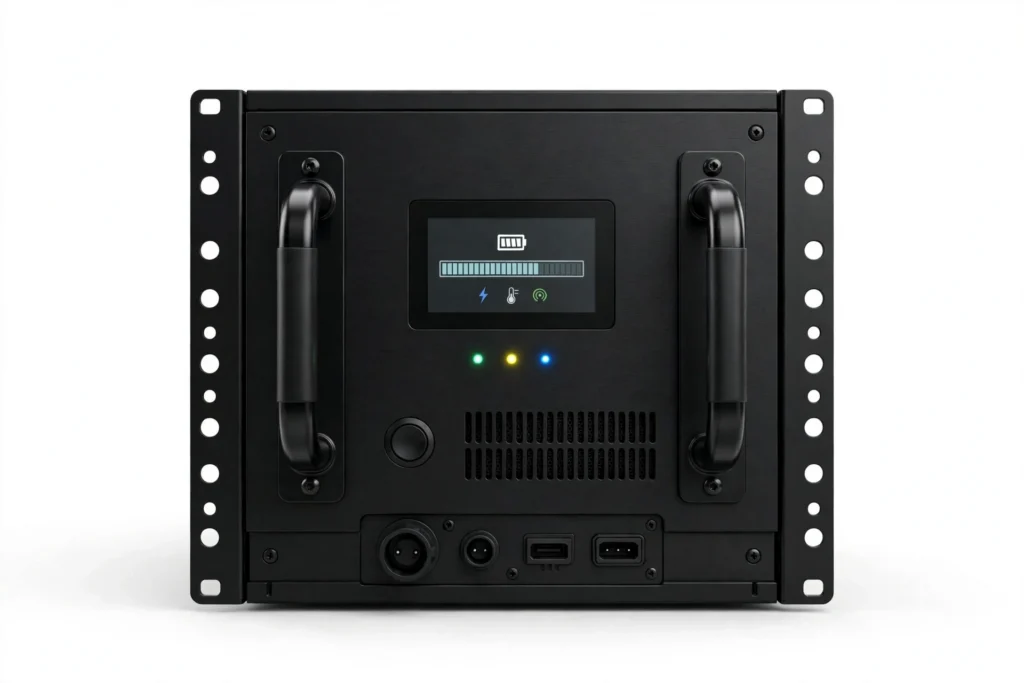
The 51.2V rack mount LiFePO4 battery fits standard 19-inch server racks, providing modular energy storage for residential and commercial solar systems. Available in 100Ah (5.12kWh) and 200Ah (10.24kWh) configurations, multiple units stack in parallel for scalable capacity.
- Standard 19-inch rack — 3U/4U form factor, easy installation
- 5.12kWh to 10.24kWh — per module; parallel configuration confirmed per project
- Built-in BMS — CAN/RS485 communication for inverter integration
- Scalable — start small, expand as needs grow
For wall-mount alternatives, see our 51.2V 200Ah wall-mounted battery and 51.2V 280Ah model.
Technical Specifications
| Group | Parameter | Value | Status |
|---|---|---|---|
| Electrical | Nominal voltage | 51.2V (16S) | Typical |
| Electrical | Capacity options | 100Ah / 200Ah | Typical |
| Electrical | Energy | 5.12kWh / 10.24kWh | Typical |
| BMS | Communication | CAN / RS485 | Typical |
| BMS | Continuous discharge | 100A | Typical |
| Physical | Form factor | 19-inch rack, 3U/4U | Typical |
| Durability | Cycle life | 6000+ cycles | Typical |
Values above are the typical configurations for this series. Final specifications — including communication protocol variant, enclosure details, and certifications for your market — are confirmed per project in the formal quotation.
Full Specifications — 51.2V 100Ah Server-Rack Module (standard buildable configuration)
The table below lists the standard buildable configuration for this series, compiled from industry-typical values for this module class. Final values are written into the project specification and confirmed in the formal quotation.
| Group | Parameter | Standard configuration |
|---|---|---|
| Electrical | Cell configuration | 16S1P, 3.2V LiFePO4 prismatic |
| Electrical | Nominal voltage / capacity / energy | 51.2V / 100Ah / 5.12kWh (200Ah = 10.24kWh on request) |
| Electrical | Operating voltage range | 44.8–57.6V typical (BMS-set) |
| Electrical | Recommended charge voltage | 55.2–56.8V (max 58.4V) |
| Electrical | Discharge cut-off | 44.8–47V typical |
| Electrical | Continuous charge / discharge | 50A recommended / 100A max continuous |
| Electrical | Peak discharge | ~120–150A for 1–3 s; short-circuit trip <1 ms |
| BMS | Protections | Cell over-voltage (~3.65–3.8V), cell under-voltage (~2.3–2.5V), over-current (charge/discharge), short circuit, charge/discharge over/under-temperature, MOS over-temperature |
| BMS | Balancing | Passive, typ. ~100–120mA, starts at >30–40mV cell delta |
| BMS | Communication | CAN + RS485 (inverter), RS232 (PC); optional Bluetooth/Wi-Fi |
| BMS | Parallel | Up to 15–16 modules standard (DIP addressing); larger banks via master/hub on request |
| BMS | Inverter protocols | Profiles for common inverters, confirmed per exact model and firmware (see compatibility section below) |
| Mechanical | Form factor | 19-inch rack, 3U (100Ah) / 4U (200Ah) |
| Mechanical | Dimensions (W×D×H) | approx. 442–483 × 460–540 × 136–175 mm |
| Mechanical | Weight | approx. 43–50 kg |
| Mechanical | Terminals | Front-panel quick connectors / M8; breaker or switch on front panel |
| Mechanical | Display | SOC LED bar + run/alarm LEDs; LCD optional |
| Thermal | Charge temperature | 0–50 °C |
| Thermal | Discharge temperature | −20–55 °C |
| Thermal | Storage | 0–35 °C recommended (long term) |
| Thermal | Low-temperature charging | Charge cut-off below 0 °C standard; self-heating option on request |
| Life | Cycle life (with conditions) | ≥6,000 cycles @ 80% DoD, 0.5C, 25 °C, to 70–80% EOL (market-typical) |
| Life | Design life | 10–15 years (market-typical) |
| Protection | Ingress rating | IP20 (indoor rack) |
| Shipping | Transport class | UN3480, Class 9 (dangerous goods) |
| OEM | Other configurations on request | 100/200/280/314Ah, 2U/3U/4U, panel colour, logo, protocol, cabling |
Certificates: UN38.3, MSDS/SDS, IEC 62619, IEC 62133, UL 1973, UL 9540A, CE/EMC, RoHS and others — arranged per project; certification and testing fees borne by the buyer.
Commercial: MOQ, lead time, price and warranty: by quotation.
For distributors & importers: 51.2V 100Ah server-rack module (5.12kWh)
LJY Energy is a China-based LiFePO4 battery supplier and OEM/ODM coordinator. Production is carried out by partner manufacturers; we match the build to your market, confirm the specification in writing and coordinate quality checks and export.
What we coordinate for each order
- Configuration: cell option, BMS rating and communication (Bluetooth / CAN / RS485 where the system needs it), enclosure and terminals, confirmed in the datasheet issued with your quotation.
- Private label: logo, case colour, rating labels, manuals and carton print for your brand.
- Quality control: pre-shipment inspection items (visual, voltage/IR consistency, BMS function, labelling) agreed per order; third-party inspection can be arranged at the buyer's request.
- Export documents: UN38.3 test summary, SDS/MSDS and dangerous-goods (UN3480, Class 9) shipping paperwork for the exact model shipped, coordinated per order.
Commercial terms and certificates
- MOQ, price, lead time and warranty: confirmed per order in the quotation. No public list price.
- How orders usually run: sample or trial order → pilot order with your labels and documents → repeat orders on a locked specification.
- Market certificates (which ones depends on the destination market and application): available/arranged per project; certification and testing fees are borne by the buyer. We tell you which source holds each report before you order.
Before the first order, read the wholesale & distributor program, the MOQ & sample order guide and our supplier verification checklist. Related: Stackable home energy storage, Inverter–battery compatibility checker.
Request a distributor quote for the 51.2V 100Ah server-rack module (5.12kWh). Send your market, quantity band, private-label needs and the inverter/charger or application.
Distributor FAQ
Who supplies and who manufactures the 5.12kWh server-rack LiFePO4 module?
LJY Energy supplies it as a China-based supplier and OEM/ODM coordinator; partner manufacturers build the modules. We confirm the cell, BMS and inverter protocol in the project datasheet, arrange pre-shipment inspection and coordinate export documents.
What is a 5.12kWh rack battery used for?
Typically low-voltage (48V-class) hybrid or off-grid solar inverters in homes and small businesses, backup power, and telecom or equipment cabinets with 19-inch racks. Modules are paralleled to reach 10–30kWh+ banks; the maximum count is set by the BMS and inverter pairing and confirmed per project.
Can a distributor stock one rack module for several inverter brands?
Usually one hardware module with the CAN/RS485 protocol set per inverter family. Tell us the inverter brands you sell; we confirm protocol, firmware and DIP settings per project so reorders ship with the same configuration on file.
Choosing Between the 100Ah and 200Ah Modules
Both modules share the same 51.2V (16S) platform, the same rack standard, and the same BMS communication options. The choice is about energy per rack unit and how the system will grow:
- 100Ah / 5.12kWh (3U class): the finer building block. Suits smaller residential systems, staged expansions, and projects where capacity is added one step at a time. As an example, a bank of sixteen 100Ah modules totals about 81.9kWh; the module count for each bank is confirmed per project.
- 200Ah / 10.24kWh (4U class): twice the energy per module and per rack position. Suits commercial systems and larger homes where fewer, bigger modules simplify wiring and installation. A bank of sixteen 200Ah modules totals about 163.8kWh on the same basis.
- Keep one module type per bank: parallel banks work best with identical modules of the same capacity and age. If a project may grow later, choose the module size you will still be buying in two years — that is what makes this series a repeat-purchase platform rather than a one-off SKU.
Inverter Communication and Parallel Operation
A rack battery earns its place in a system through its BMS communication. The built-in BMS offers CAN and RS485, the two interfaces hybrid and off-grid inverters use to read state of charge, set charge limits, and coordinate protection. Protocol details vary by inverter brand and firmware, so the protocol variant is matched to your inverter model before production — send us the inverter make and model with your enquiry. For how inverter–BMS communication works and what to check, see our guide on how to choose the right BMS for LiFePO4 batteries.
In parallel operation, modules share load and charge current across the bank. Size the bank so that the combined continuous discharge (100A per module) covers the inverter’s peak draw with headroom, and confirm the total with us against your inverter’s surge specification.
Inverter Compatibility Confirmation: How We Lock the Configuration Before Production
A rack battery does not become compatible with an inverter because a datasheet lists a logo. Compatibility is the combination of the exact inverter model, its firmware, the communication protocol profile, and the BMS configuration — and it is specific to that combination. We do not claim official compatibility certification by any inverter brand. Instead, every project goes through the confirmation process below, and the agreed configuration is recorded in writing before production, so repeat orders ship with the same setup.
The Confirmation Process
- Send the inverter details. Brand, exact model, firmware version if known, and how many battery modules will run in parallel.
- Interface and protocol check. We confirm the physical interface (CAN or RS485) and the protocol profile your inverter expects for state of charge, charge and discharge limits, and alarm reporting.
- BMS configuration. The BMS protocol profile and firmware version are set to the confirmed inverter configuration, and both are stated on the order confirmation.
- Pilot module first. For a first order with a new inverter pairing, we recommend starting with a single pilot module: verify charging, discharging, SOC reporting and alarm behaviour on your actual inverter before the balance of the order ships.
- Configuration locked for repeat orders. The confirmed pairing — inverter model, protocol profile, BMS firmware version — becomes the project specification, so expansion and repeat orders match the installed bank.
| Confirmation Item | What Is Confirmed | Status |
|---|---|---|
| Inverter brand & model | Deye, Victron, Growatt, SMA, Sol-Ark and others — confirmed per exact model and firmware, never per brand alone | Confirm before ordering |
| Communication interface | CAN or RS485; cable and pinout as required by the inverter | Confirmed per project |
| Protocol profile | SOC reporting, charge/discharge current limits, alarm and fault behaviour | Confirmed per project |
| BMS firmware version | Version matched to the confirmed protocol profile and recorded on the order documents | Recorded per order |
| Parallel configuration | Module count (100A continuous per module); same model, protocol and firmware across the bank; inverter-side parallel limits also apply | Confirm before ordering |
| Charge & discharge limits | Set by the inverter within the battery’s confirmed limits | Confirmed per project |
Parallel Expansion and Consistency
Modules added later should match the installed bank: same model, same protocol profile, same BMS firmware version. When you expand a system, quote your original order reference so the additional modules are configured identically. Mixing firmware versions or protocol profiles inside one bank is a common cause of communication faults, and it is avoidable at the ordering stage.
After-Sales, Spares and Fault Handling
Spare BMS units and communication cables can be included in the project order — confirm the spares list when the configuration is locked, not after the first fault. When a fault occurs, diagnosis starts with the BMS alarm information and the inverter’s event log; we review both with you to isolate whether the cause sits on the battery side, the inverter side, or in the settings. Replacement parts handling and warranty terms are as stated in your project agreement. To start a compatibility confirmation, send us your inverter model with the number of modules you plan to run.
Inverter-Specific Points We Confirm
The confirmation above is not generic — each inverter family has its own protocol expectations. These are the specific points checked for the brands installers ask us about most. Being named here means only that we confirm the pairing per project; LJY is not on any inverter maker’s approved-battery list, and we do not claim to be.
| Inverter | Protocol & Setting Confirmed | Note |
|---|---|---|
| Victron (GX systems) | BMS-Can communication; CVL / CCL / DCL limit support | Confirm before ordering |
| Deye / Sunsynk | CAN; the lithium mode number assigned to the battery profile | Confirm before ordering |
| Growatt (SPF / SPH) | CAN: L51 (Growatt protocol) or L52 (Pylontech-compatible), depending on the BMS protocol and confirmed per project; or RS485; model-specific minimum firmware | Confirm before ordering |
| Sol-Ark, SMA, others | CAN / RS485 protocol profile for the exact model; SMA Sunny Island supports only batteries on SMA’s own approved list (per model, firmware and use case) | Confirm before ordering |
With your inquiry, send: inverter model and its firmware version, system size (kWh) and module count, any planned expansion, on-grid or off-grid use, and the destination country (grid code and import rules differ). Installers ordering repeatedly can keep the confirmed pairing on file with us, so every site ships the same configuration.
Applications
- Residential solar energy storage
- Small commercial backup power
- Telecom base stations
- Off-grid hybrid systems
Ideal For
- Solar installers: a standard 19-inch module that drops into existing rack cabinets, with two capacity points covering most residential and small-commercial jobs.
- Distributors and wholesalers: one platform, two SKUs, parallel expansion — a stockable series your installer customers can reorder as their projects grow.
- System integrators: CAN/RS485 communication and per-project protocol matching for inverter brands you already deploy.
Wholesale, OEM & ODM
Rack batteries customizable for voltage, capacity, and communication protocols. Contact us for volume pricing.
Beyond the standard modules, OEM/ODM options coordinated per project include enclosure and front-panel branding, labeling and packaging for your brand, communication protocol configuration for specific inverter families, and capacity or form-factor adjustments within the 51.2V platform. Wholesale supply is structured for repeat ordering: distributors typically standardize on one module size per market, keep the matching communication configuration on file with us, and reorder the same specification as installations scale.
Frequently Asked Questions
Does this battery fit a standard server rack cabinet?
Yes. The modules follow the standard 19-inch rack format in 3U/4U heights, so they mount in standard server and battery cabinets. Confirm your cabinet’s usable depth with us when ordering.
How many modules can I connect in parallel?
Parallel configuration depends on the project: module count, BMS setup and inverter communication are confirmed before production. For scale reference, sixteen 100Ah modules total about 81.9kWh and sixteen 200Ah modules about 163.8kWh. Use identical modules within one bank.
Will it communicate with my inverter?
The BMS supports CAN and RS485. Protocol variants differ by inverter brand, so we match the configuration to your inverter model before production. Send the inverter make and model with your enquiry for a compatibility check.
What is the difference between the rack-mount and wall-mounted versions?
Same 51.2V platform and similar capacities, different installation format: rack modules suit cabinets and battery rooms; wall-mounted units suit homes where floor and rack space are limited. See the 51.2V 200Ah wall-mounted battery for the alternative format.
Related Technical Guides
Planning a rack-mount storage installation? These guides cover costs, technology, and system design:
- How Much Does a 10kWh LiFePO4 Battery System Cost? — TCO analysis for storage projects
- Why Tesla Megapack Uses LFP Batteries — the chemistry behind grid-scale storage
- How to Choose the Right BMS for LiFePO4 Batteries — ensure inverter compatibility
Where This Battery Is Used
This rack-mounted pack is a standard building block in our Home Energy Storage Solutions and Solar Energy Storage Solutions. Send us your inverter model, target capacity and backup loads for a rack configuration check.
Can we test the rack module on our inverter before a volume order?
Yes. Sample evaluation before a volume order can be arranged; the sample configuration, cost and shipping method are confirmed in writing per project. Test it on the exact inverter model and firmware you will sell, with the project communication cable.
Which documents should we request for the rack module?
Ask for the specification sheet, the communication protocol and cable pin-out for your inverter, the UN38.3 test summary, the SDS/MSDS, and any test reports or certificates required in your market, plus the dangerous-goods shipping documents. Which documents exist for the exact model and destination is confirmed before you commit.
Is the rack module certified for our market?
Certification and testing are available or arranged per project for the exact model, configuration and target market; certification and testing fees are borne by the buyer. No certificate is assumed to cover a model until the document for that exact model has been confirmed in writing.
Can the rack module carry our brand?
Logo, label and packaging can be specified per project for private-label supply; the details are fixed in the project specification.
How are rack battery modules shipped?
LiFePO4 batteries ship as dangerous goods: UN3480, Class 9 (UN3481 when packed with or contained in equipment). The shipment needs a UN38.3 test summary, an SDS/MSDS, DG-compliant packaging and labels, and a dangerous-goods declaration; the route and forwarder are confirmed per order.