
Share This Article
Nepal is a small inquiry market in our records — 29 Nepalese buyers on file, every one of them with a stated product need, 24 rated as serious A/B-grade inquiries — but it has the clearest signature of any market we serve: electric three-wheelers first. Kathmandu’s Safa tempos have run on batteries since the 1990s, Terai e-rickshaws are a working fleet, and behind them sits steady demand for 48V telecom backup and 12V solar home batteries. This page covers what Nepalese dealers, fleet operators, energy companies and installers actually ask us for, and how to qualify a conversion or a shipment before money moves. Research date: November 2026.
Why Nepal Buys LiFePO4 Batteries
The macro picture explains the inquiry mix — it does not by itself prove any single model, which is why the next section works from documented inquiries. First, Nepal electrified the three-wheeler before almost anyone: battery-powered Safa tempos have carried passengers in the Kathmandu Valley since the mid-1990s, a fleet of roughly 700 vehicles that historically ran on 72V deep-cycle lead-acid sets (Nepali Times; UNESCAP / Department of Transport Management). Those sets wear out on a two-to-three-year rhythm, and operators have been converting vehicles to lithium — so traction-battery replacement is a standing, recurring purchase, not a new market being invented. Second, the grid story changed, but backup did not disappear: the Nepal Electricity Authority declared the country free of scheduled load shedding — households from 2017, industry from May 2018 — yet the system is hydro-dominated, run-of-river output falls sharply in the dry season, and industrial peak-hour cuts have been reported again in dry-season months (December 2024, New Business Age). Telecom operators, hospitals and banks therefore still buy backup on uptime requirements, not on habit. Third, solar home systems and small storage remain the rural and peri-urban default where grid reach or reliability is thin, which keeps 12V and small ESS inquiries constant year-round.
What Nepalese Buyers Actually Order
The table below is drawn from real inquiries received from Nepalese buyers in our CRM records. Treat each line as a documented demand pattern — one inquiry is one signal, not a market standard — and note that specifications, pricing and lead time are always confirmed per project.
| Segment | Documented requests from Nepalese buyers | Who asks |
|---|---|---|
| Three-wheeler traction | A buyer active in Nepal’s EV sector, who leads an electric-vehicle industry association, describing a fleet of around 700 passenger three-wheelers running 72V 235Ah lead-acid batteries (Trojan T-125, in the buyer’s own words) and asking for a LiFePO4 alternative; 48V 100Ah and 80Ah tricycle packs were specified and quoted in the same follow-up | Fleet operators, EV associations, three-wheeler dealers |
| Telecom & institutional backup | An energy-management company requesting 48V LiFePO4 packs from 50Ah to 200Ah for telecom backup — naming telecom operators, hospitals and banks as end users — and for electric tricycles and light EVs; a separate base-station inquiry covering 48V 50Ah and 48V 100Ah | Energy service companies, telecom suppliers |
| 72V EV & storage packs | A 72V 50Ah energy-storage and electric-van pack inquiry from an ESS integrator | ESS integrators, EV converters |
| 12V solar & home backup | A full-range 12V inquiry listing 20Ah through 300Ah; repeated 12V inquiries combined with home energy storage from solar installers | Solar dealers, installers, retailers |
| Cells & assembly | Cell inquiries tied to solar and storage projects, including a 48V inquiry specifying cells alongside packs and storage | Assemblers, integrators |
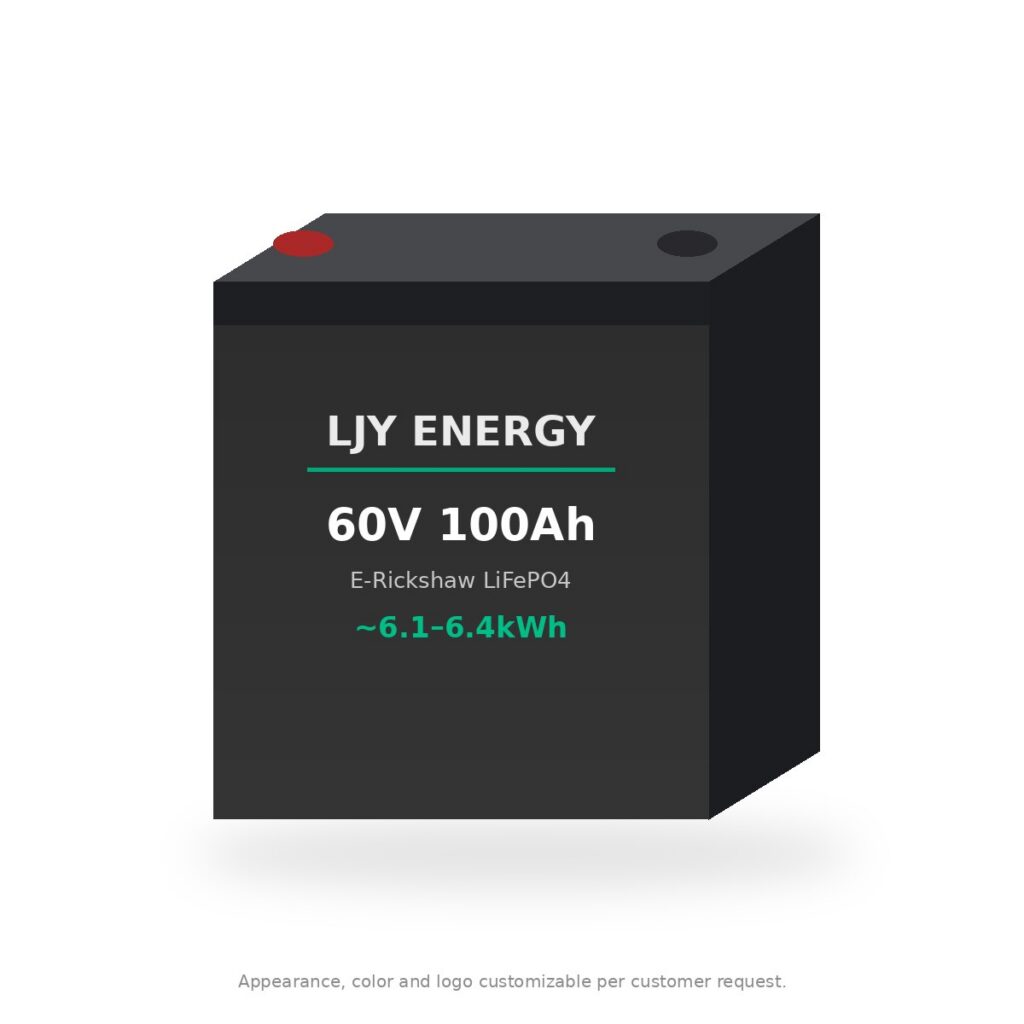
The matching standard series: the 48V e-rickshaw battery range and 48V/60V e-rickshaw packs for traction, the 48V 50Ah telecom battery and telecom backup range for base stations and institutional backup, 12V deep-cycle for solar home and backup, the solar storage range, 48V pack series and LiFePO4 cells for wholesale for assemblers. Product pages carry the specifications; this page carries the Nepal buying context.
E-Rickshaw and Safa Tempo Conversions: Confirm the Platform Before You Price
Most three-wheeler battery inquiries fail or succeed on three confirmations, not on cell brand:
- Voltage platform first — the legacy Kathmandu tempo fleet is a 72V system, while many Terai e-rickshaws run 48V or 60V. A 48V quotation for a 72V vehicle is a failed conversion, however good the price looks. Confirm the motor and controller voltage window of the exact vehicle, and quote the platform the vehicle actually runs — 48V, 60V or 72V packs are each confirmed per project.
- Duty cycle, not nameplate Ah — passenger three-wheelers historically worked two lead-acid sets in rotation, one driving and one on charge, because a single set could not cover a full day. A lithium pack is priced against that reality: state the daily kilometres, payload and charging window, then compare cost per kilometre over the pack’s cycle life against the lead-acid set it replaces — including how often the lead-acid set would have been replaced in the same period.
- Fit and environment in writing — under-seat and floor battery-box dimensions, connector and charger match, and water and dust exposure through the monsoon. Enclosure and protection ratings are confirmed per model on the specification sheet, not assumed from a headline.
Nepal’s inquiry records make the same point from the buyer’s side: the fleet inquiry above started from a working 72V lead-acid installation and asked what replaces it — the conversion question — not from a catalogue. Send the vehicle’s existing battery specification (voltage, Ah, box dimensions, charger) with your inquiry and the quotation answers the conversion you actually have.
Standards, Import Routes and Pre-Shipment Confirmation
Nepal is landlocked, so route is part of the quotation. Shipments from China commonly move either overland through the Rasuwagadhi–Kerung border crossing or by sea to Kolkata with onward transit through India; the two routes differ in transit time, handling and cost, and the route is confirmed per order rather than assumed. On standards: whether Nepal Bureau of Standards & Metrology (NBSM) certification or other documentation applies depends on the product category and the exact model — confirm the documentation set for your import with your customs broker and with us in writing before shipment; no blanket certification claim is made for a range. Lithium batteries move as dangerous goods with a UN38.3 test summary, and duty and VAT treatment are confirmed with your broker. For the general import workflow, see how to import LiFePO4 batteries from China. The checklist discipline: per-model documents, UN38.3 summary, packing and shipping documents agreed before the deposit, not promised after it.
How to Compare Quotes Landed in Nepal
Quotes from China are normally issued in USD, while your selling price sits in NPR and your freight route is longer than most — so two quotes are only comparable after the same conversion work. A five-point method:
- Same usable capacity — compare cost per usable kWh at the stated depth of discharge, not per nameplate Ah; for traction packs, extend that to cost per kilometre over warranted cycle life.
- Same delivery basis — an EXW price, a price delivered to the Kerung border and a price delivered to Kathmandu differ by overland freight, transit handling and brokerage; normalise before comparing.
- Conversion items included? — matched charger, connectors and the BMS specification your controller needs, in or out of the price.
- Documents for the exact model — requested and received before deposit, not promised after.
- Warranty terms in writing — years, capacity-retention threshold, and who handles a claim from Nepal.
How Sourcing with LJY Energy Works
LJY Energy is a China-based LiFePO4 battery supplier and sourcing partner working with qualified manufacturing partners — we coordinate specification, production and export; we do not ask you to take factory claims on faith. The workflow for Nepalese buyers: send your requirement (application, voltage platform, capacity, quantity, destination and delivery route) via the contact form; we confirm the written specification — including the documentation status of the exact model — before quotation; production runs through our manufacturing partners with checkpoints agreed per order; export documentation (UN38.3 test summary, packing and shipping documents) is prepared for your broker. For larger storage projects, the RFQ checklist shows the fields a complete quote request should carry. Dealers and assemblers can ask about custom pack configurations and cell supply on the same thread. Buyers comparing the wider South Asia picture can also read our India supplier page — a separate market with its own import rules. Three-wheeler buyers comparing across the region can also see how the same conversion questions are handled in Bangladesh, where e-rickshaws and mishuks cycle against daily load shedding.
Frequently Asked Questions
What voltage do Kathmandu Safa tempos run on?
The legacy tempo fleet was built on 72V deep-cycle lead-acid sets, and the fleet inquiry in our records describes exactly that platform — 72V 235Ah. Terai e-rickshaws more commonly run 48V or 60V. There is no single “Nepal voltage”: confirm the platform of the exact vehicle before ordering, and the pack — 48V, 60V or 72V — is specified to match it per project.
Can a LiFePO4 pack replace lead-acid in an e-rickshaw directly?
Only after three checks: the controller’s voltage window matches the pack, the pack fits the existing battery box, and the charger is LiFePO4-compatible or replaced in the same order. Where those three are confirmed in writing, a lithium pack removes the two-set rotation that lead-acid duty required; where they are not confirmed, the honest answer is to fix the mismatch first rather than ship and discover it.
If load shedding has ended, why do Nepalese buyers still purchase backup batteries?
Because the remaining demand is reliability, not darkness: dry-season hydro output falls, industrial peak cuts have recurred, and telecom base stations, hospitals and banks buy to an uptime requirement. Solar self-consumption adds a second driver. Size the backup to the load and the autonomy hours you actually need — the documented inquiries run from 48V 50Ah base-station units upward.
How are batteries shipped to Nepal, and what quantities can dealers start with?
Two working routes: overland from China via the Rasuwagadhi–Kerung crossing, or sea freight to Kolkata with transit through India; the route is chosen per order on time and cost. Starting quantities depend on the series — single-unit and small trial orders are the normal starting pattern for 12V and e-rickshaw packs in our Nepal records, while fleet conversions and storage projects are quoted per project specification. State your target quantity and route in the inquiry; no catalogue MOQ is invented here.
Share This Article