
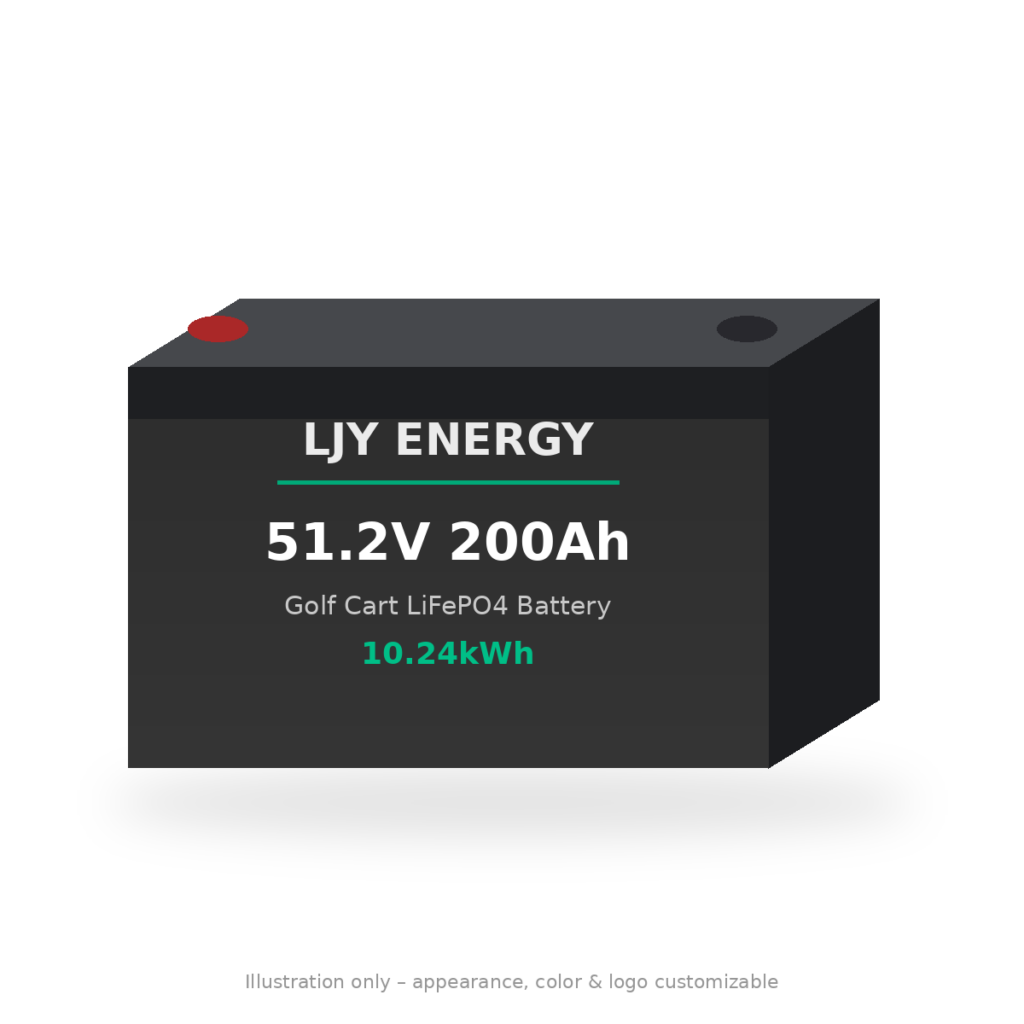
48V 200Ah Golf Cart Lithium Battery (51.2V LiFePO4)
Product Overview
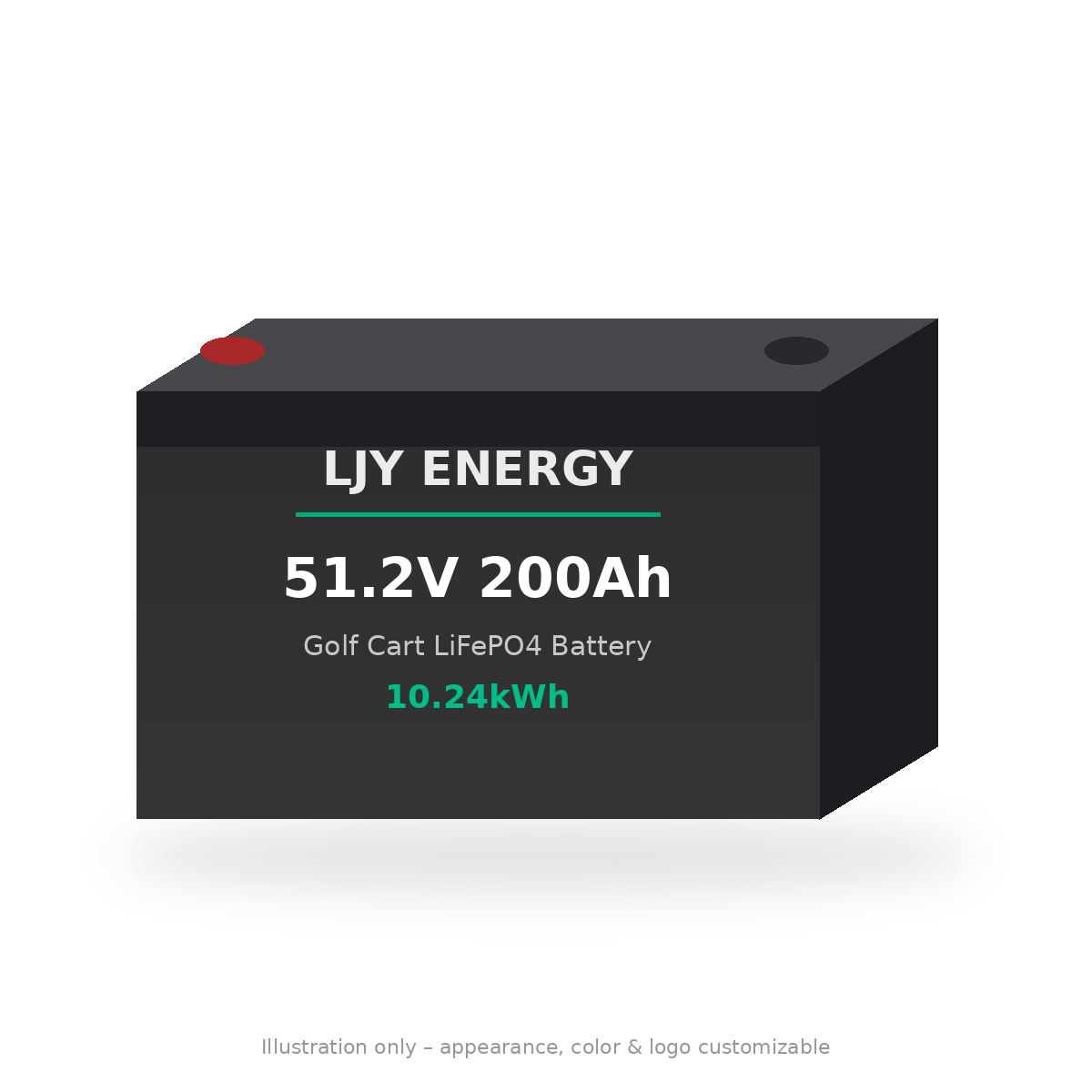
A 10.24kWh LiFePO4 traction battery (48V class, 51.2V nominal, 16S, 200Ah) for 48V golf carts, low-speed vehicles (LSVs), utility and hunting vehicles that need extended range. It replaces a 48V lead-acid set (e.g. 6×8V or 4×12V) with one managed pack.
It is the long-range step above our 48V 150Ah and 48V 100Ah golf cart batteries. LJY Energy supports cell option, BMS rating, controller communication, enclosure and kit contents for dealers, fleets and cart makers.
WhatsApp: +1 404 784 1946 (backup: +86 159 8945 0735)
Specifications
Status key: [Industry reference] = the base definition of this model class or an arithmetic value, not an LJY test result. [Optional configuration] = available by OEM/ODM project. [Confirmed per project] = fixed only in the datasheet issued with your quotation (cell option, BMS rating, dimensions, weight, terminals, documents). We do not publish unverified values — request the datasheet.
| Group | Parameter | Value | Status |
|---|---|---|---|
| Cell & chemistry | Battery chemistry | LiFePO4 (lithium iron phosphate) | [Industry reference] |
| Electrical | Nominal voltage | 48V class — 51.2V (16S) | [Industry reference] |
| Electrical | Rated capacity | 200Ah | [Industry reference] |
| Electrical | Energy | 10.24kWh | [Industry reference] |
| Electrical | Charge voltage | 56.8–58.4V | [Industry reference] |
| Electrical | Discharge cut-off voltage | Confirmed per project (datasheet issued with quotation) | [Confirmed per project] |
| Electrical | Continuous discharge current | Confirmed per project (datasheet issued with quotation) | [Confirmed per project] |
| Electrical | Peak discharge current | Confirmed per project (datasheet issued with quotation) | [Confirmed per project] |
| Cell & chemistry | Cell type | Confirmed per project (datasheet issued with quotation) | [Confirmed per project] |
| Mechanical | Dimensions (L×W×H) | Confirmed per project (datasheet issued with quotation) | [Confirmed per project] |
| Mechanical | Weight | Confirmed per project (datasheet issued with quotation) | [Confirmed per project] |
| Mechanical | Terminals | Confirmed per project (datasheet issued with quotation) | [Confirmed per project] |
| BMS & protection | Built-in BMS | Over-charge / over-discharge / over-current / short-circuit / temperature protection, balancing | [Industry reference] |
| Optional configuration | Bluetooth app / SOC meter | Dash-mount SOC meter or app monitoring | [Optional configuration] |
| Optional configuration | CAN / RS485 communication | For controller or charger integration (protocol confirmed per project) | [Optional configuration] |
| Optional configuration | Charger | 48V LiFePO4 charger, current per order | [Optional configuration] |
| Optional configuration | Low-temperature protection / self-heating | For cold-climate fleets | [Optional configuration] |
| Optional configuration | Installation kit | Brackets, cables, DC-DC converter for 12V accessories | [Optional configuration] |
| Optional configuration | Enclosure / branding | Tray-specific case, logo, labels, packaging | [Optional configuration] |
| Commercial & documents | Certifications / test documents | Per order and target market | [Confirmed per project] |
| Commercial & documents | Warranty terms | Per order agreement | [Confirmed per project] |
| Commercial & documents | Lead time | Per order quantity and configuration | [Confirmed per project] |
| Commercial & documents | Pricing | Quoted per inquiry | [Confirmed per project] |
BMS, Communication & Protection
Every pack uses a built-in battery management system with over-charge, over-discharge, over-current, short-circuit and temperature protection plus cell balancing. The BMS current rating sets what the battery can actually deliver, so it should be chosen from the load — not from the capacity. The guide below is general engineering guidance; the BMS rating offered for your order is confirmed in the quotation.
BMS sizing guide
| Load / use case | Suggested BMS rating |
|---|---|
| Standard 2–4 seat carts on flat courses | 150A BMS |
| 4–6 seat carts, lifted carts, hilly terrain | 200A BMS |
| High-speed motor/controller upgrades (e.g. 400A+ controllers) | 250A BMS — confirm controller peak current |
| Fleet with mixed controllers | Specify the controller model in the inquiry |
Match the BMS to the motor controller, not to the battery capacity: the controller peak current must stay within the BMS peak rating or the pack will cut out on hills or acceleration. Popular cart platforms differ in controller ratings, so tell us the cart model and controller.
Size & Fitment
There is no universal golf cart tray. Common lithium formats include a long single pack for the lead-acid tray, or compact packs with spacer brackets. Send the tray measurements (L×W×H) and cart make/model — we match an enclosure or bracket kit.
Most 48V lead-acid carts need a 48V–12V DC-DC converter for lights and accessories after conversion; it can be included in the kit.
48V golf cart series, cart fitment & RFQ fields
Dealers, fleet operators and cart brands usually stock a 48V lithium range rather than one capacity. Public catalog ranges in this product class commonly run from about 100–105Ah through 150–168Ah to 200–230Ah at 51.2V. LJY quotes capacity, BMS current, tray format and accessories per project, so one OEM/ODM platform can cover a dealer’s whole 48V line-up.
| Capacity | Nominal energy (arithmetic) | Typical use class (guide only) | Page |
|---|---|---|---|
| 100Ah | 51.2V × 100Ah = 5,120Wh (5.12kWh) | 2–4 seat carts, flat courses, shorter daily routes | 48V 100Ah golf cart battery |
| 105Ah | 51.2V × 105Ah = 5,376Wh (5.38kWh) | Common lead-acid-tray replacement class for course fleets | 48V 105Ah golf cart battery |
| 150Ah | 51.2V × 150Ah = 7,680Wh (7.68kWh) | 4–6 seat carts, hilly courses, longer routes | 48V 150Ah golf cart battery |
| 200Ah | 51.2V × 200Ah = 10,240Wh (10.24kWh) | Lifted / long-range carts, LSVs, utility and resort vehicles | You are here |
Other voltages: 36V 200Ah golf cart battery · 72V golf cart battery · golf cart battery series · golf cart battery solutions.
Cart fitment & configuration fields
Status classes: [Industry reference] = arithmetic or a norm for this product class, not an LJY test result. [Optional configuration] = available by OEM/ODM project. [Confirmed per project] = fixed only in the datasheet issued with your quotation.
| Group | Parameter | Value | Status |
|---|---|---|---|
| Electrical | Nominal voltage | 16S LiFePO4: 16 × 3.2V = 51.2V nominal (the lithium replacement for 48V lead-acid carts) | [Industry reference] — arithmetic |
| Electrical | Maximum charge voltage | 16 × 3.65V = 58.4V maximum; absorb / float settings follow the charger profile agreed for the cart | [Industry reference] · [Confirmed per project] |
| Energy | Nominal energy | 51.2V × 200Ah = 10,240Wh (10.24kWh) | [Industry reference] — arithmetic |
| Energy | Usable energy at an example DoD | At 90% DoD ≈ 9.22kWh; at 80% DoD ≈ 8.19kWh. Example only — the real limit is set by the BMS cut-off; no range figure is claimed | [Industry reference] · [Confirmed per project] |
| Controller | Continuous / peak discharge current | Sized to the motor controller: send the controller model and its continuous and peak amp rating. The BMS rating is stated in the quotation | [Confirmed per project] |
| Controller | Regenerative braking (charge acceptance) | AC-drive carts push regen current back into the pack; the BMS charge / regen current limit is set per cart platform | [Optional configuration] · [Confirmed per project] |
| Charging | On-board computer (OBC) and charge port | Some carts with an on-board charging computer need an OBC bypass or a lithium charging arrangement; charge-port plug and charger profile confirmed per cart | [Confirmed per project] |
| Charging | Charger | 48V-class LiFePO4-profile charger (58.4V max), charge current per order | [Optional configuration] |
| Accessories | 48V–12V DC-DC converter | For lights, radio and USB loads; rating chosen from the 12V accessory load | [Optional configuration] |
| Monitoring | SOC gauge, Bluetooth app, CAN / RS485 display link | Per dashboard or controller; protocol confirmed per project | [Optional configuration] · [Confirmed per project] |
| Protection | Sleep / storage mode, remote on-off switch | Helps prevent over-discharge in off-season storage | [Optional configuration] |
| Mechanical | Tray format, brackets and cable routing | Defined by cart make, model and year (for example Club Car DS vs Precedent / Onward, EZGO TXT vs RXV, Yamaha Drive / Drive2). Platform names are fitment inputs, not a compatibility claim | [Optional configuration] · [Confirmed per project] |
| Mechanical | Dimensions, weight and ballast | Confirmed per model before quoting; a lighter lithium pack can change ballast and handling on some carts | [Confirmed per project] |
| Climate | Low-temperature charge protection / self-heating | For cold-climate fleets; logic and limits set in the BMS | [Optional configuration] · [Confirmed per project] |
| Documents | Certificate / test documents and UN3480 shipping documents | Provided per order if available — confirm at inquiry. This page does not state that LJY holds any certificate or report | [Confirmed per project] |
| Branding | Private label | Logo, case colour, labels, manual and packaging. Appearance, color and logo customizable per customer request | [Optional configuration] |
Dealer & fleet RFQ checklist
- Cart make, model and year, and number of carts per model
- Motor controller model, continuous / peak amps, AC or DC drive (regen)
- On-board computer present? Keep or replace the charger; charge-port type
- 12V accessory load (lights, radio, USB) for DC-DC sizing
- Tray dimensions (L×W×H), photos of the tray and terminal position
- Capacity per SKU (100 / 105 / 150 / 200Ah) and monitoring (SOC gauge, app, CAN display)
- Climate (cold-charge protection), branding, documents needed for your market, annual volume per SKU
Send the checklist with Request a Quote, or WhatsApp: +1 404 784 1946 (backup: +86 159 8945 0735).
Applications
- 48V golf carts (2–6 seat, lifted and long-range)
- Low-speed vehicles (LSVs) and neighborhood EVs
- Utility, campus and resort vehicles
- Hunting and off-road UTVs (48V systems)
- Fleet lead-acid to lithium conversion programs
Application limits
- Confirm controller voltage window: some controllers need setting changes for 51.2V lithium.
- Use a LiFePO4-profile charger; lead-acid golf chargers must not be reused unless they support a lithium profile.
- Range figures depend on cart weight, terrain, speed and tires; we do not publish a guaranteed range.
See also: Golf Cart Battery Solutions · Product catalog.
OEM / ODM Options
- Branding: case color, logo printing, labels, user manual and retail packaging.
- Electrical: capacity variant, BMS continuous/peak current, charge limits.
- Monitoring & communication: Bluetooth app, SOC display, RS485 / CAN where the system needs it.
- Environment: low-temperature charge protection or self-heating.
- Mechanical: enclosure size, terminals, handles, mounting and connector type.
How we help new battery brands configure this model
- 1. Define the use case: application, largest load / inverter or controller, charging sources and climate.
- 2. Pick the configuration: we map that to cell option, BMS rating, monitoring and enclosure, and flag trade-offs.
- 3. Sample stage: evaluate samples against your own tests and documentation needs.
- 4. Pilot order: confirm labeling, packaging and document package.
- 5. Repeat supply: lock the specification so reorders stay consistent.
Wholesale & Supply Chain
LJY Energy is a China-based LiFePO4 battery supplier and OEM/ODM solutions provider offering customization, project-confirmed specifications and export supply coordination. We support configuration, project-confirmed inspection and documentation arrangements, and export logistics for importers, distributors, brands and installers. Lithium batteries ship as dangerous goods (UN3480, Class 9); the document package for your order is confirmed per inquiry. See the product catalog, our sample order guide and the wholesale & distributor program.
What to include in your inquiry
- Cart make/model and motor controller rating
- Tray dimensions (L×W×H) and terminal position
- Charger and accessory (DC-DC) needs, fleet size
- Target market (for documents/labels), estimated quantity and branding needs
WhatsApp: +1 404 784 1946 (backup: +86 159 8945 0735)
Related Products
- 48V 100Ah LiFePO4 Golf Cart Battery
- 48V 105Ah Golf Cart Lithium Battery
- 48V 150Ah LiFePO4 Golf Cart Battery
- 36V 200Ah LiFePO4 Golf Cart Battery
- 72V LiFePO4 Golf Cart Battery
- Golf Cart Lithium Battery Series
- Golf Cart Battery Solutions
- Configuration guide by application: standard, optional and project-confirmed items
Frequently Asked Questions
Is a 48V golf cart battery really 51.2V?
Yes. A 16-cell LiFePO4 pack has a 51.2V nominal voltage and is the standard lithium replacement for 48V lead-acid carts.
How far will a 200Ah battery take my cart?
Range depends on cart weight, terrain, speed and tires. 10.24kWh is roughly double a 100Ah pack; we can estimate range for your specific cart, but we do not quote a guaranteed figure.
Can I keep my old lead-acid charger?
Not unless it has a LiFePO4 profile. A matched 58.4V lithium charger is available as an option.
Do I need a DC-DC converter?
If your cart runs 12V lights and accessories from part of the old lead-acid string, yes — a 48V–12V converter is needed and can be added to the kit.
Are the specifications fixed?
No. BMS, enclosure and communication are confirmed per order.
Can you supply it under my brand?
Yes — enclosure, logo, labels, manuals and packaging are OEM options for dealers, fleets and cart makers.
Values marked [Confirmed per project] are fixed in the order specification. Product images are illustrative renders, not photographs of production units. Content as of October 2026.