
Share This Article
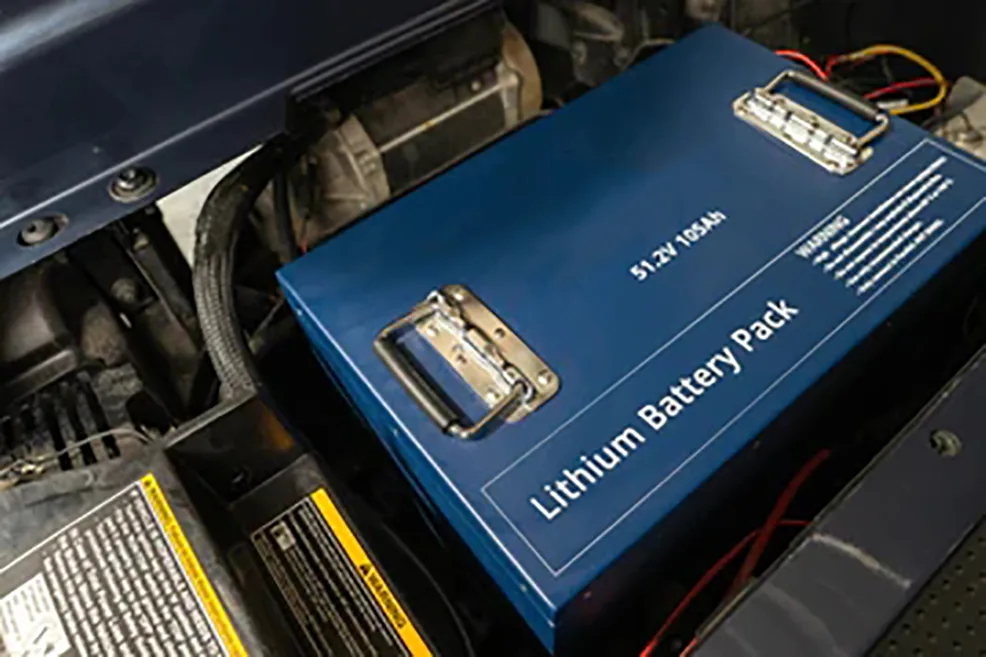
The 48V 105Ah LiFePO4 golf cart battery — 51.2V nominal, 5.38kWh from a 16S1P pack — is the standard lithium upgrade for 48V golf carts. Note the capacity: 105Ah is the golf cart industry’s standard rating point, distinct from the 100Ah used in solar storage. This page covers the specification, cell options, cart compatibility, BMS choices, and wholesale/OEM sourcing.
Specification at a Glance
| Parameter | Value |
|---|---|
| Nominal voltage | 51.2V (16S × 3.2V); marketed as 48V |
| Rated capacity | 105Ah |
| Nominal energy | 5.38kWh (51.2V × 105Ah) |
| Cell configuration | 16S1P |
| Charge voltage | 58.4V typical |
| BMS | 200A smart BMS typical (Bluetooth optional) |
| Protection | IP67 enclosure options |
| Compatibility | 48V Club Car, EZGO, Yamaha and similar |
Market naming: sold as “48V 105Ah golf cart battery” or “51.2V 105Ah”. The technical voltage is 51.2V (16S); “48V” is the cart industry’s nominal name. The 105Ah rating — not 100Ah — is the established golf cart capacity point.
Cell Options
The standard configuration uses 105Ah prismatic cells of the EVE LF105 class — the cell format this segment’s 105Ah rating point is based on. The 16S1P arrangement gives 5,376Wh with strong discharge capability for hill climbing and sustained driving. LJY Energy verifies cell model, grade, and batch documentation per project; the shipping documentation set (UN38.3 test summary and MSDS for the shipped configuration) is confirmed per project. Specifications, pricing, MOQ, and lead times are confirmed per project.
Cart Compatibility
- 48V cart platforms: built as a replacement for 48V lead-acid banks in Club Car, EZGO, Yamaha, and similar 48V carts; tray fit, charger pairing and controller behaviour are confirmed per cart model and year before ordering (see the confirmation section below).
- Range: 5.38kWh delivers substantially more usable range than the lead-acid bank it replaces, at roughly one-third the weight.
- Performance: lithium’s flat discharge curve maintains cart speed and hill-climbing power through the full discharge; the typical 200A smart BMS configuration handles acceleration and incline loads.
- 36V carts: for older 36V platforms, see our 36V 105Ah golf cart battery (38.4V, 12S) page.
BMS and Customization Options
- High-discharge smart BMS: 200A continuous typical, tuned for traction loads — see our BMS selection guide.
- Bluetooth monitoring: SOC, voltage, and cell temperatures via mobile app.
- CAN communication: optional for fleet and commercial cart management.
- Enclosure protection: IP67-rated enclosure options for outdoor, all-weather cart operation — the rating is confirmed per configuration.
- OEM branding: private-label cases, custom labels, cart-dealer specification sheets.
Wholesale and OEM/ODM
The 48V 105Ah golf cart battery is a high-volume B2B SKU. LJY Energy supplies this model wholesale to cart dealers, distributors, and fleet operators, and supports OEM/ODM private-label programs. Contact us with your target cart platform, BMS features, and volume for a project quotation.
Lead-Acid to Lithium Conversion Checklist
- Remove: six 8V (or four 12V) lead-acid batteries, the old charger, and corroded cabling.
- Install: the 48V 105Ah lithium battery, a matched 48V lithium charger (58.4V charge profile), and a battery meter or Bluetooth app for SOC monitoring.
- Check: controller voltage range, solenoid/contactor ratings, and state-of-charge gauge compatibility.
- Weight savings: one ~45–55kg lithium battery replaces ~150–180kg of lead-acid.
- Maintenance: no watering, no equalization charges. Store at 50–80% SOC for the off-season.
Compatibility Confirmation for Dealers and Converters
The sections above describe the standard configuration. Dealers and converters ordering in volume confirm the items below per cart model and production year before an order is placed — controller behaviour, charging hardware, and battery trays differ between platforms and years, and no conversion should be treated as verified until these points are checked. Nothing in this section is a compatibility guarantee; each item is confirmed in writing for your project.
EZGO RXV: Regenerative Braking and the BMS
RXV carts use an AC drive system with strong regenerative braking, and they carry a documented conversion pitfall. On the stock controller, the braking resistor’s turn-on voltage can sit above a lithium BMS’s over-voltage disconnect threshold — so under hard braking, especially downhill starting from a full charge, the BMS disconnects first: regenerative braking is lost and the cart’s electromagnetic parking brake can engage unexpectedly. Packs whose charge-current limit is low, or simply undocumented, are the ones that trip. What we confirm with RXV converters before an order:
- The BMS over-voltage disconnect threshold for the configured pack, so your technician can verify the controller’s overvoltage and braking-resistor behaviour against it
- How the configured BMS handles charge-path interruption, and its protection settings as supplied for the project
- Regenerative braking behaviour at high state of charge, on the actual cart model and year
- A pilot unit tested on one cart — braking from speed at full charge — before any fleet rollout
We do not publish controller parameter changes. Controller settings remain a matter for the cart documentation and your technician’s judgement; our role is to supply the battery-side thresholds and confirm the BMS side of the pairing.
Club Car: OBC and Charger Configuration
Many Club Car models route charging through an onboard computer (OBC) calibrated for lead-acid charging curves. A lithium conversion normally pairs this battery with a matched lithium-profile charger (58.4V charge voltage), and what happens to the OBC in the new setup is decided per model and year — on many carts it is bypassed for the standalone charger (which also disables the dash charge light and charge history), while some model years keep the OBC in place. It is confirmed for your project, never assumed. Two related points to close out at the same time: the state-of-charge gauge (lead-acid gauges misread lithium’s flat discharge curve, so Bluetooth SOC monitoring or a shunt-based meter is the usual answer), and the charger interlock behaviour, so the cart cannot be driven while plugged in.
Battery Compartment and Installation Space
Confirm the tray’s usable length, width, and height, the hold-down method, cable routing and lengths, and clearance for the charger and meter before ordering. One lithium battery at roughly 45–55kg replaces a lead-acid bank of 150–180kg, so the check is about dimensions and cable runs, not about tray strength. For non-standard trays, send the tray measurements with your inquiry and we confirm fit against the configured enclosure.
Electrical Parameters: What Is Typical, What Must Be Confirmed
| Parameter | Basis | Status |
|---|---|---|
| Continuous discharge current | 200A smart BMS typical on this model | Typical — confirm per project configuration |
| Peak discharge current | Depends on BMS configuration and duration | Confirm Before Ordering |
| Maximum charge current | Limited by the paired charger and BMS configuration | Confirm Before Ordering |
| Maximum regenerative (regen) charging current | Depends on cart, controller, and BMS configuration | Confirm Before Ordering |
| Charge voltage | 58.4V typical lithium profile | Typical — confirm per project configuration |
| BMS protection parameters | Over/under-voltage, over-current, short-circuit and temperature cut-offs, set per project configuration | Confirm Before Ordering |
| BMS over-voltage disconnect threshold | The value your technician checks the controller’s braking behaviour against (see RXV above) | Confirm Before Ordering |
| Low-voltage cutoff | Relevant to tow-mode and electromagnetic-brake behaviour | Confirm Before Ordering |
| Communication & SOC meter output | Bluetooth app, CAN, or meter output, per configuration | Confirm Before Ordering |
| Warranty term & spare BMS availability | Stated per quotation | Confirm Before Ordering |
Send These Details With Your Inquiry
- Cart brand, model, and production year
- Drive system (AC, SEPEX, or Series) and controller make, model, and current rating
- Any controller upgrade, speed tune, lift kit, or oversized tyres — all raise peak and regen current
- Current charger model, and whether an OBC is fitted
- Battery tray dimensions (L × W × H), plus a photo of the bay if available
- 12V accessories fitted (lights, stereo, USB) — they size the DC-DC converter
- Daily range target, terrain (including downhill runs that start at full charge), and typical load
- Fleet size, quantity, and rollout plan (pilot units first, or full fleet)
Send the details above via the inquiry form or WhatsApp +86 159 8945 0735 and we will confirm the configuration for your cart before quoting.
Fleet & Commercial Use
Golf courses, resorts, and rental fleets are major buyers of 48V 105Ah lithium batteries. For fleet quotations, provide cart count, daily rounds per cart, and charger infrastructure — we size the order and charger pairing per project.
Shipping, Documentation & Project Terms
Lithium batteries ship as Class 9 dangerous goods; the documentation set (UN38.3 test summary and MSDS for the shipped configuration) is confirmed per project. Sea freight from China to the US runs 3–5 weeks. Specifications, pricing, MOQ, and lead times are confirmed per project.
Frequently Asked Questions
Why 105Ah and not 100Ah?
105Ah is the golf cart industry’s established capacity point (based on the 105Ah prismatic cell class, e.g. EVE LF105), while 100Ah is the solar storage standard.
Will it fit my 48V Club Car / EZGO / Yamaha?
It is sized to replace 48V lead-acid banks in standard 48V carts. Confirm your cart’s battery tray dimensions, charger pairing and controller voltage range per project before ordering — the confirmation section above lists what we check for each cart family.
How much range will I get?
5.38kWh of lithium typically delivers 2–3× the usable range of the lead-acid bank it replaces, at much lower weight.
Do you support private-label/OEM orders?
Yes. OEM/ODM programs include private-label enclosures and custom specification sheets — request a quotation.
Related Battery Solutions & Products
Comparing 48V pack options for your cart or fleet? If your project is specified around the 100Ah rating point instead, see the 48V 100Ah golf cart battery page; for a higher-capacity 48V pack, see the 48V 150Ah golf cart battery — same 51.2V platform, different capacity point. Our Golf Cart Battery Solutions page lays out the dedicated 36V, 48V and 72V range, and the golf cart LiFePO4 battery series covers capacities and configurations in one place. Send us your cart model, controller rating and daily range target for a sizing recommendation.
Can I order a 48V 105Ah sample before stocking it?
Yes. Sample evaluation before a volume order can be arranged; the sample configuration, cost and shipping method are confirmed in writing per project.
Which documents should come with a wholesale 48V 105Ah order?
Ask for the specification sheet for the exact configuration, the UN38.3 test summary, the SDS/MSDS, and any test reports or certificates required in your market, plus the dangerous-goods shipping documents. Which documents exist for the exact model and destination is confirmed before you commit.
Can the 48V 105Ah be certified for my market?
Certification and testing are available or arranged per project for the exact model, configuration and target market; certification and testing fees are borne by the buyer. No certificate is assumed to cover a model until the document for that exact model has been confirmed in writing.
Does the 48V 105Ah BMS communicate with the cart?
CAN or RS485 communication and a display or Bluetooth option can be specified per project. Check communication with your controller on a sample first.
How is the 48V 105Ah shipped?
LiFePO4 batteries ship as dangerous goods: UN3480, Class 9 (UN3481 when packed with or contained in equipment). The shipment needs a UN38.3 test summary, an SDS/MSDS, DG-compliant packaging and labels, and a dangerous-goods declaration; the route and forwarder are confirmed per order.
Share This Article