
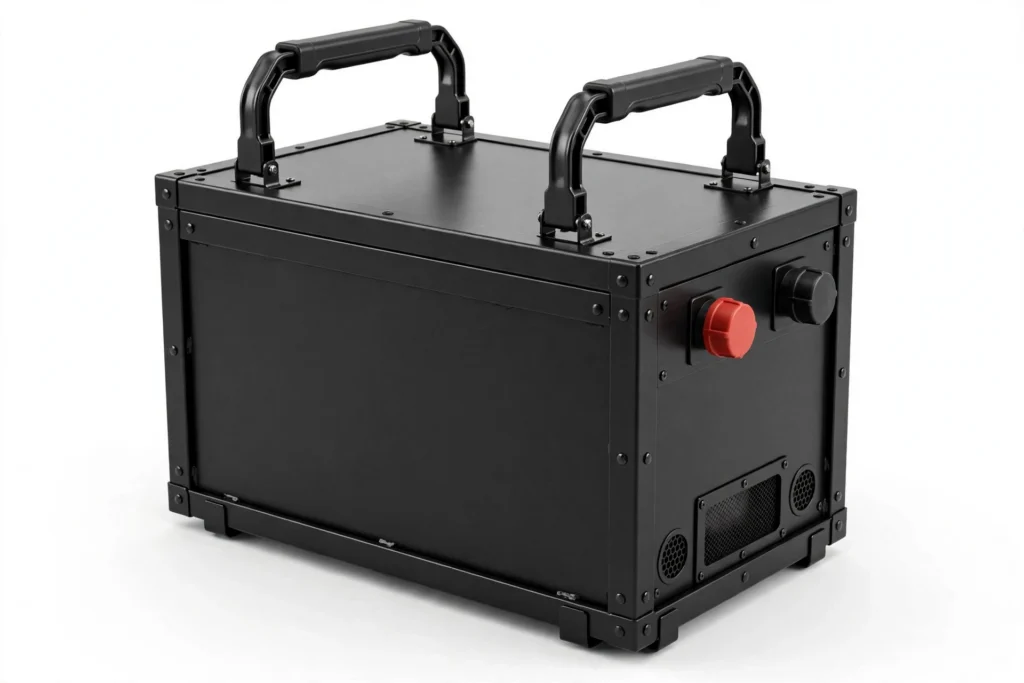
48V 150Ah lithium iron phosphate golf cart battery. 7.68kWh extended-range power for golf carts, resort shuttles and low-speed electric vehicles — framed for dealers, fleet operators and conversion shops.
Product Overview
The 48V 150Ah LiFePO4 golf cart battery delivers 7.68kWh of energy for extended driving range — 50% more than standard 100Ah units. Built for golf courses, resorts, and gated communities where carts run all day, it reduces mid-day charging needs and extends fleet operating hours.
For fleet operators upgrading from lead-acid, fitment is confirmed per cart model, year and tray dimensions (send tray size or a photo with your RFQ). See also our 48V 100Ah model for standard range, the 36V 100Ah model for 36V platforms, and the full golf cart LiFePO4 battery series.
- 7.68kWh nominal energy — range is estimated per fleet from usable energy and your carts’ consumption per km (see Range Planning below)
- 200A continuous / 400A peak (10s) BMS — typical rating; final current confirmed per project against your controller
- All-day operation — fewer charging interruptions for fleets
- Zero maintenance — no watering, no corrosion
Request a Quote | Dealer / fleet RFQ | WhatsApp +86 159 8945 0735
Technical Specifications
| Group | Parameter | Value | Status |
|---|---|---|---|
| Electrical | Nominal voltage | 51.2V (16S) | Typical |
| Electrical | Rated capacity | 150Ah | Typical |
| Electrical | Energy | 7.68kWh | Typical |
| BMS | Continuous discharge | 200A | Typical — confirmed per project |
| BMS | Peak discharge | 400A (10s) | Typical — confirmed per project |
| Charging | Charge voltage | 58.4V LiFePO4 charger required | Typical |
| Durability | Cycle life | 4000+ cycles at 80% DOD (per the cell datasheet; depends on temperature, C-rate and end-of-life capacity; confirmed per project) | Typical |
| Electrical | Cell chemistry / configuration | LiFePO4, 16S (51.2V, 48V class); 15S (48.0V) on request for controllers or meters that expect a lead-acid-like voltage | Typical configuration · 15S optional |
| Electrical | Operating voltage window | Confirmed per project for the 16S or 15S build selected | Confirmed per project |
| BMS | Regenerative braking current | Defined by the BMS charge-current limit and the controller’s regen setting | Confirmed per project |
| BMS | Protections | Over-charge, over-discharge, over-current, short circuit, high/low temperature; cell balancing | Typical configuration |
| Communication | Interfaces / display | CAN, RS485 and Bluetooth app options; SOC meter or display; CAN mapping to the controller or dash validated on a sample | Optional · Confirmed per project |
| Mechanical | Dimensions / weight / case / IP | Set by your tray drawing. Case material and IP sealing options confirmed per configuration — we do not publish a generic drop-in size on this page | Confirmed per configuration |
Values above are the typical configuration for this model. Final specifications are confirmed per project in the formal quotation. Dimensions, weight, IP rating and case material are confirmed per configuration once tray drawings are received.
Cart Compatibility: Club Car, E-Z-GO, Yamaha and Other 48V Systems
Most 48V carts can be considered for a 48V-class lithium pack. Typical examples are Club Car (Precedent, Onward, DS), E-Z-GO (TXT, RXV) and Yamaha (Drive, Drive2), plus 48V LSV, shuttle and utility platforms. Compatibility is general fit, confirmed per project:
- Tray and space: send inner tray dimensions (L×W×H) or a photo with a tape measure — pack formats vary, so we do not claim a generic drop-in for every 48V tray.
- Controller and harness: stock controllers and harnesses differ by make/model/year (for example Curtis-class systems on many Club Car and E-Z-GO carts). Tell us the controller make, model and amp rating.
- Onboard charger (OBC): Club Car and similar carts with an onboard charger may need a bypass or a matched LiFePO4 charger — identified during the fitment check.
- Voltage expectation: some legacy controllers or meters expect a lead-acid voltage curve. A 15S (48.0V) build can be quoted where 16S (51.2V) would trigger alarms.
- Charge port and brackets: cart-specific receptacles, adapters and hold-downs are quoted per cart model.
Brand and model names are listed only to help you identify your system. They are not a compatibility certification or an endorsement by the cart makers, and LJY has no affiliation with them.
Controller & Current Demand (Dealer / Fleet)
Current rating is what sells or kills a fleet conversion. Public industry references (third-party manuals, install checklists and owner forums — not LJY datasheet figures) show roughly:
| Controller class (examples to identify) | Public continuous / peak demand (industry references) | Implication for pack sizing |
|---|---|---|
| Stock OEM controllers (e.g. Curtis 1510 / 1515 / 1268 / 1206HB class) | About 125–200A continuous in normal use; short peaks higher on hills/starts | A pack around 200A continuous typically serves stock carts — still confirm your exact controller |
| Upgraded / high-amp controllers (e.g. Navitas TAC2 440A / 600A class) | Install notes often call for 300A+ continuous and 500A+ peak, plus a matching high-amp solenoid | Ask for a higher continuous/peak rating; do not assume the typical 200A / 400A pack fits |
On this page, 200A continuous / 400A peak (10s) is the typical configuration and is confirmed per project against your controller. CAN / dash mapping (Curtis, Navitas, Sevcon, OEM dash) is also per project — a CAN port alone does not prove the dash will read SOC.
Please send: controller make, model and amp rating (stock or upgraded). Curtis / Navitas examples above are only prompts for what to look up on the cart — not a compatibility claim.
Fleet Kit Checklist (Quoted Per Project)
Dealer and fleet kits commonly include more than the pack. What LJY quotes with this model is confirmed per project — none of the items below are assumed included unless written in the quotation:
- Matched LiFePO4 charger — 58.4V for 16S (or onboard type where specified) — quoted per project
- SOC meter / Bluetooth gauge / display — quoted per project
- 48V → 12V DC-DC converter for lights, audio and accessories — quoted per project
- Cart-specific charge port / receptacle and adapter — quoted per cart model
- Hold-down brackets and mounting kit — quoted per tray
- OBC bypass note (Club Car and similar) — identified during fitment check when the cart keeps an onboard charger; procedure and parts quoted per project
Wake-up kits, remote switches and harness details, where needed, are also listed in the quote — not assumed on the page.
Dealer / Fleet RFQ Checklist
To quote a multi-unit conversion accurately, send as much of the following as you can (photos welcome):
- Cart make, model and year, plus seats.
- Current battery set (6×8V / 4×12V / 8×6V / lithium) and tray dimensions or a photo.
- Controller make/model and amp rating (stock or upgraded — e.g. Curtis 1510/1515/1268/1206HB, Navitas TAC2 440/600A).
- Daily use: holes or km per day, and terrain. Lifted, off-road tyres, or utility load.
- Charging: keep onboard charger / OBC (Club Car)? Site charger input (110V / 220V).
- 12V accessories (lights, audio): is a DC-DC needed?
- Display preference: SOC meter, Bluetooth, or dash integration over CAN.
- Market and certificates required (UL 2271 / CE / local), plus who pays testing.
- Quantity: sample, pilot, or fleet. Delivery country and Incoterm.
- Branding: LJY-coordinated or private label.
- Regen braking: does the controller feed regenerative current into the pack? If known, share the controller datasheet regen note or observed behavior (we confirm regen handling per project — this page does not publish a fixed regen amp limit).
- Club Car OBC: keep the onboard charger, replace it, or bypass? Confirm cart model/year so fitment can identify the charge path before quoting.
- EZGO RXV / AC systems: any history of charger or pack over-voltage cutouts on this fleet? Share charger model and any BMS OV events so charge voltage / OV settings can be confirmed per project against the cart’s charge path.
Send dealer / fleet RFQ | WhatsApp +86 159 8945 0735
Compliance & Documentation
UL 2271 / CE / UN38.3 are available or arranged per project. Testing fees are borne by the buyer. Ask for the exact-model file number when a certificate is required — we do not publish generic cert numbers on this page. Warranty years, BMS/charger warranty and RMA path are confirmed in the quotation (fleet RFQs often ask for multi-year terms; those are not promised here). For what UL 2271 covers and which pack documents to ask for, see our UL 2271 golf cart battery guide.
Document status for a given order is listed in the quote: available now / providable per order / needs confirmation. For pre-shipment checks, see our LiFePO4 incoming inspection guide and China LiFePO4 export guide.
Range Planning for Fleets: 100Ah vs. 150Ah
The 150Ah exists for one reason: carts that cannot come back to the charger mid-day. A standard 100Ah pack covers a typical 18-hole rental pattern with a midday top-up; the 7.68kWh in this unit is sized for carts that run all day without a midday charge, which changes fleet operations in three practical ways:
- Fewer chargers per cart: overnight charging covers the full day, so the charger pool and the electrical capacity behind it shrink.
- Higher fleet availability: no carts parked at midday waiting for charge — the same fleet covers more rounds and more shuttle runs.
- Simpler rotation: every cart in the fleet has the same all-day capability, so dispatch stops tracking which carts are “morning only”.
The 200A continuous / 400A peak (typical) BMS matters as much as the capacity on hilly courses and loaded shuttle routes: range figures assume the pack can also deliver current on climbs without voltage sag cutting the run short. Confirm the final current against your controller (see Controller & Current Demand above). If your course is flat and carts return to base at midday anyway, the 48V 100Ah model is often the better fit — send us your course profile and daily cart usage and we will recommend honestly between the two. For other sizes, compare the 48V 105Ah and 48V 200Ah models.
Range planning (estimate, not a test result): usable energy ÷ your cart’s consumption per km. Terrain, load, seats, lifted carts and off-road tyres change consumption, so we use your own fleet data where you can share it; no fixed range is promised on this page.
Applications
- 18-hole and 36-hole golf course rental fleets
- Resort and hotel shuttle fleets
- Gated community transport
- University campus vehicles
- Dealer conversions and fleet refurbishment programs
Wholesale, OEM & ODM
Voltage options 36V/48V/72V, capacity 60-200Ah. Custom BMS, housing and branding available — confirmed per project. Pricing is given in the formal quotation for your configuration and quantity — request a fleet quote. See also our OEM / ODM capability page, wholesale program and distributor entry.
For distributors and fleet operators, this model is the extended-range anchor of our 48V golf cart line. OEM options per project include housing and label branding for your own battery line, BMS configuration for specific controller setups, and packaging for dealer channels. Private-label programs are coordinated per project through our OEM / ODM program. Appearance, color and logo customizable per customer request.
Frequently Asked Questions
Does it fit my existing 48V golf cart?
Fitment is confirmed per cart model, year and tray dimensions. Send us your cart model and current battery tray dimensions (or a photo) and we will confirm fitment before quoting — we do not treat tray fit as a generic “drop-in for all standard 48V trays” claim.
How far does it really go on one charge?
Range is an estimate, not a test result: divide usable energy by your cart’s consumption per km. Actual range depends on terrain, load, tire pressure, and driving style; hilly courses and heavy shuttle loads sit at the lower end. Share your course profile or measured consumption and we will estimate it for your fleet.
Can I keep my lead-acid charger?
No. This battery requires a LiFePO4 charger with a 58.4V charge voltage. Reusing a lead-acid charger risks undercharging and BMS conflicts. We quote the matched charger with the battery for fleet orders. If the cart has an onboard charger (OBC), tell us — Club Car and similar setups may need a bypass, identified during the fitment check.
What does the fleet conversion include?
Quoted per project. Typically we scope the battery, matched lithium charger and fitment confirmation per cart model; SOC meter, DC-DC, charge port, brackets and any OBC bypass are listed when needed. Wiring or tray modifications for a specific cart are identified during the fitment check — before you commit, not after delivery.
What certificates can you provide?
UL 2271 / CE / UN38.3 are available or arranged per project; testing fees are borne by the buyer. Request the exact-model file number in your RFQ when a market requires it.
Will regenerative braking trip the BMS?
It depends on the controller’s regen path and the pack’s charge/regen limits for that build. Public competitor kits publish regen figures for their packs; we do not copy those as LJY limits. Send the controller make/model and any regen rating from its datasheet — we confirm regen handling per project in the quotation.
Do I need a Club Car OBC bypass?
Many Club Car carts use an onboard charger (OBC) that may need a bypass or a matched LiFePO4 replacement. Tell us the cart model and year and whether you want to keep, replace, or bypass the OBC. We identify the charge path during the fitment check and quote the matched charger with the kit when needed.
EZGO RXV over-voltage — what should I send?
For RXV and similar AC systems, over-voltage cutouts often come from a mismatch between charger output, pack charge voltage, and BMS OV settings. Send cart model/year, charger model, and any BMS fault codes or OV event notes. Charge voltage and OV settings are confirmed per project — we do not publish a one-size OV claim for all RXV carts.
Should I choose 51.2V (16S) or 48.0V (15S)?
16S gives 7.68kWh and is the common choice. 15S (7.2kWh) can suit legacy controllers or meters that expect a lead-acid-like voltage. We recommend one after checking your controller — tell us the controller make/model in the RFQ.
Will the SOC meter or dash read the battery?
A standalone SOC meter or Bluetooth gauge can be included in the kit quote. Dash integration over CAN (Curtis, Navitas, Sevcon or OEM dash) needs protocol mapping and is validated on a sample, per project — a CAN port alone does not prove the dash will read SOC.
Where This Battery Is Used
This extended-range pack is the fleet workhorse in our Golf Cart Battery Solutions and the golf cart LiFePO4 battery series · 48V golf cart lithium conversion engineering guide. Send us your cart models, controller rating, fleet size and daily operating pattern for a conversion proposal covering batteries, chargers and fitment.
Request a Quote | Dealer / fleet RFQ | WhatsApp +86 159 8945 0735