
Share This Article
Content type: Cost-structure explainer — why Chinese lithium batteries, especially LFP, cost less than Western equivalents, and how to tell a genuine cost advantage from a suspiciously low quote. Published Date: 2026-10-11 | Last Updated: 2026-10-11 | Data As Of: October 2026 | Sources: BloombergNEF, IEA, TrendForce, IDTechEx, company filings via financial press. Prices cited are published market assessments, not quotations. LJY Energy is a China-based LiFePO4 battery supplier and OEM/ODM partner working with a trusted manufacturing partner; nothing here implies any relationship with CATL, BYD, EVE Energy, or any other manufacturer named.
The short answer: Chinese lithium batteries are cheaper for six structural reasons — (1) the LFP chemistry China standardized on uses iron and phosphate instead of expensive nickel and cobalt; (2) China makes over 75% of the world’s lithium-ion cells, so fixed costs spread across enormous volumes; (3) nearly the entire supply chain sits in domestic industrial clusters; (4) cell plants are highly automated, so this is not a cheap-labor story; (5) brutal domestic competition squeezes margins; and (6) a decade of consistent industrial policy built the ecosystem. The gap is real and measurable — about 20–30% versus Western production. But “cheap” has a floor: quotes far below published market assessments usually mean downgraded cells, refurbished cells, or missing certifications, not a better deal.
How Big Is the Price Gap, Really?
Before asking why, it helps to pin down how much. BloombergNEF’s annual battery price survey — the industry’s most-cited benchmark — put numbers on the gap in its 2025 edition:
The most persistent myth about Chinese battery prices is that they come from cheap labor. The data says otherwise. Industry estimates put direct labor at roughly 5–10% of total battery cost — a single-digit share, because modern cell plants are highly automated: electrode coating, calendering, stacking, electrolyte filling, and formation are capital-intensive processes run by machines in dry rooms, not by rows of workers.
Engineering inference (labeled): if labor is ~5–10% of cost, even a two-to-one wage gap between countries explains only a few percentage points of the price difference. China’s real manufacturing edge is cheaper capital — domestic equipment vendors, faster line commissioning, and higher utilization of automated lines — not cheaper hands. Anyone explaining 2026 battery prices with a 1990s labor-arbitrage story is modeling the wrong industry. For a walkthrough of what actually happens inside these plants, see our guide to how LiFePO4 battery cells are manufactured.
Reason 1: The Cathode — Iron and Phosphate vs Nickel and Cobalt
The cathode is the single most expensive part of a lithium-ion cell. Cost modeling puts the cathode at roughly one-third of total cell cost for LFP and over half for nickel-based chemistries (NMC/NCA), according to a 2026 peer-reviewed cost-structure review using Argonne National Laboratory’s BatPaC model. So the cheapest way to make a cheaper battery is to make a cheaper cathode — and that is exactly what LFP does.
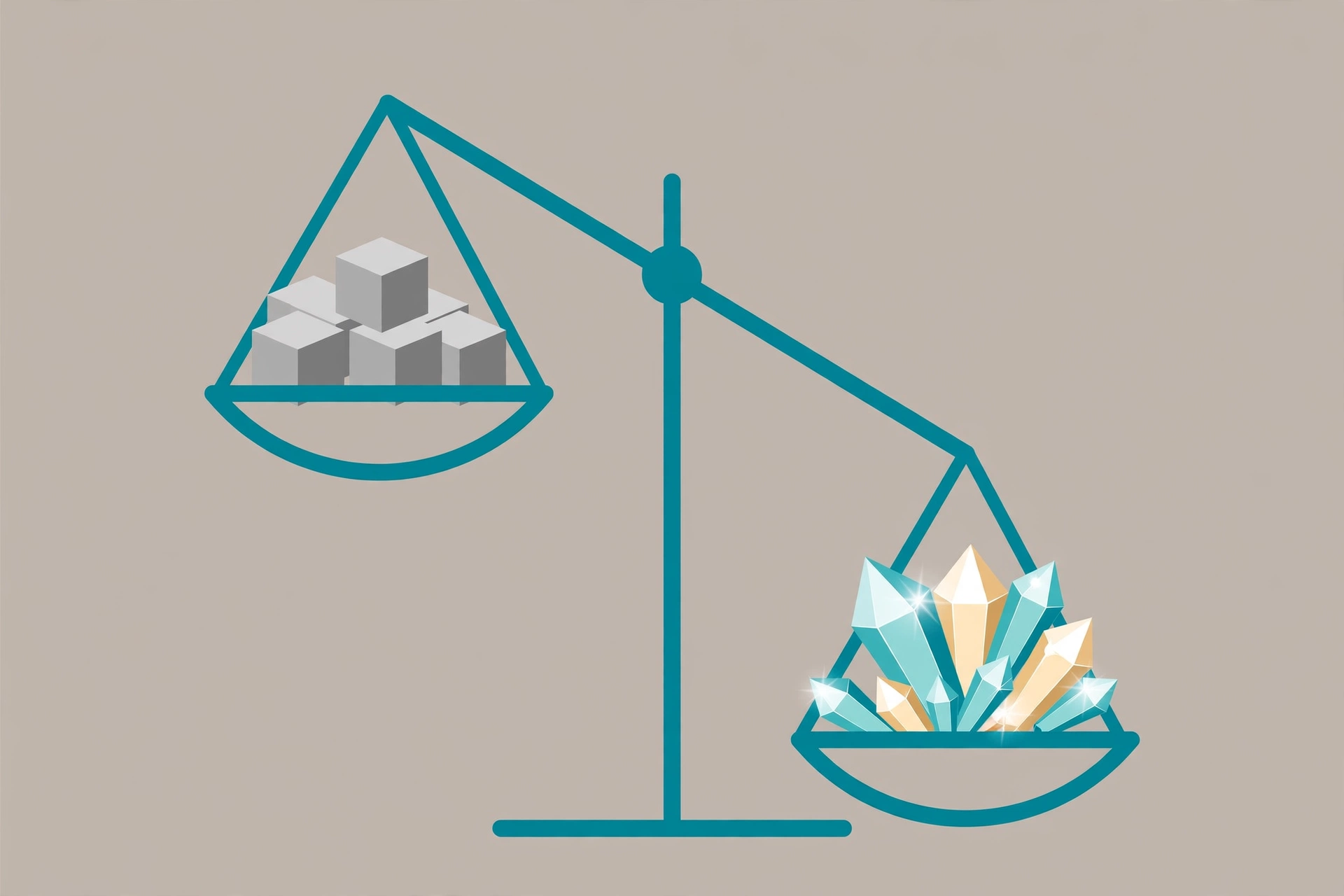
The numbers are stark. In September 2026, Chinese cathode material sold for roughly RMB 56,500 per ton for LFP versus RMB 196,800 per ton for NCM811 — a 3.5× ratio (TrendForce industry-chain price tracker, updated September 7, 2026). The reason is geology, not manufacturing magic: iron and phosphate are abundant, cheap, and geopolitically uncontroversial. Nickel and cobalt are expensive, price-volatile, and concentrated in a handful of countries.
China’s industry bet on LFP early — when much of the West dismissed it as a low-energy-density compromise — and then scaled it relentlessly. IDTechEx estimates that by 2025, raw material costs had fallen to historic lows of about $34/kWh for LFP versus $39/kWh for NMC 811, and average cell prices had dropped from $168/kWh in 2022 to just over $100/kWh in 2025. The chemistry choice alone explains a large share of the price gap, before any factory-efficiency argument enters the picture.
Reason 2: Scale — Three-Quarters of the World’s Cells
China produces over 75% of the world’s lithium-ion battery cells and dominates more than 90% of anode and electrolyte production capacity, according to the International Energy Agency. By the end of 2024, global battery production capacity had reached roughly 3 TWh per year — most of it Chinese.
Engineering inference (labeled): gigafactories are monuments to fixed cost — dry rooms, coating lines, formation halls, and the depreciation on billions of dollars of equipment. Those fixed costs get divided by every kilowatt-hour the plant produces. A plant running at high utilization in a 3-TWh national industry amortizes its fixed costs over vastly more output than a first-generation gigafactory in a new market. Scale compounds further: bigger order books buy cheaper equipment, faster commissioning builds operating experience sooner, and higher volumes justify deeper automation. None of this is mysterious — it is the same scale economics that made every manufactured good cheaper in every industrial revolution.
Reason 3: The Supply Chain Lives Next Door
More than 90% of the world’s anode and electrolyte capacity sits in China (IEA). In practice, that means the cell maker, the cathode supplier, the equipment vendor, and the pack assembler are often in the same industrial park — sometimes on the same street. China’s battery industry organizes itself into city-level clusters where materials, equipment, labor, and logistics co-locate.
What does that save? Lead times measured in hours instead of weeks. No ocean freight between process steps. Engineers who change jobs without changing cities, carrying process knowledge with them. Equipment vendors a phone call away when a line goes down. These are individually small savings that multiply across dozens of supply-chain links. (The cluster geography itself — which cities, which companies — is the subject of a companion piece in this series; the mechanism is what matters here.)
Reason 4: Automation, Not Cheap Labor
The most persistent myth about Chinese battery prices is that they come from cheap labor. The data says otherwise. Industry estimates put direct labor at roughly 5–10% of total battery cost — a single-digit share, because modern cell plants are highly automated: electrode coating, calendering, stacking, electrolyte filling, and formation are capital-intensive processes run by machines in dry rooms, not by rows of workers.
Engineering inference (labeled): if labor is ~5–10% of cost, even a two-to-one wage gap between countries explains only a few percentage points of the price difference. China’s real manufacturing edge is cheaper capital — domestic equipment vendors, faster line commissioning, and higher utilization of automated lines — not cheaper hands. Anyone explaining 2026 battery prices with a 1990s labor-arbitrage story is modeling the wrong industry. For a walkthrough of what actually happens inside these plants, see our guide to how LiFePO4 battery cells are manufactured.
Reason 5: Cut-Throat Competition (and the Margin Proof)
China’s battery market is brutally competitive. Hundreds of manufacturers fight over domestic EV and storage demand, and in an overcapacity market the weakest sell at or near cost to keep lines running. BloombergNEF’s own attribution for China’s price lead lists “lower input costs, overcapacity, intense price competition and preference for lower-cost LFP cells” — competition is named explicitly, alongside real cost factors.
Here is the critical nuance: the price leaders are not selling at a loss. CATL, the world’s largest battery maker, reported 2025 revenue of ¥423.7 billion (up 17%), net profit of ¥72.2 billion (up 42%), and a gross margin of 26.3% — up from 24.4% the year before (company filings via Morningstar/Dow Jones, March 2026). Its net margin has climbed from 10.2% in 2022 to about 17–18% in 2025. A company earning 26% gross margins at the lowest prices in the world is not dumping — it has genuinely lower costs.
Analysis (labeled): the margin story has two layers. Tier-1 leaders earn healthy profits at low prices, which proves the cost structure is real. Below them, smaller makers survive on thin or negative margins in the overcapacity squeeze — and their distress pricing drags market averages down further. Both layers push prices lower, but only the first is sustainable.
Reason 6: A Decade of Consistent Industrial Policy
None of the above happened by accident. Roughly a decade of EV mandates, purchase incentives, and supply-chain planning gave Chinese manufacturers the demand certainty needed to justify gigafactory-scale bets years before the demand fully materialized. Policy created the market volume; volume created the scale; scale created the cost advantage. This article treats policy as one of six factors, not the whole story — a companion piece in this series examines China’s battery industrial policies in detail.
The Cell Cost Stack, Summarized
| Cost block | Share of cell cost | Why China is cheaper here | Confidence |
|---|---|---|---|
| Cathode material | ~33% (LFP); >50% (NMC/NCA) | LFP chemistry: iron/phosphate vs nickel/cobalt (3.5× material price ratio) | Confirmed |
| Anode, separator, electrolyte | ~20–25% combined | >90% of anode/electrolyte capacity domestic; clustered suppliers | Confirmed |
| Manufacturing & depreciation | ~20–25% | Scale amortization; domestic equipment; high utilization | Engineering inference |
| Direct labor | ~5–10% | Small share — not the driver; automation is | Industry reporting |
| Margin & overhead | Remainder | Competition compresses it; leaders still earn ~26% gross | Confirmed |
Shares are approximate and vary by format, plant, and year; sources: BatPaC-based review (nature.com, 2026), TrendForce (Sep 2026), IEA, company filings.
When “Cheap” Is a Warning Sign, Not a Bargain
Everything above explains why legitimate Chinese batteries cost less. But there is a floor, and quotes below it are telling you something. Published market assessments give you the reference bands: BNEF’s $84/kWh China average pack price (2025), Benchmark’s ~$57.75/kWh EXW China assessment for 314Ah cells (July 2026), InfoLink’s ~RMB 0.363/Wh domestic assessment for 280/314Ah cells (October 2026). A quote near these bands is normal. A quote far below them is not a better deal — it is usually one of these:
- Downgraded (Grade B) cells sold without disclosure — lower consistency, shorter life, sold at a discount the buyer doesn’t know about.
- Refurbished or used cells repackaged as new — the fastest-growing fraud vector in the low-end market.
- Missing certifications — no genuine UN38.3 test summary, no IEC/CB/UL paperwork; the “savings” are skipped testing.
- No warranty backing — a 5-year warranty from a company that won’t exist in 2 years is not a warranty.
This is the essential discipline: quality is a distribution, not a nationality label. China produces the world’s best battery cells and its worst — the same country, the same year, sometimes the same industrial park. What separates them is grading, testing, certification, and supplier verification, not the flag on the factory. Our guide to Grade A vs Grade B LiFePO4 cells shows exactly how the low end of that distribution gets disguised as the high end.
The Price You See Isn’t the Price You Pay
One more reason the “cheap China” narrative misleads: the factory-gate price is only one layer of what a battery actually costs you. Ocean freight, import duties, import VAT, customs brokerage, certification and testing, and warranty risk all stack on top of FOB. A cell that is 20% cheaper at the factory gate but arrives with the wrong HS code, missing UN38.3 paperwork, or a DOA rate that eats your margin was never the cheaper option.
Run the full math before you compare quotes: our Battery Landed Cost Calculator walks through FOB, freight, duties, VAT, and clearance so you compare landed costs, not brochure prices. And remember the harshest arithmetic in procurement: the most expensive cell is the cheap one that fails in year three.
How to Read a Suspiciously Low Quote: A Buyer’s Checklist
- Benchmark it. Compare against published assessments (BNEF, Benchmark Minerals, InfoLink) for the same format and period — not against another supplier’s quote.
- Ask for the grade in writing. “Grade A” should mean documented test data and traceability, not a marketing word. See our Grade A vs B guide for what to demand.
- Demand the UN38.3 test summary for the exact model you are buying — not a sibling model, not an expired report.
- Check certifications against the issuing bodies — UL, IEC/CB, CE certificates can be verified; a PDF alone proves nothing.
- Verify the supplier, not just the price. Business license, export history, and third-party factory audits are standard practice — our supplier verification guide gives the full procedure.
- Price the warranty. Who honors it, from where, and with what turnaround? A warranty without a service path is a paragraph, not protection.
- Calculate landed cost, not FOB. Use the landed cost calculator before you rank suppliers.
If you are evaluating Chinese LiFePO4 suppliers and want a second pair of eyes on a quote or a specification, contact LJY Energy — we work with buyers on cell selection, pack specification, and OEM/ODM builds, and we will tell you plainly when a price looks too good to be true.
Frequently Asked Questions
Are Chinese lithium batteries cheap because of low quality?
No — at least not as a general rule. The documented reasons are structural: cheaper LFP cathode materials, massive manufacturing scale, localized supply chains, automation, and intense competition. Market leader CATL earned a 26.3% gross margin in 2025 while selling at the world’s lowest prices, which is inconsistent with a “cheap because it’s bad” story. That said, the bottom of the Chinese market does contain downgraded and refurbished cells — quality is a distribution, and verification is what separates the tiers.
Are Chinese batteries cheap because of government subsidies?
Industrial policy helped build the ecosystem — a decade of EV mandates and planning gave manufacturers demand certainty to invest at gigafactory scale. But subsidies alone cannot explain the gap: BNEF attributes China’s lead to lower input costs, overcapacity, intense competition, and LFP preference, and CATL’s healthy margins show the cost structure is genuinely lower. Policy is one of several factors, not the whole answer.
Is it cheap labor that makes Chinese batteries inexpensive?
No. Direct labor is roughly 5–10% of battery cost because cell manufacturing is highly automated. Even large wage gaps between countries move the total by only a few percentage points. The real manufacturing advantages are cheaper capital equipment from domestic vendors, faster line commissioning, and higher utilization — not cheap hands.
Why is LFP so much cheaper than NMC?
The cathode dominates cell cost, and LFP cathodes use iron and phosphate — abundant, cheap commodities — instead of nickel and cobalt. In September 2026, LFP cathode material sold in China for about RMB 56,500/ton versus RMB 196,800/ton for NCM811 cathode material (TrendForce). That 3.5× raw-material ratio flows directly into cell prices: BNEF’s 2025 survey put average LFP packs at $81/kWh versus $128/kWh for NMC.
How can I tell if a low battery quote is legitimate?
Benchmark it against published market assessments (BNEF, Benchmark Minerals, InfoLink) for the same cell format and time period. Quotes near those bands are normal; quotes far below them usually signal Grade B or refurbished cells, missing certifications, or no real warranty. Then verify: grade in writing, UN38.3 test summary for the exact model, verifiable certificates, supplier background checks, and a full landed-cost calculation.
Will Chinese batteries stay cheap?
The structural advantages — LFP chemistry, scale, localized supply chains — are durable. But several forces push the other way: lithium prices rebounded sharply in 2026, China’s battery export VAT rebate phases out completely in January 2027, a new domestic consumption tax on cells took effect in September 2026, and Western tariffs add 25%+ on Chinese batteries in some markets. Expect the factory-gate advantage to persist while the landed cost gap narrows in protected markets.
Share This Article