
Share This Article
Published: October 2026 · Last updated: October 2026 · Data as of: October 2026 — company financials from 2024 annual reports and 2025 interim disclosures; shipment claims labeled by source. China Battery Intelligence series.
Content type: Buyer intelligence briefing. This article profiles companies that assemble lithium battery packs — it is not a market-share ranking. No unified, credible industry-wide ranking of pack assemblers exists, so the “10 Leading” selection below is editorial, based on public financials, verifiable shipments, product coverage, engineering capability, and relevance to overseas buyers. Confirmed (exchange filings, annual reports), industry reporting (company-published claims), and engineering inference (labeled) are distinguished throughout. LJY Energy is a China-based LiFePO4 battery supplier and OEM/ODM partner working with a trusted manufacturing partner; nothing here implies any commercial relationship with any company named.
The short answer: China’s pack-assembly landscape splits into two camps — pack-first specialists (Desay, Topband, Highpower, Phylion) that buy cells and compete on design, BMS integration, and flexibility, and vertically integrated players (Sunwoda, EVE, Great Power, Narada, Pylontech, LEOCH) that make their own cells and compete on cost and scale. For low-voltage LiFePO4 packs (RV, marine, golf carts, home storage), the specialists often offer better OEM/ODM flexibility; for residential and C&I storage, the integrated players dominate. The right choice depends on your application, order size, and how much engineering support you need — this guide gives you the comparison framework and the screening checklist to decide.
What a Battery Pack Manufacturer Actually Does
A battery pack manufacturer sits in the middle of the value chain. It buys (or makes) individual lithium cells, then designs and builds finished packs: arranging cells into modules, welding busbars, integrating a battery management system (BMS), adding wiring harnesses, thermal components, and enclosures, and testing the finished unit. The pack is what you actually install in an RV, bolt into a golf cart, or mount on a garage wall.
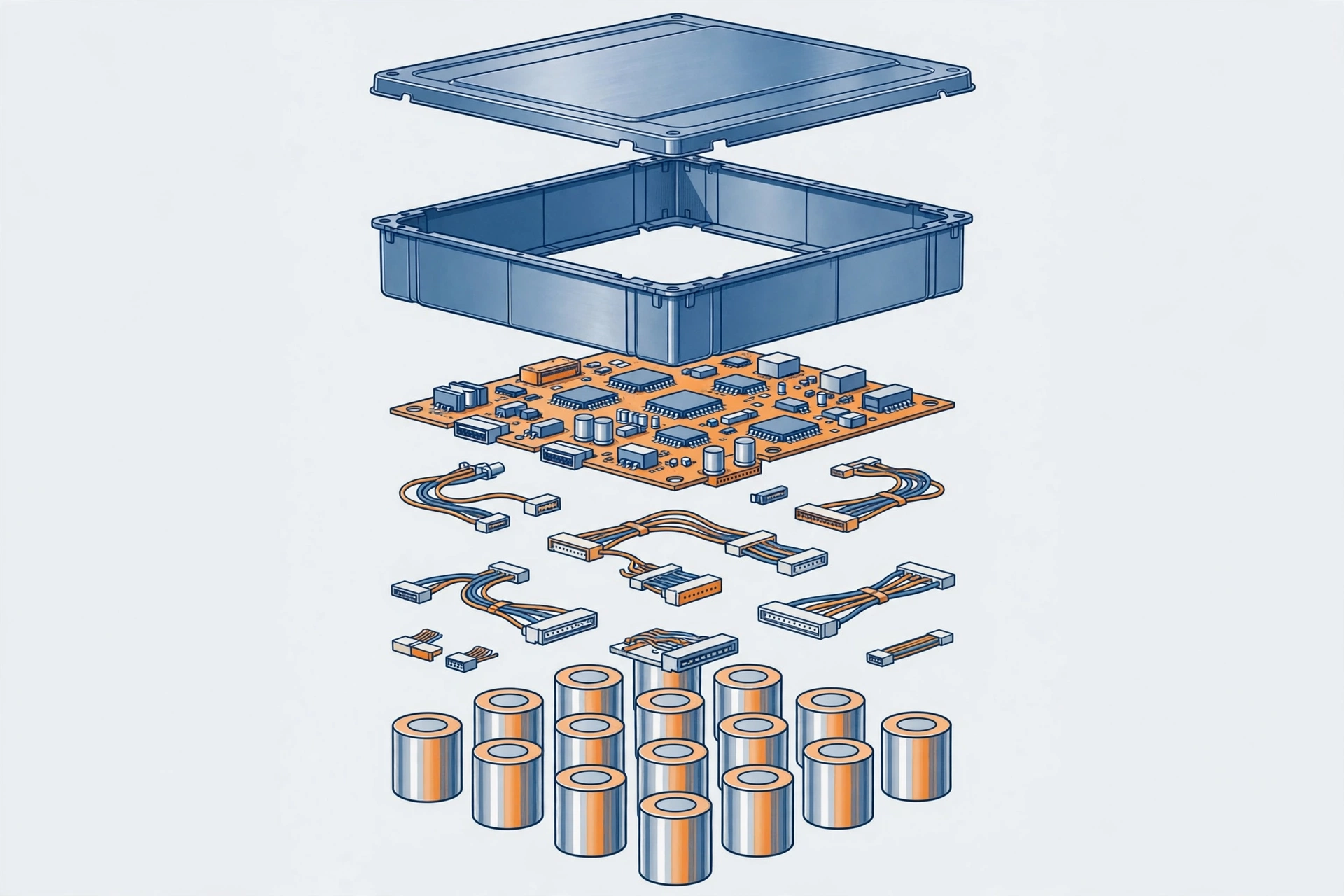
This role is distinct from three neighbors buyers often confuse it with. Cell manufacturers (CATL, BYD, EVE’s cell division) make the electrochemical core — covered separately in our cell-manufacturer guide. System integrators take finished packs and build containerized or utility-scale systems with inverters and EMS. Traders buy and resell packs without manufacturing anything. When a supplier says “manufacturer,” verify which of these four it actually is — Section 12 explains how.
How We Selected These 10 Manufacturers
We researched 16 Chinese pack assemblers (see research notes) and selected 10 for depth of public information, verifiable scale, and relevance to overseas buyers. Because no credible industry-wide pack-shipment ranking exists, this is not a top-10-by-market-share list — the order below groups companies by specialty, not by rank. Selection criteria:
- Pack assembly as a real business line — design, BMS integration, enclosure, and testing, not just cell sales.
- Verifiable scale — listed-company financials, disclosed shipments, or certified capacity (labeled by source).
- Buyer relevance — products or OEM/ODM services an overseas buyer can actually purchase.
- Segment coverage — across consumer packs, light-EV packs, low-voltage LiFePO4, and residential/C&I storage.
Pylontech (派能科技, founded 2009, Shanghai; listed 688063.SH) is the global reference brand for residential lithium storage. BloombergNEF named it a Tier 1 Global Energy Storage Manufacturer, and the company reports over one million energy storage systems delivered worldwide (Industry reporting — BNEF listing confirmed, shipment figure company-published).
Pylontech develops cells, BMS, and EMS in-house, covering residential through C&I to utility-scale applications. Buyer note: as a brand-led company, Pylontech sells primarily through its own channels and partners — it is a benchmark for product design and a potential competitor as much as a supplier. Buyers seeking white-label residential ESS should look to OEM-oriented players like Topband or LEOCH instead. Engineering inference (labeled): studying Pylontech’s modular stackable architecture is useful even if you never buy from them — it defines what end customers expect.
Phylion — Light-EV Pack Leader
Phylion (星恒电源, founded 2003, Suzhou) dominates light-electric-vehicle packs: by December 2024 it had shipped a cumulative 33 million+ light-EV lithium packs, which it describes as seven consecutive years of global shipment leadership (Industry reporting — company-published). Its 14.2 GWh annual capacity spans materials, cells, modules, PACK, BMS, and ESS products, with bases in Suzhou, Chuzhou, Indonesia, and Hungary.
Phylion’s packs serve e-bikes, e-trikes, low-speed EVs, plus growing ESS, portable power, and AGV lines. Buyer note: if you import light-EV batteries, Phylion is the default benchmark — but verify model-level certifications for your market (its e-bike packs were among the first certified under China’s new GB 43854 standard). For 12V/48V LiFePO4 RV/marine packs specifically, the customized-pack specialists below may fit better.
Topband & Highpower — Customized Pack Specialists
Topband (拓邦股份, listed 002139.SZ) has run its lithium battery business since 2006 with a “energy storage + light power” strategy, combining batteries, intelligent controllers, and IoT. It offers cells, BMS, PACK, and system solutions for home ESS, telecom backup, LEVs, and power tools — and describes itself as a leader in customized lithium batteries for细分 markets (Industry reporting — company-published).
Highpower (豪鹏科技, founded 2002, Shenzhen; listed 001283.SZ) is a consumer-pack pure play: 2024 revenue RMB 5.11 billion (+12.5%), built on square, cylindrical, and button-cell packs for customers it names as HP, Sony, Google, DJI, Amazon, and Xiaomi (Industry reporting — company-reported customer list). It is expanding into portable ESS.
Buyer note: these two are the OEM/ODM-friendly end of the market — flexible on customization and mid-size orders, with mature export processes. They are often the most practical choice for branded pack programs in the 1,000–100,000 unit range. Engineering inference (labeled): their consumer-electronics quality systems (ISO 9001, IATF 16949 at Highpower) transfer well to low-voltage LiFePO4 packs.
LEOCH, Narada, Great Power, EVE — Storage & System Players
LEOCH (理士国际, founded 1999; HK-listed) brings 16 plants and 29.8 GWh of annual capacity, with LiFePO4 lines spanning telecom backup, UPS, RV, and marine. Its 48V/51.2V LFP modules (CAN/RS485, UN38.3) and stackable home ESS (5–320 kWh, IP55) are directly relevant to overseas buyers; EMEA revenue grew 42.3% YoY in 2024 on German, French, and UK storage demand (Confirmed, annual report). UL9540A and IEC62619 certifications were reported at Battery Show Asia 2025 (Industry reporting).
Narada (南都电源, founded 1994, Hangzhou; listed 300068.SZ) is pivoting hard to lithium storage: 10 GWh of cell capacity plus 10 GWh of ESS integration capacity, with management guiding ESS to ~75% of revenue (Industry reporting — company guidance). Strengths: data-center backup (wins with major internet companies) and C&I/utility ESS.
Great Power (鹏辉能源, founded 2001, Guangzhou; listed 300438.SZ) operates 12 manufacturing bases; SMM/InfoLink ranked its 2025 H1 ESS cell shipments top 9 globally and small-storage (residential + telecom) cells top 3 (Industry reporting). Its 314Ah large-ESS and 100Ah/50Ah small-storage lines were reported at full production in September 2025.
EVE Energy (亿纬锂能, founded 2001, Huizhou; listed 300014.SZ) is included for its pack/system business only (its cell business belongs in our cell-maker guide): 2024 revenue RMB 48.62 billion, with InfoLink ranking its 2024 ESS cell shipments #2 globally at 17.2% share (Confirmed, via media). Buyer note: EVE serves large ESS and EV system buyers; minimum order expectations reflect that scale.
Which Supplier Type Fits Your Application
| Your application | Recommended supplier type | Example companies | Why |
|---|---|---|---|
| RV / marine 12V–48V LiFePO4 packs | Customized pack specialist | Topband, LEOCH | Flexible specs, mid-size MOQs, export-ready 48V designs |
| Golf carts / low-speed vehicles | Light-EV pack leader | Phylion, Great Power | Proven LEV pack platforms, volume cost |
| Home storage (branded program) | OEM-oriented ESS pack maker | Topband, LEOCH, Narada | White-label flexibility; study Pylontech as design benchmark |
| C&I / data-center backup | Vertically integrated storage player | Narada, Great Power, EVE | Cell supply security, system engineering depth |
| Consumer-electronics packs | Consumer pack specialist | Desay, Highpower, Sunwoda | DFM discipline, global brand QA experience |
| Large-volume EV/ESS programs | Scale leader | Sunwoda, EVE | Capacity, automotive-grade process control |
How to Qualify a Pack Manufacturer
Engineering inference (labeled) — the screening methodology below reflects standard battery-procurement practice; adapt it to your order size and risk tolerance.


1. Verify it actually manufactures. Ask for the factory address, business license scope (经营范围 covering battery manufacturing), and a video walkthrough of the pack line. A “manufacturer” that cannot show you a production line is a trader — price and accountability differ accordingly.
2. Trace the cells. Which cell maker’s cells go into your pack? Ask for the cell specification sheet, QR-code traceability, and whether the factory will commit to a single cell source in the contract. Our Grade A vs Grade B guide explains why cell-grade opacity is the #1 pack quality risk.
3. Review the BMS specification. Request the BMS datasheet: protection thresholds (overcharge, over-discharge, over-temperature, short-circuit), balancing method and current, communication protocols (CAN/RS485/UART), and low-temperature charge protection. See our BMS selection guide for what good looks like.
4. Test samples properly. Order samples and run capacity, internal-resistance, and protection-function tests — including a BMS trip test and, for heated claims, a low-temperature charge test. Do not skip this because the datasheet looks good.
5. Check certifications for your market. UN38.3 (transport) is the baseline; add CE, UL 1973/UL 9540A, IEC 62619, or UKCA as your market requires — and verify the certificate covers the exact pack model, not just the cell. Ask for the certificate number and issuing body.
6. Audit the factory (or hire an inspector). Key points: incoming-cell inspection records, pack aging/formation process, EOL test stations, traceability from pack serial to cell batch, and calibration records for test equipment. Our supplier verification guide gives the full checklist.
Procurement Risks When Sourcing Packs from China
Cell-grade opacity is the dominant risk: a pack assembled from Grade B or mixed-grade cells will pass initial capacity tests but degrade faster. Insist on cell traceability in the contract. Specification drift between samples and mass production is the second risk — lock the BOM (cell model, BMS firmware version, wire gauge) in the purchase contract with change-notification clauses.
Certification gaps strand shipments: a pack certified only at cell level may be rejected by your market’s authorities. After-sales reality: warranty terms are only as good as the supplier’s willingness to honor them across borders — prefer suppliers with overseas service partners or escrow-backed warranty terms for large orders.
Sources
- Sunwoda 2024 financials, HK IPO filing: https://finance.sina.cn/2025-07-02/detail-infeawwa5592888.d.html and https://finance.eastmoney.com/a/202508083479340746.html (accessed 2026-10-11).
- Sunwoda power-battery shipments, SNE ranking: https://finance.eastmoney.com/a/202601173622485331.html (accessed 2026-10-11).
- Desay Battery 2024 annual report summary: http://disc.static.szse.cn/download/disc/disk03/finalpage/2025-04-21/9faca940-ad00-4a81-88ad-a16d5fc5ec9c.PDF (accessed 2026-10-11).
- Topband Battery company profile: https://www.topbandbattery.com/news/4197.html (accessed 2026-10-11).
- Phylion product manuals: http://xingheng.com.cn/static/addons/cms/pdf/星恒产品手册2025V1.pdf and https://www.phylion.com/static/PHYLION-Energy-Storage-Product-Manual-2026V1.pdf (accessed 2026-10-11).
- Pylontech BNEF Tier 1: https://www.prnewswire.co.uk/news-releases/pylontech-ranked-as-a-tier-1-global-energy-storage-manufacturer-by-bloombergnef-302285417.html (accessed 2026-10-11).
- LEOCH 2024 annual report: https://pdf.dfcfw.com/pdf/H2_AN202504231660959791_1.pdf (accessed 2026-10-11).
- LEOCH UL9540A/IEC62619 milestone: https://aapnews.aap.com.au/aapreleases/cision20250718AE33080 (accessed 2026-10-11).
- Highpower financials: https://pdf.dfcfw.com/pdf/H3_AP202605081822061132_1.pdf (accessed 2026-10-11).
- Narada investor Q&A: https://static.cninfo.com.cn/finalpage/2025-08-15/1224490450.PDF (accessed 2026-10-11).
- Great Power ESS brochure: https://WWW.GREATPOWER.NET/vancheerfile/files/2025/9/20250923141453036.pdf (accessed 2026-10-11).
- Great Power shipments: https://finance.eastmoney.com/a/202510313551983677.html (accessed 2026-10-11).
- EVE Energy 2024 financials: https://finance.eastmoney.com/a/202506273442611793.html (accessed 2026-10-11).
Frequently Asked Questions
What is the difference between a battery pack manufacturer and a cell manufacturer?
A cell manufacturer makes the individual lithium cells (the electrochemical core). A pack manufacturer assembles those cells into finished packs — adding BMS, wiring, enclosures, and testing. Some companies (Sunwoda, EVE, Great Power) do both; others (Desay, Topband) focus on pack assembly using externally sourced cells.
Is there an official ranking of Chinese battery pack manufacturers?
No. Industry trackers rank cell shipments and system installations, but no unified, credible ranking of independent pack assemblers exists. Lists calling themselves “top 10 pack manufacturers” are editorial selections — including this one. Judge any such list by whether it discloses its methodology.
Which Chinese pack manufacturer is best for RV or marine LiFePO4 batteries?
For customized 12V/24V/48V LiFePO4 packs, look to OEM/ODM-oriented assemblers such as Topband or LEOCH, which offer flexible specs and export-ready 48V designs. Verify the BMS datasheet, cell source, and model-level certifications before committing.
Should I buy packs from a cell maker or a pack specialist?
Cell makers offer supply security and scale; pack specialists offer design flexibility and often better OEM/ODM service for mid-size orders. For large standardized ESS programs, vertically integrated players win. For branded, customized low-voltage packs, specialists are usually more practical.
How can I verify a pack supplier really manufactures?
Ask for the factory address and business license scope, request a video walkthrough of the pack assembly line, and check incoming-cell inspection and EOL test records. A supplier that cannot show production is a trader — price it accordingly.
What certifications should a lithium battery pack have for export?
UN38.3 (transport) is the baseline for all lithium shipments. Depending on your market, add CE, UL 1973, UL 9540A, IEC 62619, or UKCA — and confirm the certificate covers your exact pack model, not just the cells inside it.
Sourcing Battery Packs from China?
Choosing between pack specialists and vertically integrated makers — and verifying cell sources, BMS specs, and certifications — is where most buyers get stuck. As a China-based LiFePO4 battery supplier and OEM/ODM partner working with a trusted manufacturing partner, LJY Energy helps overseas buyers match cells, BMS, and pack designs, coordinate QC, and navigate supplier qualification. Learn more about our OEM/ODM services, start with our supplier verification guide, or talk to us directly.
Share This Article