
RV House Battery versus Starter Battery — Leisure, Habitation and Chassis Roles
An RV, motorhome, campervan or caravan almost always has two different battery jobs. One bank starts the engine. The other runs the living-area loads: lights, water pump, refrigerator, fans, sockets and, where fitted, an inverter. Buyers and search pages use several names for that second bank — house battery, leisure battery, habitation battery, living-area battery — but they are naming one purchase. The chassis starter battery is a different purchase.
This page is a procurement and RFQ checklist for that distinction. It is not a reprint of the BCI group-size catalogue, the 12 V / 24 V starter series, or the charging-path guides already on this site. LJY Energy supplies complete LiFePO4 battery pack systems. We do not claim that a house or leisure pack is a drop-in starter, or that a starter pack is a house bank, unless a dual-purpose configuration is confirmed for the project. Nothing here is a wiring or power-on procedure.
Short answer
- Buy the house, leisure or habitation battery for living-area energy. Buy the chassis starter (cranking / SLI) battery for engine start. Treat dual-purpose as a third, project-confirmed configuration, not as the default.
- VARTA, writing about leisure-vehicle batteries, states that SLI batteries “deliver an extremely high current output for brief periods,” that this starting power is measured in cold cranking amperes (CCA), and that “starter batteries are not designed to withstand extensive discharge/charge cycles.” It states that batteries for leisure applications “deliver a constant current over a long period of time” and “can be discharged and recharged repeatedly.” That is an official role distinction from a battery maker. It is not an LJY specification and it is written in a lead-acid product context.
- A LiFePO4 house pack is specified for usable energy, continuous discharge and cycling. A LiFePO4 starter pack is specified for short, very high current and for compatible alternator charging. Do not copy a competitor’s CCA or cycle-life figure onto an LJY quotation.
- Confirm system voltage for each role from the vehicle documentation. Most existing RV and caravan house systems are 12 V class (12.8 V LiFePO4). A 24 V house or chassis system is a different architecture, not a battery-only swap. See the RV battery solutions page and, for a 24 V house-bank configuration example, the 24 V 200 Ah LiFePO4 battery.
- Physical fitment (BCI group, DIN-style case, under-seat locker, terminals, hold-down) is necessary and not sufficient. A group number does not make the pack electrically finished. Use the existing group-size pages for footprints; do not assume drop-in.
- Heating and Bluetooth options can be discussed for the selected battery configuration. They are not standard on every pack, and this page does not invent heater temperatures, heater power, app brands, range, monitoring fields, or remote control.
- Send the vehicle type, which bank you are replacing, voltage, loads or CCA, and compartment limits on the contact page.
The names buyers actually use
The same two roles travel under different words in different markets. This page uses them as synonyms for those roles, not as separate products.
- United States and much of the North American RV trade: house battery (sometimes house bank) versus chassis or starter battery. Travel trailers, fifth-wheels, Class A / B / C motorhomes and many camper vans use this language.
- United Kingdom, Ireland, Australia and New Zealand: leisure battery is the usual term for the living-area bank on a caravan, motorhome or campervan, as distinct from the starter battery.
- Continental Europe: motorhome and caravan buyers and OEM documents often speak of the living-area or habitation electrical system, as opposed to the chassis or engine battery. LJY’s existing OEM factory-fit page already uses “habitation-system integration” when it discusses CI-BUS. “Habitation battery” in this article means that living-area bank, not a separate SKU family.
- Campervan and van conversions: the living-area pack is often still a leisure or house battery, sometimes mounted under a seat or in a compact locker, while the vehicle keeps a separate starter battery.
If you are buying only one of those roles, say which one. If you are buying both, specify them as two lines, even when you want them from the same supplier.
What an official leisure-battery maker says about the two roles
VARTA’s article “Battery tips for the leisure season” (retrieved 17 November 2026) draws the line in plain language:
- SLI (Starting, Lighting, Ignition) batteries deliver an extremely high current output for brief periods. Starting power is measured in cold cranking amperes (CCA); marine cranking amperes (MCA) is the corresponding marine measurement. Starter batteries are not designed to withstand extensive discharge/charge cycles.
- Batteries for leisure applications deliver a constant current over a long period of time. Unlike an SLI battery, they can be discharged and recharged repeatedly without those cycles causing damage or shortening the service life, and they are described as suited to electronic and plug-in loads in boats, caravans or motorhomes.
VARTA’s leisure product overview also separates “Engine Start” from “Energy Supply,” and it offers dual-purpose products in its own Professional range, including a Professional Li-ion line. Those are VARTA products and VARTA claims. They are not LJY packs, and none of their capacity, CCA, cycle-life or runtime figures is used as an LJY rating on this page.
The practical procurement lesson is the same in LiFePO4: starting current and living-area cycling are different design intents. Using the wrong intent shortens service life or fails the job, which is why the RFQ has to name the role.
What changes when the chemistry is LiFePO4
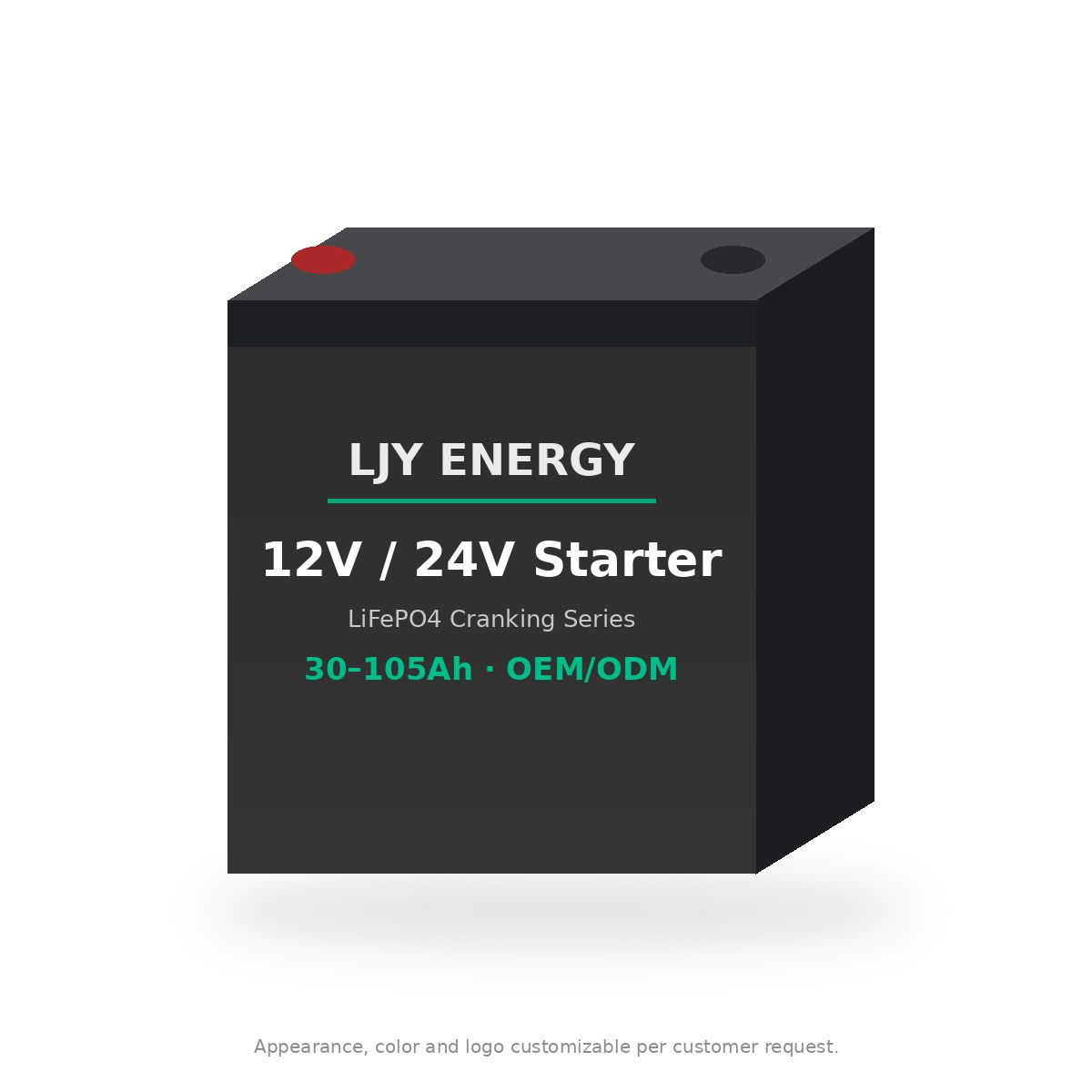
LJY’s starter series page already states that starter batteries are built for short, very high-current bursts, “a different purchase intent from our deep-cycle and house-bank models,” and that the series is “not a deep-cycle house bank unless configured as dual-purpose.” CCA is confirmed per project and test method; competitor listings are not copied. Self-heating and Bluetooth are listed there as optional configurations, not as catalogue defaults.
A house or leisure LiFePO4 pack is bought for:
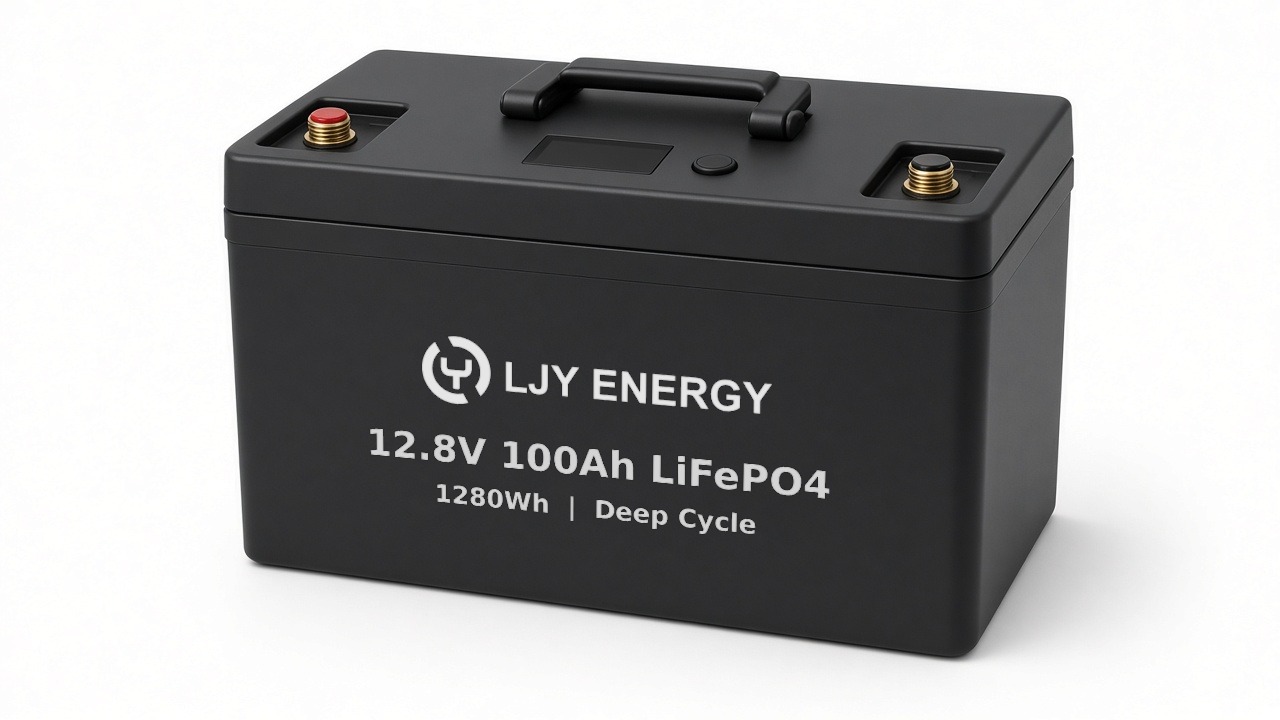
- Usable energy at a stated depth of discharge, not only the amp-hour label. A typical 12.8 V 100 Ah deep-cycle configuration is listed at 1,280 Wh nominal and about 1,024 Wh at 80 % depth of discharge on the 12 V 100 Ah deep-cycle page.
- Continuous and peak discharge current matched to inverter and DC loads, from the datasheet of the selected build.
- Charge-voltage and charge-current windows that the shore converter, solar controller and DC-DC charger can actually provide.
A starter LiFePO4 pack is bought for:
- A cranking or pulse rating and a BMS that will not trip during the start, confirmed per project against the engine and the test method.
- Case format, hold-down and terminals that match the vehicle tray.
- An alternator or charger voltage that is compatible; lead-acid equalisation or desulfation modes should be disabled or confirmed per project, as that starter page already states.
Dual-purpose (start plus house loads) is a configuration, not a synonym. The starter series lists it as confirmed per project. Do not assume that a deep-cycle house pack will crank the engine, or that a cranking pack will support a multi-hour inverter load, unless that combination is written into the quotation.
Voltage is a system choice, not a battery nickname
Most existing RV, caravan and campervan house systems are 12 V. A 12.8 V (4S) LiFePO4 pack is the usual voltage class for replacing a 12 V lead-acid house or leisure bank, provided the chargers and protection devices are compatible. That point is already made on the RV battery solutions page.
A 24 V (25.6 V nominal) house system can reduce current for a larger inverter, but the inverter, charger and DC loads must be 24 V equipment. Do not create a 24 V house bank by changing only the battery in a 12 V coach. If a 24 V configuration is the correct system, a starting point for discussion is the 24 V 200 Ah LiFePO4 battery, with ratings taken from the order datasheet.
Confirm the chassis-starter voltage from the vehicle documents as a separate fact. In some vehicles the house bank and the starter bank are not the same voltage. This page does not assume a split; it asks you to state both.
Charge-profile numbers used on existing 12 V LJY house-pack pages are typically 14.2–14.6 V absorption for 12.8 V packs, with no equalisation. Those figures remain typical configuration values, confirmed on the datasheet for the build you order. They do not make an older lead-acid converter correct by itself. Use the converter guide and the DC-DC sizing guide for the charge path; this page does not repeat them.
Space, group size and compartments — what this page will not reprint
US buyers often specify a house or leisure replacement by BCI group (commonly 24, 27 or 31 for RV house batteries, and other groups for other equipment). That fitment job already has a catalogue: LiFePO4 batteries by BCI group size and the BCI group size chart. This page does not copy those dimension tables.
What still belongs in an RV or caravan RFQ is the reminder already made on those pages: a group number fixes a maximum footprint and a terminal family. It does not finish the installation. Measure the tray or locker, including height and cable bend, confirm terminal type and polarity, and check the hold-down. A LiFePO4 pack is typically much lighter than the lead-acid unit it replaces, so a hold-down designed for a heavy battery may not restrain the new case. European motorhomes and campervans often need a DIN-style or custom under-seat or locker case rather than a BCI group; the OEM page already notes that European packs may be dimensioned to the millimetre. Send a drawing or a measured cavity, not only a group nickname.
Fitment is mechanical. Charging and role are electrical. A pack that sits in a Group 31 tray is not thereby a starter battery, and it is not a drop-in house battery until the charge sources and loads are checked.
Optional heating and Bluetooth
Living-area banks are often mounted in unheated lockers or under seats. LiFePO4 cells should not be charged below 0 °C. Low-temperature charge protection and the buying logic for self-heating packs are already covered on the heated LiFePO4 battery buying guide. Voltage of a LiFePO4 house bank also stays relatively flat during discharge, which is why existing selection pages recommend a shunt-based monitor rather than a lead-acid voltage gauge.
Heating and Bluetooth options can be discussed for the selected battery configuration — including a house or leisure pack and, where the project needs it, a starter pack. They are not standard across every LJY model. This page does not state a heater start or stop temperature, heater power, app brand, wireless range, a list of data fields, a certification, or remote control. If those items are required, they are confirmed per project. A configured house-pack example is the 12 V 100 Ah heated LiFePO4 battery, where heating parameters are “to be confirmed per order.”
What to send when you enquire
Use the existing contact page. A usable RFQ names the role first:
- Vehicle type (RV, motorhome, campervan, caravan, trailer) and market.
- Which bank you are buying: house / leisure / habitation, chassis starter, or a dual-purpose configuration.
- System voltage for that bank, and the voltage of the other bank if both exist.
- For a house or leisure bank: daily loads, inverter continuous and peak ratings if used, and any parking or rooftop air-conditioner path (see the parking air-conditioner procurement guide).
- For a starter bank: engine type and displacement, the existing group or case format, and the CCA (or equivalent) and test method you need to meet. Do not ask LJY to copy a competitor’s CCA.
- Tray, locker or under-seat dimensions, terminal type and polarity, and hold-down limits.
- Charge sources for that bank (alternator, converter, solar, DC-DC) and their models.
- Climate, and whether heating and Bluetooth options should be discussed for the selected configuration.
- Quantity, sample or production stage, branding if required, destination market and the documents you need confirmed. No certificate, lead time or rating is assumed until it is written for that build.
Acceptance — what to record, not how to energize
Acceptance belongs to the buyer and a qualified installer. Record, at least:
- The role the pack was sold for, the exact configuration, and the case and terminal actually delivered against the tray or locker measurement.
- For a house or leisure pack: a discharge and recharge against the agreed loads and charge sources, with usable energy and voltage behaviour recorded. If a voltage-only gauge is still in the vehicle, record that it was not used as the acceptance instrument.
- For a starter pack: a documented cranking test against the agreed method, and confirmation that alternator charging stayed inside the datasheet window in the test conditions you actually ran.
- If a dual-purpose configuration was sold, both of the above, not only one.
- If heating or Bluetooth was specified, record that the agreed option is present on the sample. Do not treat an app screenshot as proof of cranking current or of usable energy.
A pack that fits the tray has not yet passed an electrical acceptance.
What this page does not decide
- Cable size, isolation, battery-cutoff placement, or any modification of the vehicle electrical system.
- A general drop-in claim for lead-acid replacement.
- CCA, heater or Bluetooth parameters that have not been written for the order.
- Air-conditioner runtime or inverter peak sizing; that is the parking air-conditioner procurement page.
- Converter lithium-mode detail or DC-DC sizing; those guides already exist.
Frequently asked questions
Is a leisure battery the same as a house battery?
For procurement, yes: both names refer to the living-area bank, as distinct from the chassis starter. Use the word your customer uses, and specify the role on the purchase order so the pack is not built as a cranking battery by mistake.
Can I use a LiFePO4 house battery to start the engine?
Only if a dual-purpose or starter configuration is confirmed for that project, with a cranking rating and a BMS behaviour written down. A deep-cycle house pack is not assumed to be a starter.
Can I use a lithium starter battery as a leisure battery?
Not as a default. A starter pack is optimised for a short high current. House or leisure use needs a deep-cycle specification. Ask for a house-bank or dual-purpose configuration rather than hoping a cranking pack will cycle every day.
Will a Group 31 LiFePO4 battery drop into my RV tray?
A Group 31 maximum footprint is a mechanical starting point, not a finished installation. Check terminals, polarity, hold-down, height and the charge sources. See the BCI group-size page. This page does not call that a drop-in.
Do I need heating or Bluetooth on a leisure battery?
Not always. Heating and Bluetooth options can be discussed for the selected battery configuration when cold-weather charging or a monitoring interface matters. They are not standard on every pack, and they do not turn a house battery into a starter battery.
Sources
- VARTA Automotive, “Battery tips for the leisure season,” retrieved 17 November 2026, Asia/Shanghai, HTTP 200: https://www.varta-automotive.com/knowledge/articles/article-details/battery-tips-for-the-leisure-season. Used for the SLI versus leisure role distinction, CCA / MCA wording, and the statement that starter batteries are not designed for extensive discharge/charge cycles.
- VARTA Automotive, “Batteries for Leisure Vehicles,” retrieved 17 November 2026, HTTP 200: https://www.varta-automotive.com/products/leisure. Used only to show that a major leisure-battery maker separates Engine Start from Energy Supply and lists its own dual-purpose and Li-ion lines as VARTA products, not as LJY ratings.
- LJY Energy pages fetched this turn (HTTP 200): 12 V / 24 V LiFePO4 starter battery series; 12 V LiFePO4 batteries by BCI group size; BCI group size chart; 12 V 100 Ah deep-cycle; 24 V 200 Ah for RV and caravan; RV battery solutions; LiFePO4 batteries for RV and caravan manufacturers; heated LiFePO4 battery buying guide; 12 V 100 Ah heated.
Limitation: no official BCI.org primary PDF was re-fetched in this stream; group footprints are not restated here and should be taken from the existing LJY chart, which attributes them to BCI maximum dimensions. No market-size or search-volume figures were used or invented. VARTA cycle-life, CCA and Li-ion claims were not transferred to LJY.
Related guides
- RV battery solutions
- 12 V / 24 V LiFePO4 starter battery series
- 12 V LiFePO4 batteries by BCI group size
- BCI group size chart
- RV battery selection guide
- RV converter LiFePO4 charging guide
- Alternator and DC-DC charging for LiFePO4
- Heated LiFePO4 battery buying guide
- RV parking air-conditioner battery procurement
- LiFePO4 batteries for RV and caravan manufacturers
**Send the vehicle type, which bank you are replacing, the voltage and the compartment limits on the contact page.**
Send the vehicle type, which bank you are replacing, the voltage and the compartment limits on the contact page · WhatsApp +86 159 8945 0735