
Unattended solar CCTV and remote security sites — RFQ a low-voltage LiFePO4 pack
An unattended camera pole or remote security site has to keep recording after dark, through cloudy days, and often with no one on site to reset a charger or replace a stolen box. A low-voltage LiFePO4 pack can store the energy for that job. It does not size the cameras, choose the solar controller, or turn a shop-backup battery into a pole battery because both pages mention “cameras.”
This page is a procurement checklist for a fixed, unattended solar CCTV or remote security site: a pole, a perimeter post, a trailer left on a construction site, or a similar station that is designed to run without daily attendance. It is written so an installer or project buyer can send a complete RFQ for a pack. It is not a wiring guide, not a camera-compatibility list, and not a rewrite of the existing country landings for Kenya, Nigeria, the Philippines or South Africa. LJY Energy supplies low-voltage LiFePO4 packs and coordinates OEM/ODM work from Shenzhen; it is not a factory, and this page does not sell cameras, poles, controllers, or lockable enclosures as if they were included with the pack.
Short answer
- Build a load list for the site, not a single “camera watts” guess. Record daytime running load, night load with infrared (IR) on, and any radio, 4G/LTE, microwave or other transmission peaks. A pack sized on daytime idle will fall short after dark.
- Daily energy is the measured or datasheet load profile over 24 hours, not a street-light dusk-to-dawn figure. Autonomy is the number of poor-sun or no-charge days the project will actually accept. State both, and state the depth-of-discharge assumption as a project assumption — not as a LJY runtime guarantee.
- Match the pack voltage window to the solar charge controller (and to any DC-DC or inverter already chosen): published module classes include 12.8V, 25.6V and 51.2V (16S, often sold in the 48V storage class). 51.2V is not 48.0V (15S), and neither is a generic equivalent of a telecom −48V plant battery.
- LiFePO4 cells must not be charged below 0°C unless a documented low-temperature cut-off or heating option is in the configuration. Heating, where offered on a product page, is confirmed per order; do not treat it as a standard feature.
- A waterproof, lockable, condensed-safe site box is not the same thing as the pack’s own IP rating. An outdoor IP65-class wall format, where relevant, has its IP rating confirmed per project. Do not specify one as if it proved the other.
- Anti-theft fixing, access for maintenance, and a spare-pack plan for a multi-pole batch are project decisions. They belong in the RFQ. This page does not sell locks, cages, or cameras.
What this page is, and what it is not
Leave each neighbouring job on the page that already owns it:
| Buyer wording | The actual job | Where it already lives |
|---|---|---|
| Unattended solar CCTV, remote camera pole, perimeter or highway pole, construction-site surveillance trailer | 24-hour DC security load, PV and reserve, controller window, enclosure and spares | This page (generic procurement RFQ) |
| Solar CCTV battery in Kenya, Nigeria, the Philippines, or South Africa | Country or corridor landing, not a second generic English master | Live geo pages such as Kenya highways and estates and South Africa estates and farms (and the related Nigeria and Philippines landings). Those pages stay as location pages. |
| Shop cameras, POS and router backup when the grid fails | Attended or semi-attended premises on a utility, with an AC backup path | The offline small-shop checklist is a different job; do not retitle it as a pole RFQ. Live shop-backup pages are geo landings only. |
| Telecom base station, −48V DC plant, BTS rack | A communications plant with its own voltage and polarity rules | Live telecom base-station page and 48V vs 51.2V vs −48V. A 4G router on a camera pole is a load, not a base-station plant. |
| Camping or portable field power | A pack that is carried or moved by a person, not a fixed unattended station | Not this page. |
The four live solar-CCTV geo pages were fetched HTTP 200 on 2026-11-17 at about 22:53 Asia/Shanghai and saved in this pack’s evidence folder. They are short location landings (on the order of a few hundred visible words). They mention measured watts, night IR, controller voltage, and, on the South Africa page, winter charging below freezing. They are not a generic, complete English RFQ checklist, and this article is not a synonym slug for any of them.
Load breakdown on an unattended site
Write the loads as devices and operating modes, then convert to watts and watt-hours. A useful RFQ list usually includes:
- Each camera in its daytime mode and in its night mode (sensor, processing, and any onboard IR or white light).
- Separate IR illuminators, if they are not part of the camera.
- The transmission path: 4G/LTE or 5G router, radio, microwave, or wired media converter — including idle, typical transmit, and peak transmit if the installer can measure or read them.
- On-site recording or edge devices, if a recorder or small computer stays on the pole or in the cabinet (many sites record in a control room instead; do not invent a recorder that is not there).
- Controller, telemetry, or door/cabinet sensors that stay powered with the pack.
- Any heater, fan, or demister in the enclosure, if the project actually includes one. Do not assume a pack heater and an enclosure heater are the same device.
Counts matter. Two cameras that share one router are not twice the router load, but they may be twice the IR load at night. State how many devices share each circuit.
Prefer a measured average with IR on, and a note of any short peaks, over a brochure wattage. If only a datasheet is available, say so, and say whether the figure is typical, maximum, or unmarked. This page will not publish a standard camera-watt table. Camera and radio brands are not certified here.
Night IR and transmission peaks are not the daytime average
A solar CCTV site is not a street light. The cameras and the link usually run 24 hours. Infrared and some radios draw more at night or during an upload than they do in daylight. If you multiply only the daytime figure by 24 hours, the bank will look large enough on paper and still be empty before morning.
The following figures are a worked arithmetic example with assumed loads. They are not LJY camera ratings, not a recommended SKU, and not a test result from a named site.
| Assumed item (example only) | Assumed figure | What to replace it with on a real RFQ |
|---|---|---|
| Daytime average, cameras + router, IR off | 8 W assumed | Measured or datasheet daytime watts |
| Night average, IR on, same devices | 18 W assumed | Measured night watts with IR on |
| Short radio transmit peak | a peak above the night average, duration unknown in this example | Peak watts and duration from the radio or router, if relevant to the DC path |
| Assumed day / night split | 12 h / 12 h, for arithmetic only | Actual night length in the worst season you are designing for |
| Assumed daily energy | (8 W × 12 h) + (18 W × 12 h) = 312 Wh/day | Integral of the real profile, or a stated estimate |
If someone instead writes “8 W × 24 h = 192 Wh/day,” they have dropped the night IR. The pack enquiry should not use that number. Peaks that last only seconds may or may not change daily energy much, but they can trip a small controller, a fuse, or a pack current limit. Current limits belong with the chosen module’s published typical values and with the controller manual — not with an invented site rating on this page.
Energy, cloudy reserve and seasonal PV
Once the 24-hour energy is stated, the project still has to name a reserve: how many days the site must record if the array cannot recharge the pack as expected. That number is a contract or design choice. This page does not invent a regional outage or sunshine statistic, and it does not publish a hidden autonomy formula.
Continuing the same assumed example: 312 Wh/day × two assumed cloudy or no-charge days = 624 Wh of stored energy before you apply a depth-of-discharge assumption. If the project assumes, for illustration only, that it will use 80% of nameplate, 624 Wh / 0.80 = 780 Wh of nameplate. A published 12.8V 100Ah module is listed on the live 12V 100Ah deep-cycle product page as 1,280Wh typical nameplate (confirm the datasheet on the order). That arithmetic does not mean “one 100Ah pack is the right CCTV battery.” Usable energy is less than nameplate; controller and cable losses are not included; winter night length may be longer than the 12 h / 12 h split; and a second module may be a spare or a parallel bank, which is a different acceptance job.
The live 48V-class energy-storage page lists a 51.2V 100Ah module as 5.12kWh typical. The live 24V 100Ah page lists 25.6V (8S) as 2.56kWh typical. Use those classes only when the controller window matches. Do not pick a voltage because the kilowatt-hour figure looks convenient.
Seasonality is a charge-source problem as well as an energy-bank problem. Short winter days, monsoon cloud, or a panel that has been soiled or shaded will reduce recharge. Name the array size only if you already know it from the site file; do not invent a panel wattage here. Name whether a generator or a maintenance visit is an accepted charge source. A pack quote is not a solar-yield study.
Controller and DC voltage window
The solar charge controller, and any DC-DC converter already in the design, set the pack voltage window. The RFQ should give the controller make and model if known, or state that it is not yet chosen, and should give the nominal system voltage the installer intends to run.
- A 12.8V pack is a 12V-class LiFePO4 module. The live 12V 100Ah deep-cycle page cites a typical charge window of 14.2–14.6V. A lead-acid charge profile is not a substitute.
- A 25.6V pack is an 8S 24V-class module. The live 24V 100Ah page cites a typical charge window of 28.4–29.2V.
- A 51.2V pack is 16S, often sold as 48V-class storage, with 5.12kWh typical for a 100Ah module. A true 15S pack is 48.0V nominal and needs different charge settings. See the live 48V vs 51.2V vs −48V page. That distinction is about labels and charge windows, not about CCTV brands.
Do not land a pack on an undocumented “12V,” “24V,” or “48V” point because the labels look close. Do not treat a 16S storage pack as a drop-in for a telecom −48V rectifier plant. If a site really is a −48V communications cabinet that also happens to have cameras, that job belongs on the telecom pages, not on this RFQ.
Current limits are confirmed against the module and the controller. The 12V 100Ah deep-cycle page cites a typical continuous 100A and a typical peak 200A for ≤3 s. Those are typical product-page values, not a measurement of a camera pole, and not a promise that every CCTV SKU in a quote will carry the same figures. Confirm the datasheet in the order.
Low-temperature charging, and heating only if the order confirms it
The same 12V 100Ah deep-cycle page states a typical charge temperature range of 0°C to 45°C, and that the pack should not be charged below 0°C unless low-temperature protection is fitted. The live heated 12V 100Ah page repeats that LiFePO4 cells must not be charged below 0°C, and that heating engagement and heating power are confirmed per configuration. The 24V 100Ah page treats low-temperature charge cut-off and a self-heating pad as optional.
For an unattended pole, that boundary is operational, not decorative. A winter night can sit below freezing while the pack is also at a low state of charge. If the controller tries to recharge at dawn in that condition, a pack without a documented cut-off or heating path may refuse the charge, or, if someone bypasses the rule, may be damaged. This page will not invent a heater wattage, a heat-up time, or a Bluetooth app as standard equipment. If the site needs a heated configuration, say so in the RFQ and confirm it on the order. Optional heating is not a default.
Discharge and storage temperature limits, where they matter, also come from the datasheet for the chosen configuration, not from a generic sentence on this page.
The site box is not the pack IP rating
Unattended outdoor sites usually need a lockable enclosure that keeps out rain, dust, and, as far as the design can, condensation. That box is a site component. The pack has its own mechanical rating, if any is published for that SKU.
The live outdoor wall-mounted 51.2V page is an IP65-class format whose IP rating is confirmed per project. Confirming that format for a wall-mounted energy-storage module does not automatically rate a 12V or 24V pole pack, and it does not rate the metal or plastic box the installer hangs on the pole. Conversely, a well-sealed pole cabinet does not turn an indoor-rated pack into an outdoor product.
Condensation inside a closed box can wet terminals even when the cabinet “looks waterproof.” Drainage, desiccant, vents, or a documented enclosure heater are installer design choices. This page does not prescribe them and does not treat them as pack accessories. State in the RFQ whether the pack will sit inside a lockable outdoor box, in a ventilated cabinet, or in another documented location, and whether an outdoor-rated pack format is being requested.
Anti-theft, maintenance access and batch spares
A pack that is correctly sized still fails the project if it can be removed overnight, or if a failed unit cannot be swapped without a long custom lead. The RFQ should say:
- How the enclosure will be fixed and locked, in the installer’s own method — this page will not publish a wiring or lock-picking-resistant construction guide, and it does not sell cages or fasteners.
- Whether maintenance staff can reach the pack without taking down the cameras or the array.
- How many identical poles or trailers are in the batch, and whether a spare pack (or a spare module count) is part of the first order.
- What document follows a swap: the same voltage window, the same charge settings, and the same acceptance checks as the first unit.
Lead time, warranty wording, and listing documents are confirmed per order. Do not read a published module class as a stock promise for a named quantity.
What to send with an enquiry
Use the existing contact page. Include, if you have them:
- Country and site type (unattended pole, perimeter, trailer, or other fixed security station — not a shop and not a telecom plant unless that is truly the job).
- Device list: cameras, IR, transmission, and any on-site recorder, with counts.
- Day watts, night watts with IR on, and any transmit peaks, marked as measured or datasheet.
- The 24-hour energy figure you are using, or enough data to compute it, and the reserve days plus the depth-of-discharge assumption (clearly labelled as an assumption).
- Solar charge controller make and model, or “not yet chosen,” and the intended nominal voltage (12.8V, 25.6V, or a 48V-class window).
- Array size only if already known; worst-season or cloudy-day assumption; any other charge source.
- Minimum expected ambient temperature, and whether a heated pack configuration is being requested.
- Where the pack will sit (lockable outdoor box, cabinet, other) and whether an outdoor-rated pack format is requested. Do not treat box IP and pack IP as one line.
- Batch size, spare-pack count, and any anti-theft or maintenance constraint the installer already has in writing.
- Shipping and document needs the importer already knows must be filed. UN38.3 and SDS/MSDS are coordinated or confirmed per order, not claimed here as a blanket certificate for every market.
If the controller or the night load is still unknown, say that. A pack can be quoted as a voltage-class energy module. It should not be labelled as a complete solar CCTV system until those fields are named.
What to agree at acceptance — no wiring steps
Acceptance should match the job. A workshop discharge of a pack is not proof that a pole recorded through a night with IR on, or that the controller charged inside the published window after a cold morning.
Agree, in writing, what will be witnessed on a pilot pole or a sample unit: the load list used, whether night IR and a transmit event were included, the voltage window actually applied, whether charge was refused or allowed near the low-temperature boundary if that is in scope, and the reserve assumption that was tested. Document identifiers for the pack and the controller belong in that file. This page does not publish a commissioning script, torque values, or cable sizes.
Compatibility boundaries — no modification steps
- LJY does not, on this page, certify a named camera, NVR, IR lamp, router, radio, solar controller, or pole brand, and does not publish a compatibility matrix.
- A pack is not a solar controller, a camera, a pole, a lockable enclosure, or an anti-theft cage, and this page does not sell those accessories as included items.
- Do not invent cycle-life, generic IP, Bluetooth, or heating ratings beyond what the cited product pages already mark as typical or optional and confirm per order.
- Do not charge below 0°C unless the configuration documents a cut-off or heating path. Do not add unofficial heaters, adapters, or charger “tweaks.”
- Do not relabel this job as a small-shop backup, a telecom −48V plant, or a camping pack in order to reuse another page’s conclusions.
- Country solar-CCTV landings on this site are location pages. They are not a specification for a site in another country, and they are not a substitute for measured loads.
What this page does not decide
- It does not calculate a named highway or estate, and it does not invent market size, crime statistics, or sunshine hours.
- It does not choose a camera count or a recording standard, and it does not rank 4G routers or radios.
- It does not replace the telecom, voltage-label, outdoor-IP, or 12V/24V/48V product pages.
- It does not give electrical installation steps or lock-fitting instructions.
Frequently asked questions
Can I use the same pack I would use for a small shop’s cameras?
Only if the voltage window, the charge path, and the load profile actually match — which they often do not. A shop backup is usually an AC-side job on a utility, with POS and router loads and an attended building. An unattended solar pole is a 24-hour DC job with night IR, a controller, and a reserve for poor sun. Do not copy a shop runtime into a pole RFQ.
Is a 12.8V 100Ah pack “the” solar CCTV battery?
No. 12.8V 100Ah / 1,280Wh is a published typical nameplate on the live deep-cycle product page, and it is a useful reference class when the controller is 12V. The site’s measured night load, reserve days, and charge window decide whether that class is small, sufficient, or only a starting module. The assumed 312 Wh/day example earlier is not a reason to standardise on one SKU.
Will the solar panel keep the cameras up in winter or in the rainy season?
Only if the array, the controller, the reserve, and the temperature plan are designed for that season. This page does not invent a yield figure. Send the worst-season assumption you are willing to design to, and any other charge source you will accept.
Do I need a heated pack?
You need a documented way to avoid charging LiFePO4 below 0°C if the site can reach that temperature with the charger active. That may be a low-temperature cut-off, a heated configuration confirmed on the order, or a placement that the installer can actually defend. Heating power and engagement are not standard and are not quoted from this page as a default.
Does an IP65 pack replace a lockable pole box?
No. Pack IP, where published and confirmed per project, is about the module. The site still has to design theft resistance, access, and condensation for the cabinet. The two ratings are not interchangeable.
Can LJY supply the cameras or the solar controller as well?
This article is a pack RFQ checklist. It is not a camera or controller catalogue, and it is not a promise that LJY will source or certify a named device. Send the controller model so the pack can be quoted against a published voltage window.
Sources
- LJY Energy, “12V 100Ah Deep Cycle LiFePO4 Battery” — typical 12.8V, 100Ah, 1,280Wh; typical charge 14.2–14.6V; typical charge 0°C to 45°C; do not charge below 0°C unless low-temperature protection is fitted; typical continuous 100A; typical peak 200A for ≤3 s; typical self-discharge <3% per month at 25°C. Used from the first-party lock already recorded for tonight’s low-voltage packs (live page checked HTTP 200, 2026-11-17, about 21:44–21:50 Asia/Shanghai). https://ljyenergy.com/12v-100ah-deep-cycle-lifepo4-battery/
- LJY Energy, “12V 100Ah Heated LiFePO4 Battery” — do not charge below 0°C; heating engagement and power confirmed per configuration (same first-party check window). https://ljyenergy.com/12v-100ah-heated-lifepo4-battery/
- LJY Energy, “24V 100Ah LiFePO4 Battery” — typical 25.6V (8S), 2.56kWh, charge 28.4–29.2V; low-temperature cut-off / heating optional (same check window). https://ljyenergy.com/24v-100ah-lifepo4-battery/
- LJY Energy, “48V 100Ah LiFePO4 Energy Storage Battery” — typical 51.2V (16S), 5.12kWh, 48V ESS class (same check window). https://ljyenergy.com/48v-100ah-lifepo4-energy-storage-battery/
- LJY Energy, “48V vs 51.2V vs −48V.” https://ljyenergy.com/48v-vs-51-2v-vs-minus-48v-lifepo4/ (HTTP 200, 2026-11-17, about 21:46 Asia/Shanghai).
- LJY Energy, “Outdoor IP65 Wall-Mounted LiFePO4 Battery 51.2V” — IP rating confirmed per project (same check window). https://ljyenergy.com/outdoor-ip65-wall-mounted-lifepo4-battery-51-2v/
- LJY Energy, contact page — only CTA. https://ljyenergy.com/contact/
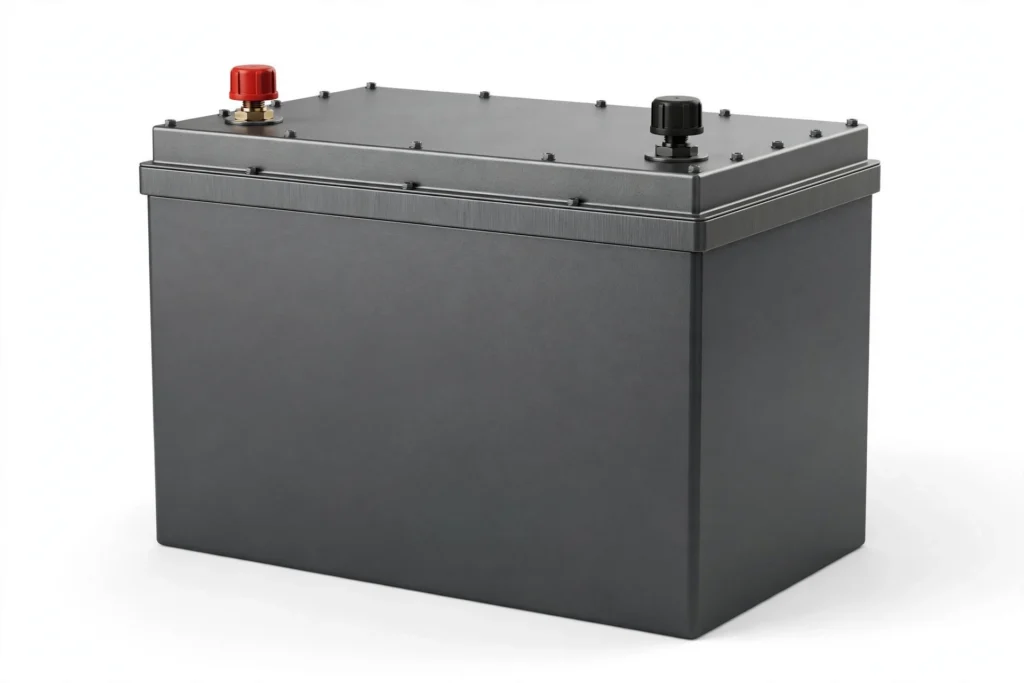
- Existing product photograph ljy-24v-100ah-lifepo4-front-white-bg-1024×683.webp (HTTP 200 at the 21:44–21:50 Asia/Shanghai first-party check already recorded in tonight’s stationary pack).
- Related live geo landings, cited as location pages only, not as parameter sources: solar-cctv-battery-kenya-highways-estates and solar-cctv-pole-battery-south-africa-estates-farms (HTTP 200, 2026-11-17 22:53 Asia/Shanghai; copies in
evidence/). Related sitemap URLs, not re-fetched as full sources in this pass: Nigeria estates and highways, Philippines LGU roads and beacons.
No third-party camera, controller, or radio manual is quoted. No market-size, sunshine, or crime statistic is used. The 8 W / 18 W / 312 Wh and two-day reserve figures are assumed worked examples, not first-party measurements.
Related guides
- 12V 100Ah deep-cycle LiFePO4 battery
- 12V 100Ah heated LiFePO4 battery
- 24V 100Ah LiFePO4 battery
- 48V vs 51.2V vs −48V
- Outdoor IP65 wall-mounted 51.2V pack
- Telecom base-station LiFePO4 rack battery (different job)
- Solar CCTV batteries in Kenya (location landing)
- Solar CCTV pole batteries in South Africa (location landing)
- Send the pole load breakdown, controller voltage and reserve assumption on the contact page
Send the pole load breakdown, controller voltage and reserve assumption on the contact page · WhatsApp +86 159 8945 0735