
Share This Article
Date: 2026-11-02
South Africans still search for batteries in the language load shedding taught them: stages, kilowatts and kilowatt-hours. That language still works for sizing a system — but the reason to buy has changed. Eskom has now gone well over 500 days without load shedding, and the buyers we work with in South Africa are no longer purchasing out of blackout fear. They are buying against rising electricity tariffs, for solar self-consumption, and to keep the backup layer in place if load shedding returns. This guide is written for that reality: how to size a 48V lithium battery the load-shedding way, how to match it to Sunsynk, Deye and Victron inverters without guessing, and what installers and resellers should confirm before quoting.
How Load Shedding Stages Translate Into Battery Size
Eskom’s stage framework is still the planning unit South African buyers know. Each stage represents roughly 1,000 MW removed from the national grid, and stages run from 1 to 8. Your municipality’s block schedule converts a stage into actual outage hours at your address — the higher the stage, the more and longer the outage blocks in a day. For battery sizing you do not need the stage itself; you need the daily outage hours you want to survive, taken from the worst stage you are planning for:
Usable energy needed (kWh) = essential load (kW) × outage hours you want to cover
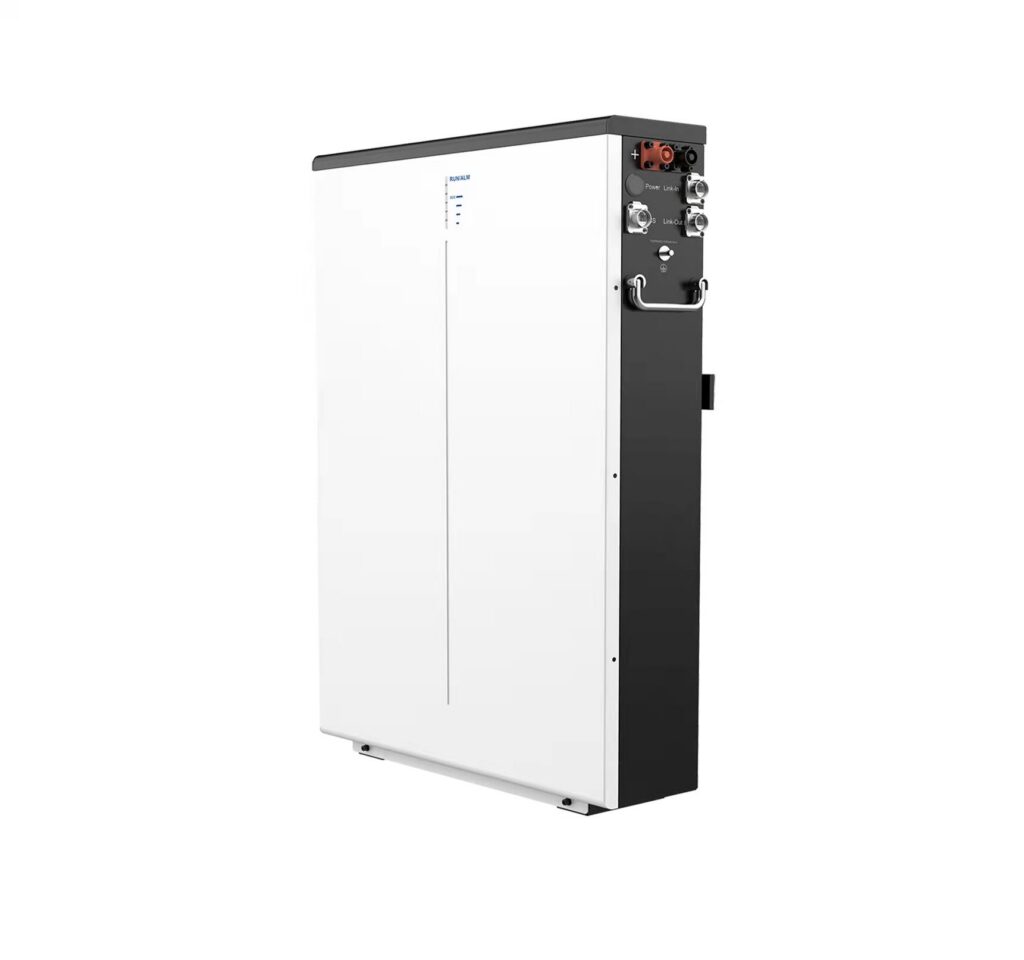
Worked example: a home keeps lights, Wi-Fi, TV, a fridge and a gate motor running — an average essential load of about 800W. To cover 6 hours of outages it needs 0.8 × 6 = 4.8kWh of usable energy. A 51.2V 100Ah LiFePO4 battery stores 5.12kWh nameplate and delivers roughly 4.6kWh usable at a 90% depth of discharge — a close match with a small margin. A business that must cover a full working day of outages at a 1.5kW average load needs 12kWh usable, which means the 15kWh class or stacked 5kWh units. Size to the outage window you genuinely plan for; buying for Stage 8 when your real planning case is Stage 2–4 doubles the battery budget for hours you will rarely use.
The Two Builds South African Buyers Actually Install
| Build | Inverter | Battery | Usable energy | Runtime at 500W avg | Runtime at 1kW avg | Runtime at 2kW avg |
|---|---|---|---|---|---|---|
| Standard home | 5kW hybrid | 51.2V 100Ah (5.12kWh) | ≈4.6kWh | ≈9 hours | ≈4.5 hours | ≈2.3 hours |
| Larger home / small business | 5–8kW hybrid | 51.2V 200Ah (10.24kWh) | ≈9.2kWh | ≈18 hours | ≈9 hours | ≈4.6 hours |
Three checks decide whether these numbers survive contact with a real installation:
- Continuous discharge current. An 8kW inverter at full output pulls roughly 160A from a 51.2V battery. One 100Ah pack with a 100A BMS cannot feed that alone — parallel packs share the current, which is one reason the 10kWh build is usually two packs or a 200Ah unit with a higher-rated BMS. Get the BMS continuous rating in writing.
- Charge window. If the grid returns for only a few hours, the inverter’s charge current decides whether the battery refills in time. Check charger amps against battery size before blaming the battery for a half-full morning.
- Expansion path. Most 51.2V wall and rack packs parallel up to a stated limit. Confirm the parallel limit and whether mixed-age packs are supported if you plan to start at 5kWh and grow.
Matching Sunsynk, Deye and Victron Inverters — Without Guessing
“Is it compatible with my inverter?” is the first question South African buyers ask, and the honest answer is: compatibility lives in the communication protocol and the settings, not in the brand names on the boxes. What can be stated from documentation:
- Deye and Sunsynk (Sunsynk inverters are built on the Deye platform) pair with 48V lithium batteries over CAN or RS485. Deye’s own approved-battery documentation uses the Pylontech CAN profile — inverter battery setup code 00 — for documented pairings. A battery whose BMS offers the Pylon CAN profile is therefore the documented route, with the setup code confirmed for the exact inverter model.
- Victron systems run through a GX device with DVCC; documented configurations exist both for CAN-connected BMS units and for voltage-based charging with defined charge voltages — for 15S 48V packs the charge voltage differs from 16S packs, and using the wrong one is a common commissioning error.
- Where no documented protocol pairing exists for a specific model, voltage-based (lead-acid mode) operation is the fallback — workable, but you lose state-of-charge accuracy and some protections, which should be a conscious decision, not a surprise after installation.
Before ordering, confirm three things for your exact inverter model: the protocol the BMS must speak, the setup code or profile to select, and the charge voltage setpoints for the pack’s cell configuration (15S vs 16S). Our inverter communication guide walks through the settings matrix brand by brand. LJY Energy coordinates battery specification against the inverter model you name in your inquiry — send the model number and we will specify the BMS protocol and settings on the quote rather than leaving compatibility as a verbal promise.
The Compliance Layer Installers Cannot Skip
In South Africa the battery is only half the job. Small-scale embedded generation (SSEG) registration with your municipality or Eskom applies to grid-connected solar-plus-storage systems, the inverter must appear on the NRS 097-2-1 approved list for legal grid connection, and the installation needs a Certificate of Compliance. Systems quoted without these items are cheaper for a reason. Installers sourcing batteries wholesale should treat the paperwork path as part of the product: it decides whether the installation can be signed off, insured and resold with the property.
Sourcing as an Installer or Reseller: What a Complete Inquiry Looks Like
The South African inquiries that move fastest with us are complete-system requests: one recent example asked for a complete 6kW charger/inverter with a 48V 500Ah LiFePO4 system, plug-and-play, 230V 50Hz. That format works because everything a supplier needs is already in it. Resellers typically start with a small sample order (single-digit units) and move to regular batches of 50–100 units once the product is proven in their installations. To get a quote that can actually be compared, include:
- Inverter brand and exact model (drives the BMS protocol specification)
- Battery size per system — 5.12kWh, 10.24kWh, or stacked — and systems per order
- Whether you need wall-mounted or rack-mount format (see the 51.2V 200Ah and 48V rack-mount ranges)
- Sample quantity and expected regular volume
- Destination — Durban and Cape Town are the usual entry ports — and who handles your clearing
Send your system specification for a trade quote →
For the broader picture — tariffs, import duty and how the South African market is structured — see our South Africa supplier guide.
FAQ
Load shedding has stopped — is a battery still worth buying?
On backup value alone, the case is weaker than in 2023, and any seller who tells you otherwise is selling fear. The current case rests on tariff savings from solar self-consumption, keeping essential loads stable through grid faults and maintenance outages (which are not the same thing as load shedding), and owning the backup layer before any return of stages rather than during the price spike that would follow. Run the numbers on your tariff and daytime usage first.
Will a 5kWh battery carry a house through a long outage?
It carries the essential load — lights, connectivity, TV, fridge — for roughly 4.5 to 9 hours depending on what is actually running. It will not carry geysers, ovens, pool pumps and air conditioning together. The sizing formula above, applied to your own load list, is the only honest answer.
Can I start with one 5kWh pack and add more later?
Usually yes — most 51.2V packs in this class support parallel connection up to a stated unit limit. Confirm the limit and the same-model requirement before the first purchase, and keep the inverter’s maximum charge/discharge current in mind as packs are added.
What must be confirmed before my installation can be signed off?
SSEG registration for the system, an inverter on the NRS 097-2-1 approved list, and a Certificate of Compliance from the installer. Confirm all three with your installer before paying a deposit — a battery cannot fix a paperwork problem after the fact.
Share This Article