
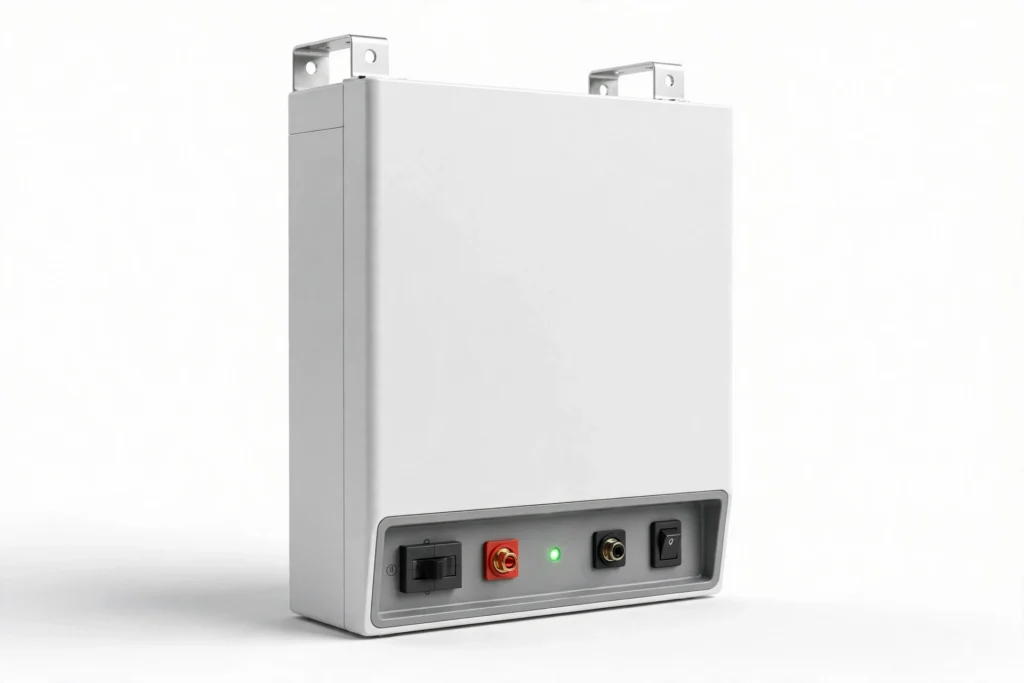
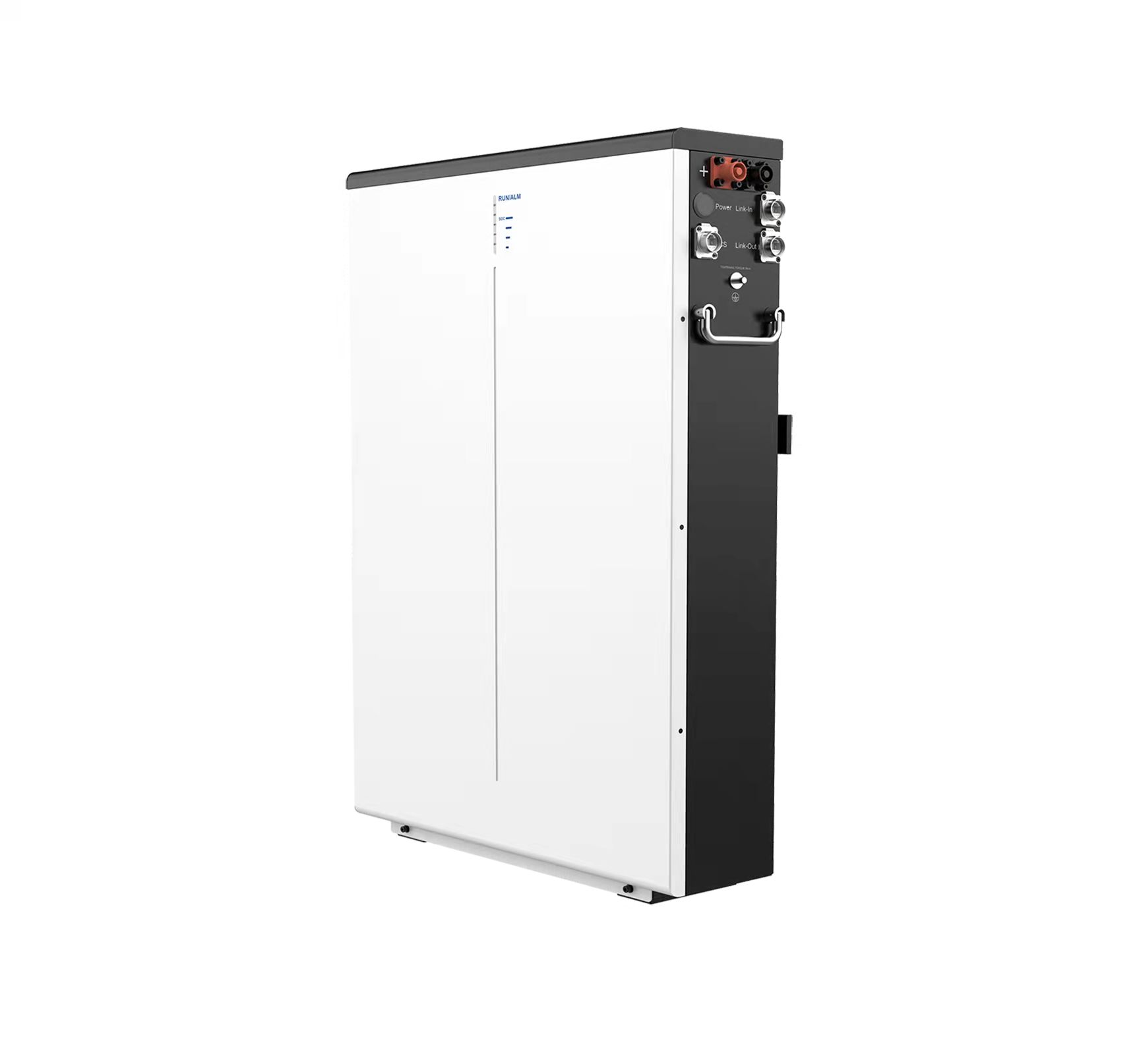
48V 100Ah Wall-Mounted LiFePO4 Battery
Product Images
Product Overview
A 5.12kWh LiFePO4 battery (51.2V nominal, 100Ah) in a space-saving wall-mounted enclosure — the entry point of our home storage range. Mounting the battery on the wall keeps it off the garage or utility-room floor, out of the way and close to the inverter. Although it is marketed in the 48V class, the pack is a 16S LiFePO4 build whose 51.2V nominal voltage sits inside the battery window of mainstream 48V hybrid inverters, making it a straightforward starter battery for solar self-consumption and essential-loads backup.
Start with one unit, then scale as the household grows: up to four units in parallel deliver 20.48kWh. Homes that already know they need more from day one can step up to the 51.2V 150Ah and 51.2V 200Ah wall-mounted models instead. As a China-based LiFePO4 battery supplier and OEM/ODM solutions provider, LJY Energy configures BMS rating, inverter communication and branding to your market requirements.
Typical Specifications
Values below are typical configurations. “Optional” items can be specified per order; “To be confirmed” items depend on the final configuration and order — contact us for the datasheet of the exact build you need.
| Parameter | Value | Status |
|---|---|---|
| Battery chemistry | LiFePO4 (lithium iron phosphate) | Typical |
| Nominal voltage | 51.2V (16S) — 48V class | Typical |
| Rated capacity | 100Ah | Typical |
| Energy | 5.12kWh | Typical |
| Enclosure | Wall-mounted enclosure, space-saving indoor installation | Typical |
| SOC indication | Front-panel state-of-charge indicator | Typical |
| Parallel expansion | Up to 4 units in parallel (20.48kWh total) | Typical |
| Charge voltage (bulk/absorption) | 56.8–58.4V | Typical |
| Inverter communication | RS485 / CAN closed-loop communication | Optional |
| Built-in BMS | Current rating per final configuration | To be confirmed |
| Bluetooth / app monitoring | Cell voltages, SOC, temperature on mobile app | Optional |
| Low-temperature charging protection | Charging cut-off below 0°C; self-heating pad available | Optional |
| Certifications | UN38.3 / MSDS / CE and others per target market | To be confirmed per order |
| Warranty terms | Subject to configuration and order agreement | To be confirmed |
| Dimensions & weight | Per final configuration | To be confirmed — datasheet on request |
| Lead time | Subject to order quantity and configuration | To be confirmed |
Why a 5.12kWh Wall-Mounted Pack
Most homes adding storage for the first time do not need a full off-grid bank — they need to shift a day’s solar surplus into the evening and keep the essentials running through an outage. That is exactly the job of this capacity class: 5.12kWh covers a typical evening of lights, refrigeration, connectivity and entertainment, and charges again from the roof the next morning. The wall-mounted format matters in practice: no floor footprint in the garage, no battery cabinet to buy, and short, tidy cable runs to a wall-mounted hybrid inverter. Because the pack speaks the 48V-class language of the mainstream hybrid inverter ecosystem, installers are working with familiar equipment — and when consumption grows (an EV, a heat pump, a bigger array), parallel units scale the same system to 10.24, 15.36 or 20.48kWh without replacing the first battery. Our Home Energy Storage solutions page sets out how this class of battery fits a complete residential system.
Charging & Compatibility
Typical charge profile: bulk/absorption at 56.8–58.4V, then termination — LiFePO4 needs no float stage and no equalization. Those figures are the 51.2V (16S) row of our charging voltage reference; see the complete charging guide for CC/CV operation.
- Hybrid inverters: choose a 48V hybrid or off-grid inverter whose battery voltage window covers a 51.2V nominal (16S) pack, and set the charge voltage to 56.8–58.4V.
- Inverter communication: RS485 / CAN closed-loop communication is available as an optional configuration — tell us your inverter model at the inquiry stage so the protocol can be matched. Voltage-based (open-loop) operation works without it.
- Solar / MPPT: program absorption to 56.8–58.4V; disable equalization (a lead-acid routine incompatible with lithium).
- Parallel banks: when units are paralleled, confirm the inverter’s total charge-current setting suits the combined bank capacity, and interconnect all units per the installation manual.
If the battery ever refuses to charge, work through our troubleshooting guide before assuming a fault.
Battery Lifespan
Cycle aging and calendar aging together determine real life. Typical reference for quality LiFePO4 cells: around 6,000 cycles at 80% depth of discharge (25°C, to 80% capacity retention) at cell level — pack results depend on BMS, thermal design and usage. Home storage duty is comparatively gentle: a daily self-consumption cycle is usually a partial discharge, and running at moderate DoD roughly doubles cycle life versus full-depth cycling while sacrificing only part of the per-cycle capacity. Over a ten-year horizon, calendar aging and installation environment (heat is the enemy) matter as much as cycle count. Our DoD vs cycle life guide explains the throughput economics, and should you charge to 100% covers the practical charge strategy.
Evaluating supplier cycle-life claims? Our procurement checklist shows how to read datasheet curves and spot inflated marketing.
Sizing & Selection
Size from your daily consumption and your backup load list, not from panel count alone. One 5.12kWh unit suits a smaller home shifting solar generation into the evening and backing up essential circuits — refrigerator, lighting, router, fans and device charging — through a typical outage. Two units (10.24kWh) cover larger households or longer backup windows; the four-unit ceiling (20.48kWh) is the growth limit of this model, beyond which the 150Ah and 200Ah wall-mounted versions become the better starting point. Installers: confirm the inverter’s battery window and charge-current settings at the quoting stage, and confirm whether the project needs closed-loop inverter communication — that choice is made per order, not retrofitted.
Applications
Wholesale, OEM & ODM
We support distributors, wholesalers, solar installers and home storage brands with flexible cooperation models. New to battery importing? Start with our MOQ and sample order guide, then see the wholesale buyer’s guide for sourcing from China step by step.
- Wholesale: volume pricing for distributors and resellers; terms vary by configuration and order size.
- OEM branding: custom enclosure, logo, labeling and packaging for your brand.
- ODM configuration: voltage, capacity, BMS rating, communication protocols and heating options matched to your application.
- Samples: sample and trial orders welcome for evaluation before volume commitment.
- Documentation support: datasheets, UN38.3/MSDS and market-specific files coordinated per order.
Frequently Asked Questions
How many units can I connect in parallel?
Up to four units, for 20.48kWh in total. Each added unit contributes another 5.12kWh — two units give 10.24kWh, three give 15.36kWh. When paralleling, match the inverter’s charge-current setting to the combined bank and interconnect the units per the installation manual.
Which inverters does it work with?
48V hybrid and off-grid inverters whose battery voltage window covers a 51.2V nominal (16S) LiFePO4 pack — that describes most mainstream 48V hybrid models. Closed-loop RS485 / CAN communication is an optional configuration matched to your inverter model per order; voltage-based operation works without it.
What does wall mounting require?
A solid, load-bearing wall and fixings rated for the unit’s weight, with reasonable ventilation clearance and protection from direct heat and water spray, following standard installation practice. The exact weight depends on the final configuration — request the datasheet for the build you are quoting before committing the wall layout.
What charge voltage should I set?
56.8–58.4V for bulk/absorption (16S at 3.55–3.65V per cell), with no float or equalization stage. Set the same values on the inverter’s battery charger or MPPT. See our charging guide for details.
Can I get this with my own brand?
Yes. We support OEM branding (enclosure, logo, labeling, packaging) and ODM configuration, confirmed per project. Contact us with your target specs.
Specifications are typical configurations and subject to the final order specification. Certifications, warranty, dimensions, lead time and pricing are confirmed per inquiry. Content as of October 2026.