
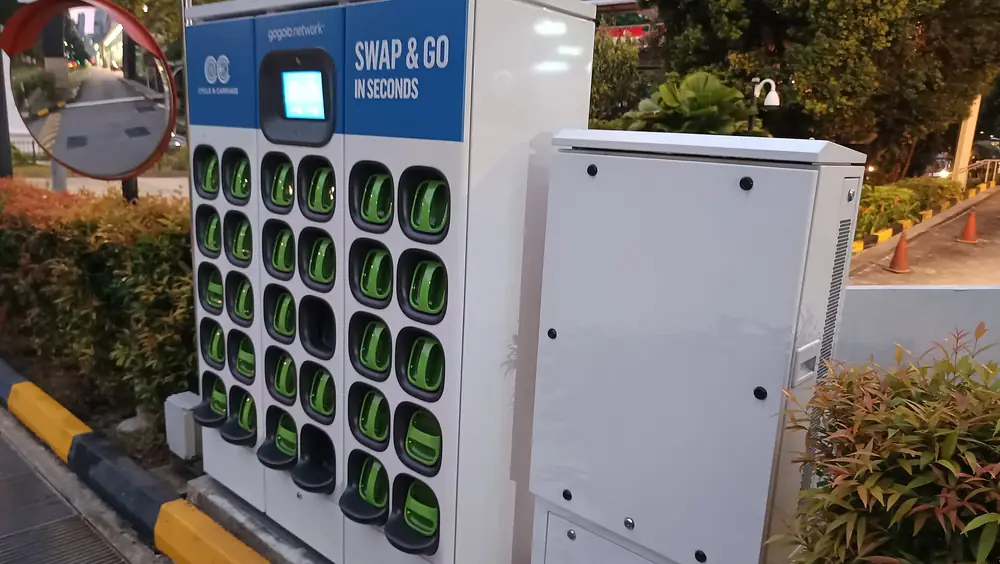
Easy-bikes and battery rickshaws in Dhaka and in district towns are still charged overnight in a garage, on strings of 12V lead-acid batteries that are replaced often. A swap kiosk would let a rider change the pack in minutes, but only if every pack fits every kiosk and every approved vehicle. An operator searching for an easy-bike battery swap pack in Bangladesh has to write one specification for the whole network.
LJY Energy is a LiFePO4 supplier and OEM/ODM coordinator in Shenzhen, not a factory, and we do not build kiosks or run a swap network. Our three-wheeler pages describe a 48V-class pack as 51.2V with 16 cells in series, charged at 58.4V, and say lead-acid chargers are not suitable. Any 60V pack is confirmed per project, because series count, charge cut-off, connector and the BMS protocol toward the kiosk must stay the same across Dhaka and the district towns.


Request a quote for an easy-bike swap pack · WhatsApp +86 159 8945 0735
What a swap specification has to lock in
| Item | Why it matters in a network | Confirmed per project |
|---|---|---|
| Series count and charge cut-off | the kiosk charger must stop at the pack’s voltage | 16S or 20S, in writing |
| Connector and pack size | packs must drop into every kiosk and every vehicle tray | drawing and sample |
| BMS to kiosk | the kiosk needs state of charge and charge limits | protocol and pinout |
| Flooded streets | connectors and IP rating in monsoon months | seal and mounting |
| 48V 100Ah three-wheeler pack | 51.2V 16S reference | capacity per shift |
A lead-acid charger left in a garage is not acceptable on a LiFePO4 swap pack; the kiosk profile is written into the specification.
Nominal voltage, charge cut-off, series count and BMS
A 48V or 60V nameplate (60V supply confirmed per project) does not say how many cells are in series or where a kiosk charger must stop. The table multiplies public per-cell values by the series count: LiFePO4 from the EVE LF304 datasheet, NMC from the Samsung SDI 18650-25R datasheet, and lead-acid from Battery University charge limits. Every 60V pack is confirmed per project.
| Chemistry and series | Nominal | Charge cut-off | BMS configuration |
|---|---|---|---|
| LiFePO4 16S (3.2V / 3.65V per cell) | 51.2V | 58.4V | 16S board |
| LiFePO4 20S | 64.0V | 73.0V | 20S board |
| LiFePO4 24S | 76.8V | 87.6V | 24S board |
| NMC 16S (3.6V / 4.2V per cell) | 57.6V | 67.2V | 16S board, NMC limits |
| NMC 20S | 72.0V | 84.0V | 20S board, NMC limits |
| Lead-acid 60V (5 × 12V, 30 cells, 2.30–2.45V per cell) | 60V | 69.0–73.5V | no BMS; LiFePO4 replacement confirmed per project |
| Lead-acid 72V (6 × 12V, 36 cells) | 72V | 82.8–88.2V | no BMS; LiFePO4 replacement confirmed per project |
A 60V lead-acid set charges up to about 73.5V, while a 20S LiFePO4 pack stops at 73.0V, so 60V supply is confirmed per project and the kiosk charger is set to the pack. A 16S BMS cannot protect a 20S pack. We never infer compatibility from a voltage name.
What the operator sends before a quote
- Vehicle models that will share the pack, and their controller cut-offs.
- Kiosk charger model, communication protocol and connector.
- Mechanical envelope of the pack and of the kiosk slot.
- Expected swaps per pack per day, and number of kiosks in the first towns.
- UN38.3 and SDS for the chosen pack come with the quote; import stays with the importer.
Pilot a few kiosks first
Operators who run one pack specification on a few kiosks in one Dhaka district through a monsoon month, then freeze the drawing, can open the next towns without mixing chargers and connectors. Prices and lead times only in a quotation.

How we proceed
Vehicle, kiosk and connector data → pack specification → pilot kiosks → network orders. Prices and lead times only in the formal quote.
Send your kiosk and vehicle data and request a pack specification
LJY Energy, Jack Lai. Unit 705, Building 1, Lecai Industrial Park, 10 Kaijing Road, Longtian Street, Pingshan District, Shenzhen 518122, China. +86 159 8945 0735.