
Telecom -48V LiFePO4 Backup Batteries: The RFQ Spec Sheet Integrators Actually Need
Replacing VRLA strings with LiFePO4 modules in base stations and outdoor cabinets is mostly a specification problem. The battery has to fit the rectifier’s voltage window, the rack slot, the monitoring system and the site’s temperature range. RFQs that only say “48V 100Ah rack battery” get quotes that are hard to compare, and the gaps tend to show up during commissioning.
This guide lists the fields a telecom battery RFQ should cover, why each one matters, and what to ask the supplier to state from a model datasheet. It is a procurement checklist, not a wiring procedure and not a claim that every named rectifier or operator test is pre-approved for a named LJY build. A quotation is not an approval to connect a pack to a rectifier or monitoring system.
The short answer
A useful RFQ gives the supplier four things: your DC system (rectifier model, float, boost and low-voltage disconnect settings, load and required backup time), the physical slot (rack standard, height, depth, terminal access), the monitoring you need (dry-contact alarms, RS485/CAN protocol, SNMP if required), and the site conditions and documents (temperature range, transport and safety documents, operator tests). It then asks the supplier to answer each field from the datasheet of a named model.
1. -48V positive-ground systems vs 48V and 51.2V LiFePO4 modules
Under ETSI EN 300 132-2 V2.6.1 (re-checked 2026-11-18 against the official PDF), the nominal voltage at the equipment power interface is -48 VDC with the positive conductor connected to earth, and the normal service voltage range is -40.5 VDC to -57.0 VDC. The standard notes that in most cases the -48 V nominal is based on a 24-cell lead-acid battery, and that lithium-ion use is increasing. It also distinguishes isolated DC return from common DC return systems, which affects how the battery’s communication ports and enclosure should be referenced.
LiFePO4 cells have a nominal voltage of 3.2 V and a typical published operating range of about 2.5 to 3.65 V per cell (industry reference chemistry range, not an LJY charge setting). A “48V” module is therefore usually built from 15 or 16 cells in series, and the two behave differently inside the same -40.5 to -57.0 V window:
| Cells in series | Nominal voltage | At 3.65 V/cell (full charge) | At 2.5 V/cell (empty) | Cell voltage at a 40.5 V cut-off |
|---|---|---|---|---|
| 15S | 48.0 V | 54.75 V | 37.5 V | 2.70 V |
| 16S | 51.2 V | 58.4 V | 40.0 V | 2.53 V |
Simple arithmetic from the cell voltages above; actual charge and cut-off limits come from the model datasheet and BMS settings.
Two practical points follow. At the top, a 16S module charged to 3.65 V per cell would exceed 57.0 V, so the rectifier’s float and boost settings must sit below that, and the supplier must state the float voltage it recommends. At the bottom, a load or low-voltage disconnect set near 40.5 V cuts a 15S module off while its cells are still around 2.7 V, so part of the rated capacity is not usable on that site. Neither is a fault; both need to be in the RFQ so that backup time is calculated on the capacity you will actually get. For a broader label-decoding of 48V vs 51.2V vs -48V, see the live 48V vs 51.2V vs -48V guide.
What to put in the RFQ
- Rectifier or power system model, and the current float, boost and LVD settings.
- Whether you can change those settings, or the battery must work with them as they are.
- Supplier to state: series cell count, recommended float and boost voltages, discharge cut-off, and usable capacity at your LVD setting.
- Supplier to provide a wiring diagram for a positive-earthed -48 V bus.
2. Form factor: 19-inch rack, height, depth, weight and terminals
Most telecom battery modules are built for 19-inch racks. Under the EIA-310 and IEC 60297 rack standards, the front panel is 482.6 mm (19 in) wide and one rack unit (1U) is 44.45 mm (1.75 in) of height, so 2U is 88.9 mm, 3U is 133.35 mm and 4U is 177.8 mm. Height in U is only part of the fit, so specify the rest:
- Depth, including handles, terminals, breakers and cable bend radius. Cabinet depth is often the binding limit.
- Weight per module, and whether one person can install it in your racks.
- Terminal and breaker position: front access is usually required in cabinets that cannot be reached from the rear.
- Mounting: ears and rails, and whether the module may be installed horizontally only.
- If your cabinets use another standard, give the internal width and mounting pitch instead.
Do not copy a marketing “2U/3U-class” label into the tender as if it were a measured tray drawing. Ask for the datasheet dimensions of the exact build.
3. Monitoring: dry contacts, RS485/CAN and SNMP
Monitoring is where “compatible” claims most often fall apart, so ask for documents rather than yes/no answers.
Dry contacts
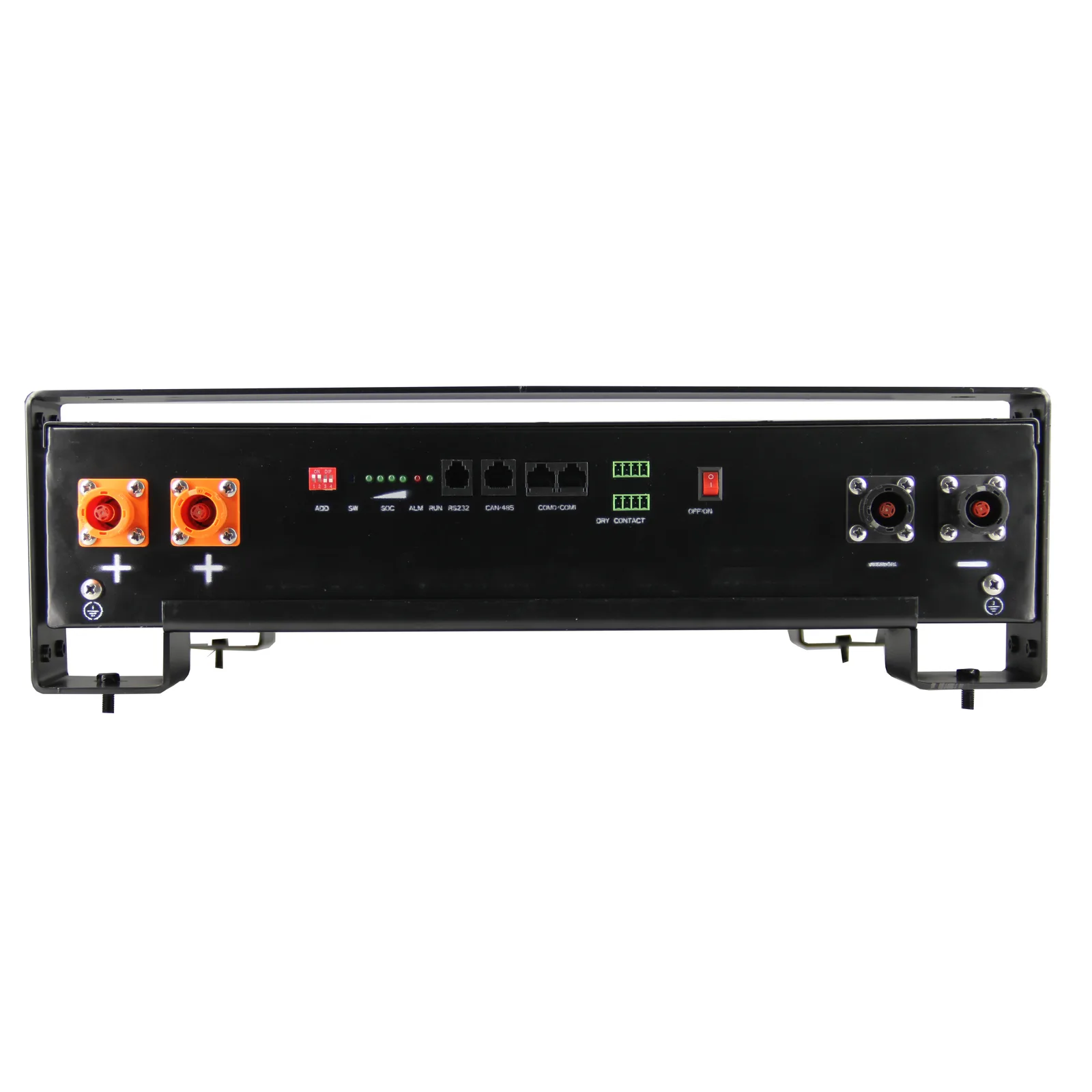
List the alarms you need on relay outputs (for example low state of charge, battery fault, over-temperature, discharge in progress) and ask the supplier which alarm maps to which contact, whether each is normally open or normally closed, and the contact rating. With several modules, ask whether alarms are per module or aggregated.
RS485 and CAN
Ask for the protocol document and the register map for the exact model and firmware, and name the controller or rectifier monitoring unit it must talk to. Also ask how addresses are set when modules run in parallel.
SNMP
Do not assume SNMP is built in. It may exist on some models or only through a gateway; confirm per model. If you need it, ask whether it is built in or needs an external gateway, which SNMP versions are supported, and for the MIB file so your NMS team can test integration before the order. The live 48V 50Ah telecom enquiry page, fetched 2026-11-18, lists CAN, RS485 and SMbus for site monitoring and does not list SNMP as a built-in item on that page.
4. Charge current: rectifier limit vs BMS limit
Rectifier battery-current-limit settings are often left at values chosen for the old lead-acid string. After a long outage, a discharged LiFePO4 bank can draw more current than that setting assumed, and if it exceeds the module’s rated charge current, the BMS may protect itself by opening, which takes the battery offline when the site most needs it.
- State the rectifier’s battery current limit and spare rectifier capacity.
- Ask the supplier for the maximum continuous charge current per module and whether the BMS actively limits charge current or only disconnects.
- State your required recharge time after a full discharge, so the supplier can check it against the current limits.
5. Temperature range and heating for outdoor cabinets
Lithium-ion batteries, LiFePO4 included, should not be charged below freezing (0°C / 32°F) unless the design allows it. Outdoor cabinets in cold climates therefore need either a temperature-controlled enclosure or modules with self-heating. Hot cabinets matter too, because high temperature shortens service life.
- Give the cabinet’s internal temperature range (minimum and maximum), not only the outdoor climate.
- Ask for separate charge and discharge temperature ranges, any derating at high temperature, and whether a heater option exists for the model.
6. Parallel strings, migration and anti-theft
The number of modules that can run in parallel depends on the model’s BMS and communication design and is stated on the model datasheet, so do not assume a figure from another brand. Ask, per model:
- The maximum number of modules in parallel, and whether a master module or hub is required.
- Whether modules may run alongside the existing VRLA string during migration. Get the answer in writing.
- Whether modules of different ages or firmware may be mixed when you add capacity later.
Battery theft is a real cost at remote sites. Options such as lockable brackets, GPS or motion sensors and software locks vary by model, so ask what exists rather than assume.
7. Documents and tests
Two documents matter for every shipment. Manufacturers and subsequent distributors of lithium batteries must make available a UN38.3 test summary (UN Manual of Tests and Criteria, 38.3.5) that identifies the battery model, and you will need a safety data sheet (SDS) for transport and site safety files. Ask for both for the exact model and, if you are importing, check that the model number matches your order.
For product safety, IEC 62619 covers secondary lithium cells and batteries for industrial applications, and its scope names stationary telecom and UPS use. Operators may also require their own acceptance tests. Request IEC 62619 and operator-specific testing for the exact build; they are arranged per project, with certification and testing fees borne by the buyer. The certificate verification guide on this site explains how to check a report before you rely on it. Do not treat a marketing page as already having certified the site.
8. RFQ table: copy into your tender
| Section | You provide | Supplier states (from the model datasheet) |
|---|---|---|
| DC system | Rectifier model; float, boost and LVD settings; earthing (isolated or common DC return) | Series cell count; recommended float and boost; discharge cut-off; usable capacity at your LVD |
| Load and autonomy | Site load (W or A at -48 V); required backup time; growth margin | Proposed module and quantity; calculated backup time |
| Form factor | Rack standard; available U; maximum depth; front or rear access | Height (U), width, depth with handles and terminals, weight; terminal and breaker position |
| Monitoring | Required dry-contact alarms; controller or NMS to integrate; SNMP need | Alarm-to-contact map; RS485/CAN protocol document and register map; SNMP built in or via gateway; MIB file |
| Charging | Rectifier battery current limit; recharge-time target | Maximum charge current; BMS current limiting or disconnect behaviour |
| Environment | Cabinet internal temperature range; altitude; indoor or outdoor | Charge and discharge temperature ranges; heater option; derating |
| Expansion | Planned module count now and later | Maximum parallel count; master/hub need; mixing rules |
| Security | Theft risk at site | Available locking, tracking or software-lock options |
| Documents | Operator test list; import country | UN38.3 test summary and SDS for the model; IEC 62619 or operator tests arranged per project (fees borne by buyer) |
Existing enquiry pages — use them as entries, not as a hidden catalog guarantee
These live pages can be used as enquiry entries. Values marked on those pages as typical, industry reference, optional, or confirmed per project remain in those categories. This article does not convert them into stock promises or certified-for-every-rectifier claims.
- 48V 50Ah telecom LiFePO4 page (fetched 2026-11-18) — the page states a typical 48.0 V (15S), 50 Ah, 2.40 kWh configuration, a typical 54.75 V charge voltage, a 19-inch rack 2U/3U-class form factor, and CAN, RS485 and SMbus for site monitoring. Certifications are marked per project. Enquiry code on that page:
48V-50Ah-Telecom. - 48V 50Ah LiFePO4 telecom product page (same date) — a second enquiry entry for the same 50 Ah class; use it for form-factor context, not as a second, different guaranteed SKU matrix.
- Telecom backup power solutions — the solutions overview, not a substitute for the rectifier and monitoring fields above.
- 51.2V rack-mount LiFePO4 page — a 16S-class rack enquiry entry. Do not treat it as a drop-in for a -48 V rectifier without checking the voltage window and grounding.
The primary enquiry tag for this checklist is the existing telecom backup solutions code. If your enquiry is clearly a 48V 50Ah module request, say so in the message so it is not treated as a solar 16S or house ESS pack.
Send your rectifier model and site spec · WhatsApp +86 159 8945 0735
Sourcing telecom LiFePO4 modules through LJY
LJY Energy supplies LiFePO4 packs used in telecom backup enquiries and coordinates OEM/ODM supply; it is not a factory. For telecom projects the work is to match your RFQ fields to a named model, answer each field from that model’s datasheet, and coordinate documents and any project testing. Where a field such as SNMP or a heater depends on the model, it is confirmed per model rather than assumed.
What this page does not decide
- It does not approve a pack for a named rectifier, NMS or operator acceptance test.
- It does not publish a guaranteed parallel-module count, SNMP feature list, or dry-contact map for a LJY build.
- It does not give wiring, bonding, or rectifier-modification steps.
- It does not invent prices, lead times, MOQ, or a claim that a pack is already certified for every telecom survey.
FAQ
Can LiFePO4 float on a -48V rectifier?
It can, provided the rectifier float and boost voltages are set within the battery model’s recommended range and below the 57.0 V upper limit of the ETSI normal service range. Put your rectifier model and current settings in the RFQ and ask the supplier to state the recommended float voltage for the model.
Should a -48V telecom battery be 15S or 16S?
Either can work if the settings match. A 15S module (48.0 V nominal) reaches 54.75 V at 3.65 V per cell, while a 16S module (51.2 V nominal) gives more usable capacity above a 40.5 V cut-off but needs float and boost settings kept below 57.0 V. Choose based on your rectifier settings and LVD, and ask for usable capacity at your settings.
Is SNMP built in?
Do not assume it. SNMP may exist on some models or only through a gateway, so confirm per model and ask for the MIB file before ordering. The live 48V 50Ah telecom enquiry page, as fetched, lists CAN, RS485 and SMbus, not SNMP.
How many modules can be paralleled?
The maximum is set by each model’s BMS and communication design and is stated on the model datasheet. Ask whether a master module or hub is needed and whether modules of different ages may be mixed later.
What alarms come out on the dry contacts?
It varies by model. List the alarms you need, such as low state of charge, battery fault and over-temperature, and ask for an alarm-to-contact map with normally open or closed status and contact rating.
Can LiFePO4 batteries be charged in a cold outdoor cabinet?
Lithium-ion batteries, including LiFePO4, should not be charged below 0°C unless the design allows it. Give the cabinet’s internal temperature range and ask whether the model has a self-heating option.
Sources
- ETSI EN 300 132-2 V2.6.1 (2019-04), official PDF re-fetched 2026-11-18: nominal -48 VDC at interface “A” with the positive conductor connected to earth; isolated vs common DC return; note that the -48 V nominal is in most cases based on a 24-cell lead-acid battery and that lithium-ion use is increasing; normal service voltage range -40.5 VDC to -57.0 VDC. ETSI PDF.
- Live LJY Energy page 48V 50Ah telecom product page, ordinary public GET, 2026-11-18 Asia/Shanghai — typical 48.0 V / 15S / 50 Ah / 2.40 kWh figures, typical 54.75 V charge voltage, 19-inch 2U/3U-class form factor, CAN/RS485/SMbus, certifications per project; enquiry code
48V-50Ah-Telecom. - Live LJY Energy pages 48V 50Ah LiFePO4 telecom product page, telecom backup solutions, 48V vs 51.2V vs -48V, and 51.2V rack-mount page, same date — used as enquiry and label-decoding links, not as a guaranteed SKU matrix.
- Topic brief T04 in
ljy-knowledge/products-tech/research/content-topics-20261029/and the unpublished 2026-10-29 ready-to-paste drafttelecom-48v-lifepo4-battery-rfq-specification, reviewed and updated 2026-11-18 before publish. Competitor datasheets in that brief were used only as a reminder of which RFQ fields to list, not as numbers to copy. - Battery University BU-205 / BU-409 / BU-410 and EIA-310 / IEC 60297 rack geometry were used in the 2026-10-29 draft for the typical 3.2 V / 2.5–3.65 V cell window, the 0°C charge caution, and 19-inch / 1U arithmetic; those figures remain labelled as industry-reference or standard geometry, not as LJY model limits.
- PHMSA lithium-battery test-summary guide / 49 CFR 173.185(a)(3) for the duty to make a UN38.3 test summary available; IEC webstore description of IEC 62619:2022 for industrial, including stationary telecom, scope.
Related guides
- 48V vs 51.2V vs -48V LiFePO4 — what the label means
- 48V 50Ah telecom product page
- Telecom backup power solutions
- Closed-loop inverter communication for 51.2V packs — a related communication check, not a telecom SNMP method
- How to check a battery certificate before you rely on it
- Custom LiFePO4 RFQ checklist — a different, non-telecom RFQ job
Send your rectifier model and site spec · WhatsApp +86 159 8945 0735