
DC-portable LiFePO4 packs for field instruments and camping — procurement and acceptance
A datalogger on a mast, a conservation camera, a survey radio, or a camping box that only feeds 12V lights and a fridge is a DC-portable pack job. The buyer is not asking for a whole-house storage cabinet, and is not asking us to build a consumer “solar generator” brand. They need a low-voltage LiFePO4 pack whose voltage window, current, charge path, climate limits and standby behaviour can be accepted against the instruments or DC loads they already have.
LJY Energy is a LiFePO4 supplier and OEM/ODM coordinator in Shenzhen; we are not a factory. We supply battery packs. We do not claim that a pack is approved for a named instrument, camera, radio or camping fridge, and we do not claim industrial or medical grade. Nothing on this page is a wiring or modification procedure. Typical figures come from published LJY product pages and must be confirmed on the order datasheet.
Short answer
- Match the instrument or camping DC load to a pack voltage class — commonly 12.8V (12V class), sometimes 25.6V (24V class) — using the load’s own input window, not a marketing “12V” label.
- Energy (watt-hours × days in the field) and current (running plus any compressor, radio or motor startup) are separate checks. A catalogue amp-hour figure does not clear the startup check.
- A pack is not a complete portable power station. Brands that need a pack built into a branded station, without the inverter, MPPT and outlets, already have a different page: LiFePO4 battery packs for portable power stations (OEM/ODM).
- An RV house-battery or chassis install is a different procurement job and is not specified here.
- Do not charge below 0°C unless the ordered configuration includes documented low-temperature charge protection or heating. Field and camping packs are often charged from a small solar array on cold mornings — that is a charge-boundary issue.
- Instruments left for weeks need a standby figure, not only a runtime figure. The 12V 100Ah deep-cycle page publishes a typical self-discharge of <3% per month at 25°C; BMS parasitic draw still has to be confirmed on the order datasheet. Do not copy that figure onto a 24V pack.
What this page covers, and what it does not
This page covers pack-level procurement and acceptance for:
- Field instruments and small outdoor electronics that already have a DC input: environmental loggers, weather stations, conservation or survey cameras, radios and similar equipment the buyer names. “Similar” is not a licence to treat this as a medical, laboratory or industrial-certified product page — we do not make those claims.
- Camping and portable DC loads: lights, 12V sockets, a 12V compressor fridge, phone charging from a DC outlet the buyer already has. The pack may be carried between sites.
This page does not cover: a complete portable power station sold as a finished consumer product; OEM work for a power-station brand (use the existing OEM page); RV or camper-van house and starter batteries; marine trolling or house banks; vehicle auxiliary installs; home energy storage; telecom −48V plants; or shop AC backup (that is a separate checklist in this pack).
Load, startup and days in the field
Load. Write each device, its permitted input voltage, and a measured or nameplate current. For instruments that sleep and then wake, use the duty cycle the buyer can defend (sleep current × hours, plus wake current × hours). For a camping 12V fridge, use the running current and the duty cycle in the climate where it will be used, if the fridge maker publishes one — do not invent a duty cycle here.
Startup. Compressor fridges, some radios and any small motor can demand a short peak. The pack’s continuous and peak discharge ratings must be checked against that peak. The 12V 100Ah deep-cycle page lists a typical continuous current of 100A and a typical peak of 200A for ≤3 s. Those are typical values for that SKU class, not a guarantee and not a claim that this is the right portable pack for every fridge or radio.
Runtime or days in the field. Agree whether you are buying one working day, a weekend, or unattended weeks. Convert that to usable energy after the depth of discharge you are willing to write into the quotation. The same 12V 100Ah page lists typical nominal energy of 1,280Wh and a typical usable figure of about 1,024Wh at 80% depth of discharge. Use those only as published typical arithmetic for that page, then confirm the datasheet.
Stay DC unless an inverter is specified — and then specify it
The default path on this page is DC-to-DC: pack → a distribution lead or a DC socket the buyer already uses → the instrument or camping load. Add an inverter only when there is a real AC load and a named inverter with a documented battery window. An inverter changes startup behaviour, idle consumption (the inverter itself may drain a small pack overnight) and the charge architecture. LJY does not certify named inverters or named fridges on this page.
Charge sources must be written down: an AC LiFePO4-profile charger, a solar charge controller with a documented lithium or user-defined profile, or both. A typical absorption range on the 12V 100Ah deep-cycle page is 14.2–14.6V. The 24V 100Ah page lists a typical charge voltage of 28.4–29.2V at a nominal 25.6V. A lead-acid “12V solar” profile is not automatically correct. We do not publish a default charger model or a default array size.
Do not treat a 48V / 51.2V storage module, or a telecom −48V rack module, as a portable 12V field pack. Those are different classes and, for telecom, a different polarity. See 48V vs 51.2V vs −48V.
Climate: cold charge is the usual field failure
Portable packs are charged outdoors. The published 12V 100Ah deep-cycle page states a typical charge range of 0°C to 45°C and says not to charge below 0°C unless low-temperature protection is fitted; typical discharge is −20°C to 60°C. The 12V 100Ah heated page states that charging LiFePO4 cells below 0°C can cause permanent lithium plating, and that a standard pack’s BMS will block charge until the cells are warm. Heating engagement and power are confirmed per configuration.
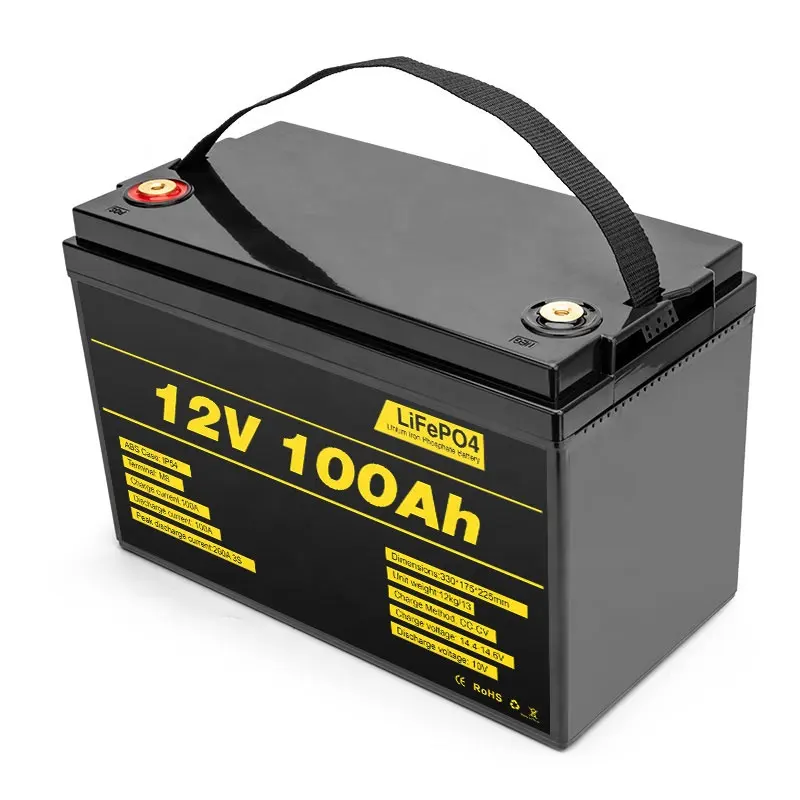
If a logger or camping box will be charged from a solar panel on a sub-zero morning, the RFQ should ask for low-temperature charge protection or a heated configuration. If the pack is only charged indoors above 0°C, say that — a heated option may be unnecessary. Enclosure ingress ratings are confirmed on the datasheet, not inferred from a carry-handle photograph. The deep-cycle page describes a typical ABS case with a carry handle; other terminal types are typical or optional.
Standby for unattended instruments, and how to accept a pack
A camping pack used every weekend and an instrument pack left on a mast for a season fail in different ways. For unattended instruments, the quotation should include:
- The sleep and wake currents you used to size energy.
- A datasheet figure for BMS standby or parasitic draw, not only the typical monthly self-discharge published for the 12V 100Ah deep-cycle page.
- How the pack will be recharged in the field, and what happens when charge is blocked by low temperature.
- The acceptance method written in the quotation (for example a discharge to a recorded load, or a capacity method agreed in the order). This page does not invent a universal field-calibration protocol.
- Shipping documents for the configuration you order. UN38.3, MSDS and any market marks are described on product pages as coordinated or confirmed per order.
Bluetooth or app monitoring is listed as optional on several published 12V and 24V pages. If you need to read state of charge or cell temperature without opening the box, ask for it in the RFQ; do not assume it is fitted.
What to send when you enquire
- The instrument or camping load list, input voltage windows, running current, and any published startup or compressor figures.
- Days unattended or hours of camping use, and whether the pack must be carried by hand (weight and handle are then part of the enquiry; the 12V 100Ah deep-cycle page lists a typical weight of about 12 kg — confirm the datasheet).
- Charge method: AC charger, solar controller already on hand, or both, including any profile you already use.
- Minimum and maximum temperatures, and whether charge may occur below 0°C.
- Connector or terminal preference if you have one; published pages describe typical M8 terminals on the 12V 100Ah deep-cycle pack, with other types typical or optional. We do not treat a connector photograph as a standard for every order.
- Whether this is actually an OEM power-station pack request — if it is, use the OEM page, not this checklist.
Send the load list, days in the field and charge method on the contact page.
What this page does not decide
- It does not approve a named logger, camera, radio, fridge, charger or inverter.
- It does not specify an RV house or starter battery, and it does not size a portable power station as a finished consumer product.
- It does not claim medical, laboratory or industrial certification.
- It does not turn a 51.2V storage module or a −48V telecom module into a portable 12V pack.
Frequently asked questions
Can I use this pack as the battery inside a portable power station I sell?
That is an OEM/ODM pack project for a branded station, not this checklist. Use the existing portable power station OEM page and send mechanical and certification requirements with the enquiry.
Is this the same as an RV house battery?
No. A house battery in a road vehicle has a different install, charge path and duty. This page is for DC-portable packs used with instruments or camping DC loads, not for a vehicle habitation install.
Will a 12.8V pack run my “12V” instrument without checks?
Not automatically. Confirm the instrument’s input window against the pack’s rest, load and charge voltages on the datasheet. The same applies to a 25.6V pack used with equipment labelled only as “24V.”
Do I need heating if I only discharge in the cold and charge indoors?
If charge never occurs below the datasheet minimum, a heater may not be required. If a solar panel may try to charge the pack below 0°C, low-temperature protection or heating should be in the RFQ.
Sources
- LJY Energy, 12V 100Ah deep-cycle LiFePO4 battery (typical 12.8V, 100Ah, 1,280Wh, about 1,024Wh at 80% DoD; charge 14.2–14.6V; charge 0°C to 45°C; discharge −20°C to 60°C typical; 100A continuous / 200A for ≤3 s typical; self-discharge <3% per month at 25°C typical; typical weight about 12 kg): https://ljyenergy.com/12v-100ah-deep-cycle-lifepo4-battery/
- LJY Energy, 12V 100Ah heated LiFePO4 battery: https://ljyenergy.com/12v-100ah-heated-lifepo4-battery/
- LJY Energy, 24V 100Ah LiFePO4 battery (typical 25.6V, 2.56kWh, charge 28.4–29.2V): https://ljyenergy.com/24v-100ah-lifepo4-battery/
- LJY Energy, LiFePO4 battery packs for portable power stations (OEM/ODM) — different buyer job: https://ljyenergy.com/lifepo4-battery-packs-portable-power-station-oem/
- LJY Energy, 48V vs 51.2V vs −48V: https://ljyenergy.com/48v-vs-51-2v-vs-minus-48v-lifepo4/
- LJY Energy, contact: https://ljyenergy.com/contact/
Source limitation: typical and optional values are not guarantees and are not a compatibility matrix. No instrument standard, camping regulation or certification was invented.
Related guides
- LiFePO4 packs for portable power stations (OEM/ODM) — brand / enclosure OEM, not this DC-portable checklist
- 12V 100Ah deep-cycle LiFePO4 battery
- 12V 100Ah heated LiFePO4 battery
- 24V 100Ah LiFePO4 battery
- 48V vs 51.2V vs −48V
Send the load list, days in the field and charge method on the contact page