
Share This Article
Content type: B2B product-family page for US resellers, distributors and private-label buyers. Group dimensions are BCI maximum footprints as published in our BCI group size chart. Demand examples are drawn from real LJY Energy inquiry records (buyer names withheld). No pricing, MOQ, certification or lead-time claims are made on this page; specifications are confirmed in writing per order.
The short answer: US buyers do not shop for 12V lithium batteries by amp-hours — they shop by BCI group size. The group number fixes the physical footprint a tray, box or compartment was built for, so a reseller’s catalogue has to be organised the same way. This page organises LJY Energy’s 12V LiFePO4 supply by the four groups US resellers ask us about most — Group U1, Group 24, Group 27 and Group 31 — with the fitment checks that decide whether a “drop-in replacement” actually drops in.
Why US buyers spec by group size, not amp-hours
The inquiry pattern from US buyers is consistent enough to build a page around. In our own records, American buyers ask for tiered quotations — 10 / 50 / 200 units, or samples at 10 / 100 / 1,000 / 10,000+ — and they name the product by group size: “12V 35Ah Group U1 replacement batteries”, “12 Volt 100AH group 31 … for reselling to the American market”. One Texas reseller scoped a Group 31 programme around a national network of independent reps; one powersports brand asked for Group U1 pricing together with BMS specifications and cell C-ratings before anything else. Amp-hours appear in these inquiries, but the group size is the headline — because the group size is what their customers’ equipment already dictates.
That is the gap this page closes. Chinese suppliers typically list 12V batteries by capacity alone, which forces the US buyer to reverse-engineer fitment from a dimension line in a datasheet. Below, each group is matched to the applications it serves, the LJY supply route for that footprint, and the details a reseller should confirm before quoting it onward.
The four resale groups at a glance
| BCI group | Max footprint, mm (in) | BCI-listed terminals | Typical US applications | LJY supply route |
|---|---|---|---|---|
| U1 | 197 × 132 × 186 (7¾ × 5³⁄₁₆ × 7⁵⁄₁₆) | X | Garden tractors, mobility equipment, small solar and standby power | Coordinated build — 35Ah-class U1-case packs specified per project |
| 24 | 260 × 173 × 225 (10¼ × 6¹³⁄₁₆ × 8⅞) | A, A2 | Travel trailers, small boats, compact battery boxes | Standard 12V series, footprint-specified |
| 27 | 306 × 173 × 225 (12¹⁄₁₆ × 6¹³⁄₁₆ × 8⅞) | A, A2 | RV house batteries, mid-size marine banks | Standard 12V series — the 100Ah class is the volume fit |
| 31 | 330 × 173 × 240 (13 × 6¹³⁄₁₆ × 9⁷⁄₁₆) | A, M, M1 (31A) · T, M, M1 (31T) | Large RV banks, commercial vehicles, marine house systems | Standard 12V series — 100Ah deep-cycle anchor, 200Ah class for larger banks |
Footprints above are BCI maximum case dimensions, not the dimensions of any single model. For the full chart — including Groups 4D, 8D, GC2 and the DIN/EN equivalents — see the BCI group size chart for LiFePO4 batteries. Exact case dimensions of the model you order are confirmed on its datasheet before production.
Group U1: the small-format quote magnet
Group U1 is the smallest footprint on this page and, per inquiry volume, the one US buyers most often ask Chinese suppliers to quote in tiers. The U1 case (197 × 132 × 186 mm maximum) serves garden tractors, mobility equipment, small off-grid solar and standby applications — equipment sold in high unit counts through exactly the dealer and rep networks that resellers run. The LiFePO4 configuration buyers request in this footprint is the 12V 35Ah class.
U1 is not a catalogue line we hold as a standard series model; it is supplied as a coordinated build: the U1 case, terminal arrangement and BMS are specified per project and confirmed in writing before production. That is also how the serious U1 buyers already work — the most detailed U1 inquiry in our records led with two questions, BMS specification and cell C-rating, ahead of price tiers. A reseller specifying a U1 programme should expect to confirm, per project:
- Continuous and peak discharge the application actually draws — starting and traction loads in U1 equipment are short but not small, and the BMS rating must be chosen against them, not against the capacity.
- Cell C-rating and configuration, stated in the written specification, so the quoted pack and the delivered pack are the same pack.
- Terminal form and position against the equipment being replaced — U1 trays leave no room for cable workarounds.
- Low-temperature charge protection where the equipment lives outdoors or in unheated storage.
If you are building a U1 programme, send the application, the discharge profile and your quantity tiers. We return a fitment-checked specification before any order is placed — the same written-confirmation route described in our wholesale buyer’s guide.
Group 24 and Group 27: RV and marine house batteries
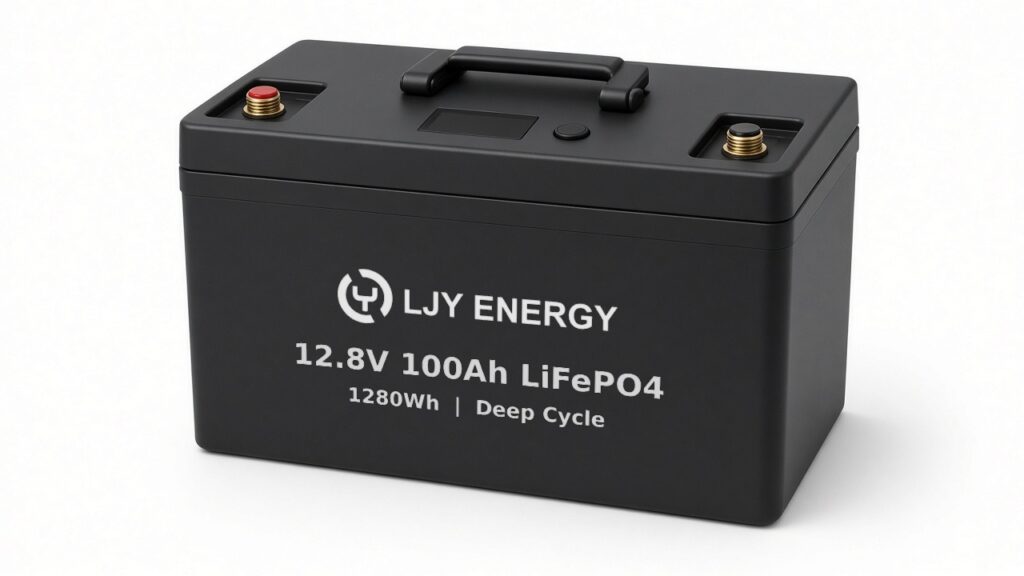
Groups 24 and 27 are the house-battery heartland: travel trailers, RVs and mid-size marine banks. Group 27 is the most common house-battery footprint in North America, and it is where our standard 12V series does its volume work — the 100Ah class (12.8V nominal, 1.28kWh) is the standard fit resellers stock against this tray size, with the 200Ah class serving larger banks where the installation allows a bigger case or paired units. Group 24 covers the compact end — smaller trailers, small boats and tight battery boxes — and is specified from the same series platform.
The series shares one 12.8V platform (4S prismatic cells, 14.6V typical charge voltage) across capacities, so a dealer stocking against Groups 24/27/31 is holding one system, not three. The full capacity ladder, feature options and dealer stocking logic are on the 12V LiFePO4 battery series page; the volume model itself is the 12V 100Ah deep-cycle LiFePO4 battery.
Group 31: the reseller’s volume size
Group 31 is the big standard — large RV banks, commercial vehicles and marine house systems — and the footprint US resellers most often frame a programme around. The configuration buyers ask us for in this size is 12V 100Ah: deep-cycle, sized for resale into the American market through dealer and rep networks. Our anchor for the footprint is the same 12V 100Ah deep-cycle model above, with the 200Ah class from the 12V series covering larger banks built in or around the Group 31 envelope.
Two Group 31 details decide repeat orders. First, the 31A / 31T terminal split: BCI lists different terminal sets for the two variants, and a reseller whose customers run stud terminals cannot quietly substitute post terminals — confirm the variant on the order, not on delivery. Second, weight: a LiFePO4 pack is roughly a third of the weight of the lead-acid unit it replaces, so hold-downs designed for a heavy battery may not grip the lighter case. Both checks are in the fitment list below; both are cheaper on paper than in a returns bay.
“Drop-in replacement”: what the group number guarantees — and what it does not
A BCI group number is an open fitment standard, not a brand certification. It guarantees the maximum footprint and the terminal family — which is why a battery built to a Group 31 footprint fits a Group 31 tray regardless of the badge on the battery it replaces, and why US buyers comparing domestic brands (our Battle Born alternative guide covers that comparison) still start from the group size. It does not guarantee that the replacement is electrically or mechanically finished. Before quoting any group-size battery as a drop-in replacement, run the five checks:
- Tray dimensions — length, width and usable height, including lid clearance and cable bend radius.
- Terminal position and polarity — lithium cases place terminals differently than the lead-acid unit they replace; confirm type and which corner the positive lands on.
- Hold-down — a battery at a third of the original weight may need brackets or a box the installation does not yet have.
- Charging compatibility — fitment is mechanical, charging is electrical: the system needs a lithium charge profile (14.6V absorption class), not a lead-acid equalisation cycle.
- Cable reach and fuse placement — if the new terminal sits farther from the distribution panel, budget the longer cable run in the quote.
The worked version of this checklist, with the DIN/EN equivalents for buyers who also source for European equipment, is in the BCI group size chart and the fitment section of the 12V series page.
Specifying a group-size order
LJY Energy is a China-based LiFePO4 battery supplier and OEM/ODM coordination partner. Production is carried out by qualified manufacturing partners; we match the build to your market, confirm the specification in writing, and coordinate quality checks and export. For group-size programmes, the fastest route to an accurate quotation is to send:
- The BCI group (and variant, for Group 31) and the application it serves;
- Target capacity and the discharge profile, if the application is motor-driven;
- Quantity tiers — US buyers typically quote samples, first stocking order and programme volume as separate lines, and we price the same way;
- Terminal and polarity requirements, plus any monitoring requirement (Bluetooth, low-temperature cut-off, heating);
- Private-label requirements, if the programme carries your brand — enclosure, label and documentation options run through our OEM & ODM programme.
Resellers building a broader first order can browse the full range in the product catalog or the 12V LiFePO4 hub. When you are ready, send the group size, application and quantity tiers through the contact page — group-size inquiries are answered against the written specification for that footprint, not a generic 12V datasheet.
Frequently asked questions
Does a Group 31 LiFePO4 battery fit any Group 31 tray?
It fits the footprint — that is what the group standard fixes. Finishing the installation still requires the terminal, polarity, hold-down and charging checks above; a tray fit is necessary, not sufficient.
Why do two batteries with the same group size have different capacities?
The group number fixes the box, not the contents. Cell format, cell count and BMS hardware inside the same case vary by model, which is why capacity in one footprint legitimately differs between brands — and why the written specification matters more than the group label.
Can you supply Group U1 in our own brand?
Yes — U1 programmes run as coordinated OEM/ODM builds, including private-label enclosure and documentation options confirmed per project through our OEM & ODM programme.
What should a first group-size order look like?
Most resellers start with samples of one or two groups against real customer equipment, then place the stocking order on the group that validated. Quantity tiers are quoted separately so the sample price is never mistaken for the programme price.
Do you publish prices or MOQs for group-size batteries?
No. Pricing depends on the confirmed specification, quantity tier and destination, and is provided in the quotation. What this page commits to is the process: fitment checked against the group footprint, specification confirmed in writing, and export coordinated from China to your port.
Share This Article