
Share This Article
Content type: Engineering conversion guide — what actually has to change when you replace a golf cart’s lead-acid bank with a LiFePO4 pack, and what can stay. This guide strictly separates confirmed electrical facts, engineering inference (labeled calculations), and industry reporting (vendor claims and forum consensus, labeled as such). Range and cost figures from sellers are presented as claims, not measurements. LJY Energy is a China-based LiFePO4 battery supplier and OEM/ODM partner working with a trusted manufacturing partner; nothing here implies any relationship with Club Car, EZGO, Yamaha, or ICON, and no product specifications, stock levels, or certifications are promised.
The short answer: on a cart that is already a 48V system, a lithium conversion means swapping five things — the battery bank, the charger, the Club Car OBC (bypass, on older models), the 48V→12V reducer, and the battery gauge — while the motor, controller, and solenoid usually stay. The two mistakes that ruin conversions are an undersized BMS that cuts out on hills and keeping the old lead-acid charger, which charges to the wrong profile. Get the voltage math and those two items right and the rest is mechanical work: a 51.2V 100Ah LiFePO4 pack stores 5.12 kWh, weighs less than a third of the lead-acid bank it replaces, and typically pays for itself before the second lead-acid replacement would have been due.
Key Facts at a Glance
| Fact | Value + unit | Source | Confidence |
|---|---|---|---|
| 48V-class LiFePO4 pack (16S) | 51.2 V nominal; 58.4 V full charge (3.65 V/cell) | Product specs, multiple vendors | Confirmed |
| 48V lead-acid bank | 48 V nominal (6×8V / 8×6V / 4×12V); ~50–52 V fully charged | Electrical fundamentals; wiring guides | Confirmed |
| 36V lead-acid bank | 36 V nominal (6×6V); ~38–39 V fully charged | Electrical fundamentals; wiring guides | Confirmed |
| 100Ah lithium pack energy | 51.2 V × 100 Ah = 5.12 kWh | Arithmetic | Engineering inference (labeled) |
| Typical conversion-kit BMS | 200A continuous; ~1000A peak (3–5 s) | Vendor product specs | Industry reporting |
| Lithium charger for 48V pack | 58.4 V, typically 15–20A; CC-CV profile | Vendor product specs | Industry reporting |
| Pack weight, 100–105Ah lithium | ~83–110 lbs (38–50 kg) | Vendor product specs | Industry reporting |
| 48V lead-acid bank weight | ~380 lbs (~172 kg) | Vendor comparison data | Industry reporting |
| Cycle life, LiFePO4 (claimed) | 4,000–6,000 cycles | Vendor claims | Industry reporting — claim, not measured |
| Cycle life, flooded lead-acid | 300–500 cycles | Industry consensus | Confirmed (range) |
| Range per 100Ah charge (claimed) | 40–50 miles | Vendor claims | Industry reporting — claim, conditions unstated |
| Real-world consumption | ~20–30 Wh/mile flat; 40–60+ Wh/mile hills/load | Vendor sizing guides | Industry reporting |
Terms used in this article: OBC = On-Board Computer (Club Car’s charge-management module on older carts). BMS = battery management system. CC-CV = constant-current / constant-voltage charging profile. DoD = depth of discharge. SOC = state of charge. 16S = 16 cell groups in series. Tow/Run = the maintenance switch that disconnects the controller.
What “48V” Means: Lead-Acid vs Lithium Voltages
The single most misunderstood fact in golf cart conversions: a “48V” lithium battery is not 48 volts. The standard drop-in replacement is a 16-series LiFePO4 pack at 51.2 V nominal, charging to 58.4 V (3.65 V per cell). A 48V lead-acid bank, by contrast, sits at 48 V nominal and roughly 50–52 V fully charged. The lithium pack therefore runs about 7 V higher at full charge — and this is normal. The conversion-kit market is built on this exact voltage, and most stock 48V controllers tolerate it; if your controller is old or modified, verify its maximum input voltage covers 58.4 V before converting.
But voltage matching is a system question, not a battery question. Before buying anything, identify your cart’s system voltage — count the batteries and check the charger label, or measure the full pack with a multimeter (36V reads ~38–39V charged; 48V reads ~50–52V). A 36V cart cannot take a 48V-class lithium pack as a drop-in. That is a full system conversion — controller, solenoid, charger, and wiring must all move to 48V — not a battery swap. Match the lithium pack to the voltage your cart already is: 36V carts take 36V-class (38.4V nominal) lithium kits; 48V carts take 51.2V kits.
The 5 Things That Must Change
On a cart that is already 48V, the conversion is five items — no more, no fewer:
1. The battery bank. Six to eight lead-acid units come out; one integrated 51.2V LiFePO4 pack goes in (typical sizes: 100Ah = 5.12 kWh, 105Ah = 5.376 kWh). Measure the tray — the pack must fit and be secured so it cannot shift.
2. The charger. The old lead-acid charger must be replaced with a lithium-profile charger (58.4V, typically 15–20A, CC-CV). See the charger section below for why this is non-negotiable.
3. The Club Car OBC — bypass, on affected models. Club Cars from roughly the mid-1990s to 2013 carry an On-Board Computer that manages charging against lead-acid voltage curves; with lithium it undercharges, stops randomly, or blocks charging entirely. It must be bypassed (details below).
4. The 48V→12V reducer. Lights, horn, and USB ports run on 12V. Verify the existing reducer is compatible or replace it; some lithium kits include a 12V output.
5. The battery gauge. A lead-acid meter reads voltage against a sloping discharge curve; lithium’s flat curve makes it read wrong. Replace it with a lithium SOC gauge (many kits include one).
What Stays: Motor, Controller, Solenoid
On an existing 48V cart, the motor, controller, and solenoid normally stay — they were already built for this voltage class, and the lithium pack’s 51.2V nominal sits comfortably inside their operating range. This is what makes the 48V-to-lithium swap a weekend job rather than a rebuild.
The story changes for a 36V→48V upgrade, where every high-voltage component must move up together:
| Component | 36V system | 48V requirement | Source |
|---|---|---|---|
| Motor controller | 36V, ~300A | 48V, 400–600A | Industry guides |
| Solenoid/contactor | 36V, ~200A | 48V, 400A | Industry guides |
| Charger | 36V lead-acid | 48V lithium-profile (58.4V) | Vendor specs |
| Wiring | Often 6 AWG | 4 AWG or thicker | Industry guides |
| Motor | 36V motor | 48V-compatible (verify or replace) | Industry guides |
Engineering inference (labeled): the payoff for the full 36V→48V jump is real — at the same current, 48V delivers 33% more power (P = V × I), which is why converted carts climb hills and accelerate noticeably better. But it is a conversion project, not a battery purchase: budget for the controller, solenoid, charger, and wiring together, typically $750–$1,400 in parts (industry reporting).
BMS Sizing: Why 200A Is the Baseline
This is the most common conversion failure, and it is entirely avoidable. The BMS is the pack’s current gatekeeper: exceed its rating and it disconnects the pack to protect the cells — which, on a hill, means the cart stops dead. Typical conversion-kit ratings are 200A continuous with ~1000A peak for 3–5 seconds (vendor product specs); higher-spec options offer 250A continuous.
Engineering inference (labeled) — the math: a stock 3–5 kW cart motor at 51.2V draws roughly 60–100A cruising (3000 ÷ 51.2 ≈ 59A; 5000 ÷ 51.2 ≈ 98A). Cruising is easy. The stress case is a hill start or a lifted cart on oversized tires, where locked-rotor and stall currents spike to several hundred amps for seconds. A 200A-continuous BMS handles stock carts with margin; lifted carts, 4-passenger haulers, and hilly courses should step up to 250A continuous. If a converted cart “randomly dies on hills and works again after a rest,” an undersized BMS tripping on peak current is the first suspect — not a defective battery.
When reading a kit spec sheet, check three numbers, not one: continuous discharge current, peak current with its duration (500A for 8 seconds is a different claim than 500A unspecified), and low-temperature charge cutoff. Our BMS selection guide explains what each protection actually does.
Chargers: Why Your Lead-Acid Charger Has to Go
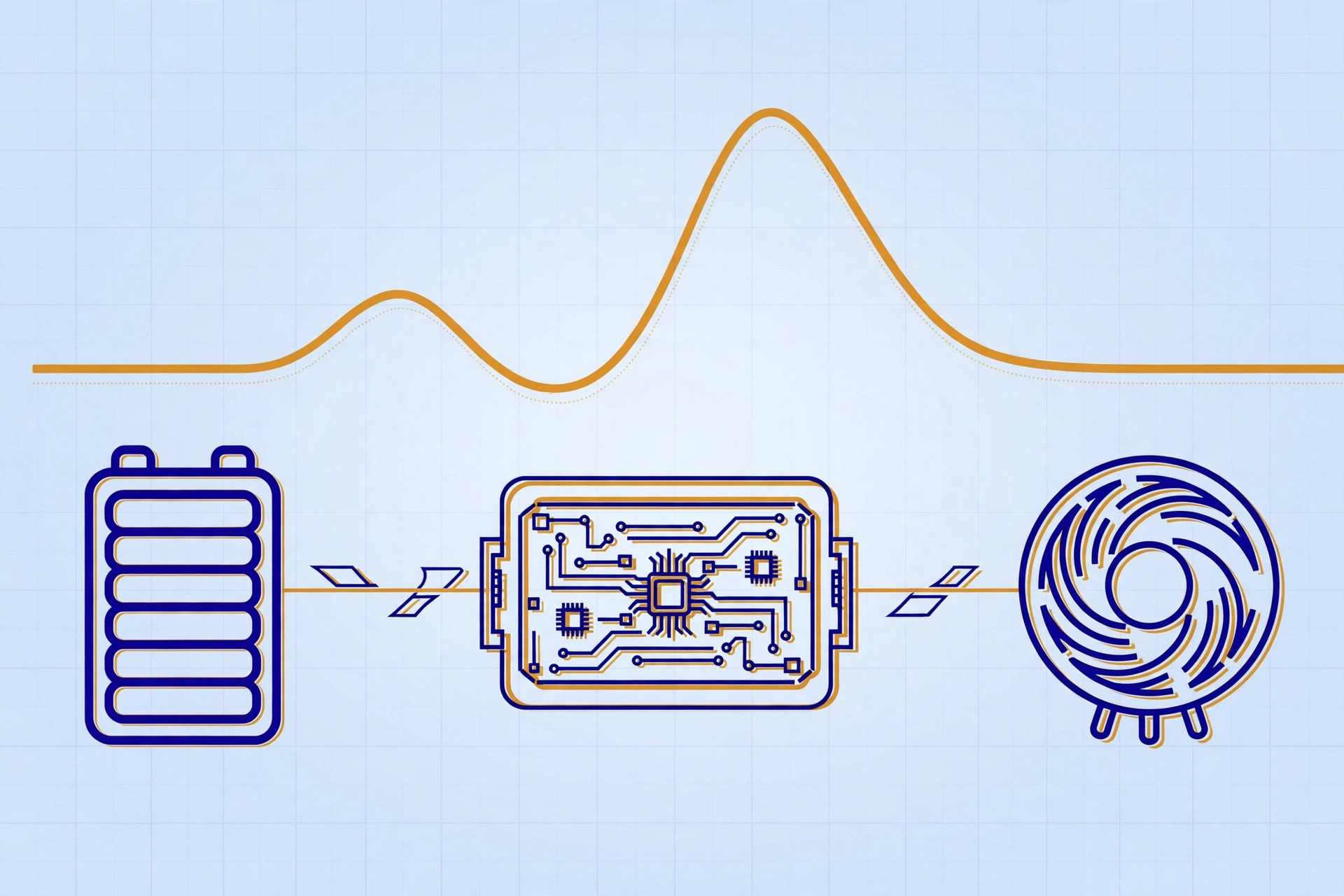
A lead-acid charger and a LiFePO4 pack speak different charging languages, and the difference is not a setting — it is the profile. Lead-acid chargers run bulk/absorption stages and may apply equalization voltages that exceed the lithium 3.65V-per-cell limit; the result is BMS protection trips, incomplete charges, or cell degradation over time. Lithium requires a precise CC-CV profile terminating at 58.4V for a 48V-class pack. This is why every reputable conversion kit ships with its own matched charger — typically 58.4V at 15–20A.
Engineering inference (labeled) — charge-time math: a 105Ah pack at 18A charges in roughly 105 ÷ 18 ≈ 5.8 hours from empty; a 100Ah pack at 15A takes about 6.7 hours. Both beat the 10–12 hours of a lead-acid bank, and partial charging doesn’t harm lithium the way deep cycling harms lead-acid — opportunity charging between rounds is fine.
Two rules with no exceptions: never use the old lead-acid charger on the new pack, and never bypass the BMS to force a charge. For winter storage, leave the pack at 50–60% SOC and check it every few months; lithium’s low self-discharge holds that level for a season.
The Club Car OBC Bypass
This one is brand-specific, and it catches first-time converters. Club Car carts built from the mid-1990s to about 2013 carry an On-Board Computer that manages the charging handshake against lead-acid voltage curves. With a lithium pack and lithium charger, the OBC undercharges the pack, stops charge cycles randomly, or blocks charging entirely — the classic symptom is a freshly converted cart that “won’t charge.” The fix is a bypass that gives the new charger a direct path to the pack.
How to tell if your Club Car has one (industry reporting): serial-number prefixes AA, AQ, PQ, PH, CE, PD, PE, PJ, PU, PV generally have an OBC and need the bypass; JE, BN, BR, BU, BV, JH, JA, JN generally do not. A physical heuristic: a large, heavy POWERDRIVE-branded charger means OBC; the smaller, lighter ERIC charger (usually with a yellow cord) means no OBC. Confirm against your cart’s serial number before ordering parts — and note that on IQ/Excel models the OBC also feeds the controller control circuit, so the bypass must restore that feed (typically a fused low-current line), not just the charge path.
EZGO and Yamaha carts do not have this module — one less step. This is exactly the kind of brand-specific detail that separates a conversion done right from a conversion done twice.
Range: Physics vs Vendor Claims
Range is where marketing and physics diverge most, so here they are side by side.
The physics (engineering inference, labeled): start with usable energy, not nameplate amp-hours. A 51.2V 100Ah pack holds 5.12 kWh, of which ~90% is usable ≈ 4.6 kWh. Divide by consumption: at 25 Wh/mile (flat ground, light load) that’s ~184 miles of theoretical range; at 40 Wh/mile (mixed use) ~115 miles; at 60 Wh/mile (hills, full payload) ~77 miles. Real carts land below theory — stops, wind, accessories, and tired tires all take their cut. Compare with lead-acid: a 48V bank’s nameplate means little because only ~50% depth of discharge is practical without killing it; a “7.2 kWh” lead-acid bank delivers roughly 3.6 kWh of usable energy — less than the lithium pack despite the bigger nameplate.
The vendor claims (industry reporting — labeled as claims): kit sellers advertise 40–50 miles per charge for 100Ah packs and “up to 50 miles” for 105Ah, with test conditions unstated. These are plausible for flat-course duty and consistent with the physics above, but they are marketing figures, not measurements — treat any range number without a stated load, terrain, and speed as a brochure, not a specification.
Cost: When Lithium Pays for Itself
Engineering inference (labeled) — a 10-year sketch with stated assumptions: a 48V lead-acid set costs roughly $800–$1,200 and lasts 3–4 years, so a decade of golf means about three sets: $2,400–$3,600, plus distilled water and terminal cleaning labor. A 51.2V 100Ah lithium kit with matched charger lists around $900–$1,800 once (vendor listings), with a 4,000-cycle cell life that at one cycle per day spans ~11 years. On those assumptions lithium breaks even before the second lead-acid replacement would have been due — and the weight, maintenance, and consistent-power benefits arrive from day one.
Your numbers will differ — duty cycle, local lead-acid prices, and whether you do the labor yourself all move the crossover point. Run your own figures through our LiFePO4 vs Lead-Acid TCO Calculator rather than trusting anyone’s payback slide, including ours.
Installation Safety Checklist
Lithium conversions are straightforward electrical work, but the currents involved demand respect. This checklist covers the non-negotiables; it is not a wiring diagram for any specific model — for brand-specific wiring, follow the kit manufacturer’s instructions and, when in doubt, hire a professional.
- Switch the cart to TOW mode and disconnect the old bank before touching anything.
- Use 4 AWG or thicker cable on high-current paths; inspect old cables and replace anything corroded or undersized.
- Install a fuse or breaker on the main positive; fit terminal boots over exposed positives.
- Torque terminals to the manufacturer’s spec — loose terminals arc, overtightened ones crack.
- Secure the pack so it cannot shift in the tray under braking or bumps.
- Keep charger wiring routed away from high-current drive cables where possible.
- Never mix lead-acid and lithium in the same bank.
- Cold weather: do not charge LiFePO4 below 0°C/32°F unless the BMS provides low-temperature charge cutoff or the pack is self-heating.
- Storage: 50–60% SOC, disconnected, check every ~3 months.
- After power-up: verify pack voltage with a multimeter, confirm the charger runs its full cycle, and do a short test drive watching for hot cables or BMS cutouts.
Choosing a Kit: A Spec-Sheet Reading Guide
For converters buying one kit and wholesalers stocking dozens, the spec sheet is where money is made or lost. Read it in this order:
1. BMS ratings — all three numbers. Continuous discharge current (≥200A for stock carts, 250A+ for lifted/hilly duty), peak current with duration, and low-temperature charge cutoff. A sheet that lists only “200A BMS” without a peak duration is hiding something.
2. Cell grade evidence. “Grade A” on a listing is a marketing claim until backed by factory test reports, scannable QR codes, and a warranty honored by someone you can find. Our Grade A vs Grade B verification guide shows exactly what to demand before a volume order.
3. Charger match and certifications. Confirm the charger is 58.4V CC-CV for the pack, and check which safety certifications the charger and pack carry for your destination market — requirements differ by country.
4. Warranty holder. Ask who actually honors the warranty — the cell manufacturer, the kit assembler, or the importer. A 5-year warranty from a company that didn’t exist last year is worth exactly what you can enforce.
5. Mechanical fit. Tray dimensions, terminal position and type (M8 is common), hold-down provisions, and display/gauge compatibility with the cart model you’re converting.
For dealers and converters ordering in volume, custom voltage, capacity, branding, and packaging are standard OEM/ODM options — see our OEM/ODM solutions for what’s feasible.
Brand Compatibility Notes
Industry reporting — vendor claims, verify yourself: kit sellers list direct-fit compatibility for EZGO (TXT/RXV 48V), Club Car (Precedent/Tempo/Onward/DS 48V, with OBC bypass where applicable), Yamaha (48V models), and ICON, with some kits also naming Polaris and Cushman. Treat these lists as a starting point, not a guarantee: verify tray dimensions, terminal layout, and controller voltage range against the specific cart in front of you. Year-to-year running changes within a brand can move mounting points and wiring colors.
Sources
- Voltage readings by system (36V≈38–39V, 48V≈50–52V, 51.2V LiFePO4 to 58.4V): https://www.vatrerpower.com/en-ca/blogs/news/how-to-wire-golf-cart-batteries (accessed 2026-10-11).
- 36V LiFePO4 kit with 43.8V 20A charger; lead-acid charger must be replaced: http://vatrerpower.com/products/36-volt-ez-go-golf-cart-batteries (accessed 2026-10-11).
- Club Car OBC bypass guide (affected years, serial prefixes, POWERDRIVE vs ERIC heuristic): https://voltrac.com.au/pages/club-car-obc-bypass-guide (accessed 2026-10-11).
- OBC bypass technical detail (charge vs control circuits, fused feed): https://www.vatrerpower.com/en-de/blogs/news/bypassing-the-onboard-computer-obc-in-club-car-golf-carts-a-comprehensive-guide (accessed 2026-10-11).
- Lead-acid vs lithium charging profiles (CC-CV, 58.4V termination, equalization risk): https://www.redway-tech.com/can-you-charge-a-lithium-battery-with-a-regular-golf-cart-charger/ (accessed 2026-10-11).
- Lithium conversion kit specs (200A BMS, 58.4V 18A charger, weights, dimensions): https://www.amazon.com/dp/B0F2G7Q1R9 and https://www.amazon.com/dp/B0FJ2H3HGF (accessed 2026-10-11).
- 105Ah kit specs (250A BMS, 500A/8s, 800A/3s, 5376Wh): https://www.novaicpower.com/products/novaic-lt-48v-105ah-lifepo4-golf-cart-lithium-battery (accessed 2026-10-11).
- Conversion kit contents, range claims (40–50 miles), weight comparison: https://www.golfcartgarage.com/battlite-bat5000-48v-51-2v-100ah-lithium-golf-cart-battery/ (accessed 2026-10-11).
- Wh/mile sizing method (20–60 Wh/mile bands): https://www.vatrerpower.com/blogs/news/why-you-should-upgrade-your-golf-cart-to-lithium-battery (accessed 2026-10-11).
- 36V→48V conversion component requirements and costs: https://vibms.com/48v-golf-cart-faster-than-36v/ and https://thegolfmine.com/can-you-put-48v-batteries-in-a-36v-golf-cart/ (accessed 2026-10-11).
- Fleet installation procedure (Tow mode, torque, test drive): https://leochlithium.us/how-to-install-lithium-golf-cart-batteries/ (accessed 2026-10-11).
- Owner-forum OBC troubleshooting threads: https://cartaholics.com/threads/club-car-carryall-2-switched-to-lithium-wont-charge.22519/ (accessed 2026-10-11).
Troubleshooting After Conversion: Symptom, Cause, Check
Most post-conversion problems are system-matching problems, not failed batteries. Work through the symptom before replacing parts:
| Symptom | Likely cause | What to check |
|---|---|---|
| Cart will not power on after install | BMS in sleep or protection mode; blown fuse; loose main disconnect | Wake the pack as its manual specifies (often a charger connection), then check the fuse, main disconnect and terminal torque before assuming a dead battery. |
| Cart cuts out during acceleration or on hills | BMS discharge limit below controller demand; undersized pack or cables | Compare the pack’s continuous and peak discharge ratings with the controller’s draw; check cable gauge and whether lugs run warm after a short drive. |
| Power loss or fault during braking | Regenerative braking current the pack cannot accept at high state of charge | Confirm regen settings with the controller manufacturer; until compatibility is confirmed for your configuration, avoid regen-heavy descents on a full charge. |
| Battery will not charge | Lead-acid charger profile retained; Club Car OBC not bypassed; low-temperature charge protection active | Use a lithium-profile charger matched to pack voltage; verify the OBC bypass where applicable; if the pack is below freezing, warm it first — a low-temperature cutoff is protection working, not a fault. |
| Battery gauge reads wrong | Lead-acid voltmeter cannot read lithium’s flat discharge curve | Fit a shunt-based (coulomb-counting) monitor and calibrate it at a full charge. |
| 12V accessories stopped working | Accessories were tapped from one battery of the old series string, or the new pack has no 12V tap | Power accessories through a dedicated DC-DC reducer sized for the load, on a fused circuit. |
If shutdowns repeat after these checks, re-check the whole ratings chain — pack, charger, controller, cables — in that order. Dealers and converters who confirm these points before ordering (a pre-order compatibility checklist is built into our 48V 105Ah golf cart battery page) avoid nearly all of them.
Frequently Asked Questions
Can I put a 48V lithium battery in a 36V golf cart?
No — not as a drop-in. A 36V cart needs a full system conversion (48V controller, solenoid, charger, and wiring) before it can use a 48V-class lithium pack. If you want lithium without the conversion project, buy a 36V-class (38.4V nominal) lithium kit built for your existing drivetrain.
Can I keep my old lead-acid charger?
No. Lead-acid chargers use bulk/absorption/equalization profiles that can exceed the 3.65V-per-cell lithium limit and don’t terminate correctly at 58.4V. Use the lithium-profile (CC-CV) charger matched to the pack — reputable kits include one.
What size lithium battery do I need for a golf cart?
For a 48V cart: 100Ah (5.12 kWh) covers typical golf and neighborhood duty; step up to 105–150Ah for lifted carts, steep hills, or 4+ passenger hauling. Size the BMS first (≥200A continuous stock, 250A+ modified), then capacity.
Why does my converted cart cut out on hills?
The most common cause is an undersized BMS hitting its overcurrent protection under peak load — the pack disconnects and reconnects after a rest. Check that the BMS continuous rating covers your cart’s real peak current; lifted carts and big tires raise it substantially.
Do I need to bypass the OBC on my Club Car?
If your Club Car is roughly 1995–2013 with the original charging system, almost certainly yes — the OBC manages charging against lead-acid curves and will undercharge or block a lithium pack. Check your serial-number prefix and whether you have the heavy POWERDRIVE charger (OBC) or the lighter ERIC charger (no OBC).
How long does a lithium golf cart battery last?
Vendors claim 4,000–6,000 cycles versus 300–500 for flooded lead-acid. At one cycle per day, the lithium claim implies roughly a decade of service — but treat cycle claims as vendor figures, keep the pack within its temperature and current ratings, and the calendar will usually decide before the cycle count does.
Supplying Golf Cart Batteries or Conversion Kits?
Whether you’re a converter fitting one cart a week or a dealer stocking kits by the pallet, the same fundamentals decide the outcome: correct system voltage, a BMS sized for real peak current, a matched charger, and cells you can verify. As a China-based LiFePO4 battery supplier and OEM/ODM partner working with a trusted manufacturing partner, LJY Energy supports dealers and converters with 48V LiFePO4 batteries, LiFePO4 cells, and custom pack configurations — plus engineering support on BMS sizing and charger matching for your cart models. To compare ready configurations, see the 48V 200Ah golf cart lithium battery (51.2V, 10.24 kWh), our golf cart battery solutions or the full product catalog.
WhatsApp: +86 159 8945 0735
Share This Article