
Share This Article
Content type: Technical explainer — what public engineering sources actually disclose about Starlink satellite batteries, and what terrestrial battery engineers can learn from it. This article strictly separates confirmed facts (official SpaceX, Starlink, or NASA disclosures), engineering inference (labeled calculations and deductions), and not publicly disclosed information. No cell model, chemistry, supplier, or capacity is asserted for Starlink beyond what official sources state. LJY Energy is a China-based LiFePO4 battery supplier and OEM/ODM partner working with a trusted manufacturing partner; nothing here implies any commercial relationship with SpaceX or Starlink.
The short answer: SpaceX has never publicly confirmed the cell chemistry, cell model, supplier, or per-satellite capacity of Starlink batteries. What is confirmed: Starlink’s own technology page describes “a dual solar array and high capacity battery,” and SpaceX’s Ray Barsa (identified on the deck’s title slide as Principal Battery Engineer) and Denis Trofimov disclosed a 230 Wh/kg pack-level design figure — plus the screening, qualification, and operating methods behind a fleet of more than 9,500 orbiting satellites — in a briefing presented at the NASA Aerospace Battery Workshop 2025 (held January 20–22, 2026; this presentation: Wednesday, January 21, 8:30 AM), hosted on NASA’s website. Everything below is built only on what those sources actually say. Inference is labeled as inference, and unknowns are listed openly rather than papered over.
This guide answers the six questions buyers, engineers, and the merely curious actually ask — and closes with what satellite practice teaches anyone who buys batteries on Earth.
What Type of Batteries Do Starlink Satellites Use?
Not publicly disclosed: the cell model, cathode chemistry, cell supplier, per-satellite capacity, series/parallel configuration, and bus voltage of Starlink batteries have never been officially confirmed. Any article that tells you “Starlink uses NMC 21700 cells” is reporting rumor as fact — treat it accordingly.
Here is what confirmed sources actually say. Starlink’s official technology page (starlink.com/pr/technology) devotes exactly one clause to the subject: Starlink satellites feature “dual solar array and high capacity battery to provide power to the payloads.” That is the entirety of Starlink’s public statement on its satellite batteries — no chemistry, no capacity, no cell information.
The substantive numbers come from a single primary source: confirmed: “Starlink Batteries: Reliability Lessons from 10,000 LEO Satellites,” a technical briefing by Ray Barsa (identified on the deck’s title slide as Principal Battery Engineer) and Denis Trofimov, SpaceX, presented at the NASA Aerospace Battery Workshop 2025 (held January 20–22, 2026; this talk: Wednesday, January 21, 8:30 AM) and hosted on NASA’s website. All figures below are “as disclosed in that briefing,” not current satellite parameters:
- 230 Wh/kg — pack design figure. The briefing explicitly labels this a pack-level design value: the energy density target for the complete battery pack, not a cell specification and not a measured result. It is not attributed to any particular satellite generation.
- 9,500+ satellites in orbit at the briefing date, with 1,500+ deorbited and, remarkably, 1 dead satellite in the operational fleet.
- Over 100 MWh of battery capacity in orbit, growing by more than 50 MWh per year, at a production cadence of 1,000+ satellites per quarter.
Engineering inference (labeled): a 230 Wh/kg figure at pack level sets a demanding bar for the cells inside it, because the pack carries structure, wiring, thermal hardware, and electronics that all dilute cell-level energy density. That implies high-energy-density cells — but the briefing never states the chemistry, and chemistry cannot be honestly reverse-engineered from one pack number. We will not do it here.
LJY Energy’s view: the more useful question than “which chemistry” is “how do they make any chemistry survive at that scale” — and on that, the briefing is unusually generous. That is what the rest of this article covers.
Why Do Satellites Need Batteries When They Have Solar Panels?
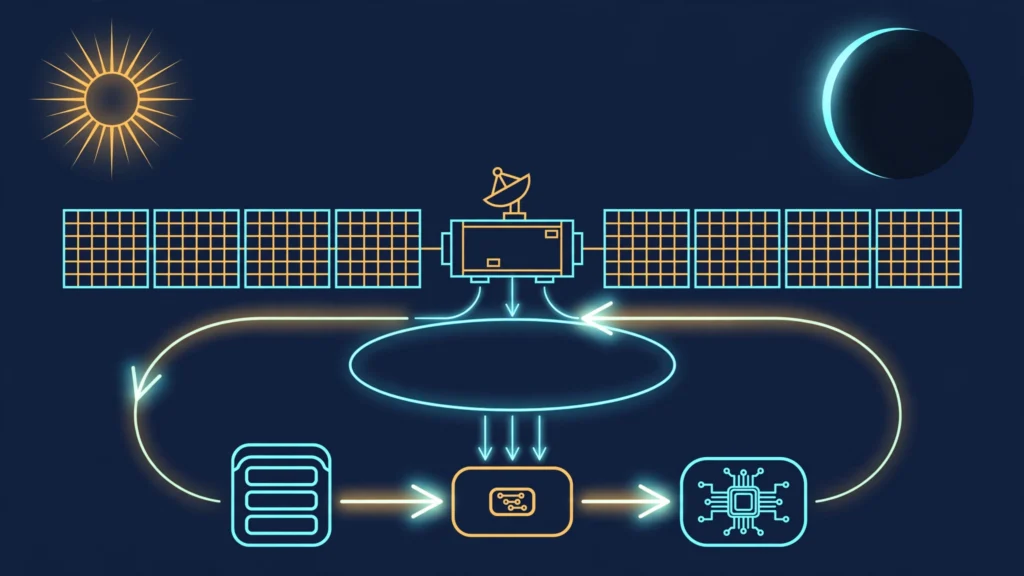
Because for roughly a third of every orbit, the solar panels produce nothing at all.
Confirmed: a satellite in low Earth orbit passes through Earth’s shadow — eclipse — on most orbits. At Starlink’s operating altitude of about 550 km (confirmed: starlink.com/pr/technology), reference values put the maximum eclipse at roughly 35 minutes per ~95-minute orbit (Borthomieu, Satellite Lithium-Ion Batteries, Elsevier, 2014; NASA’s Hubble power page cites ~36 minutes of shadow per ~95-minute orbit for Hubble). During eclipse the arrays are dark, and the battery carries the entire payload — communications electronics, propulsion readiness, thermal control — alone.
Batteries also cover three jobs beyond eclipse. Confirmed (standard spacecraft power-system design, described in EE Times’ space power survey and NASA’s Hubble electrical power page): the battery supplies power during orbit-raising and maneuvering when demand outruns the arrays, and it absorbs peak payload bursts that exceed the arrays’ instantaneous output. Engineering inference: it additionally stabilizes the power bus against the sharp load steps of a communications payload switching between idle and full transmission — the same bus-stability role a battery plays in any hybrid power system on Earth.
In short: the solar array is the primary source, but the battery is what makes the satellite a continuous machine rather than a daylight-only one.
How Do Satellite Batteries Survive Thousands of Charge-Discharge Cycles?
By never asking the battery to work hard — and by verifying, cell by cell, that it doesn’t have to.
Start with the arithmetic. Engineering inference (labeled): a ~95-minute orbit means roughly 16 charge-discharge cycles per day. Over the 5-year mission that appears in the briefing’s acceptance-test flow, that is on the order of 29,000 cycles — two orders of magnitude beyond what a terrestrial EV or storage battery is designed for. The briefing does not state a cycle count; the number follows from orbital period × mission life, both publicly documented inputs.
The industry’s answer to that number is depth-of-discharge discipline. Confirmed (industry design norms — not Starlink’s parameters, which are undisclosed): Saft’s VL10ES space-cell program (NASA Aerospace Battery Workshop, 2019) targets over 220 Wh/kg at cell level and designs LEO missions around 20–30% DOD; an ALE briefing at NASA’s 2023 battery workshop quotes a LEO design envelope of 20% DOD for 15,000 cycles over 3 years, 25,000 over 5 years, and 75,000 over 15 years, at roughly 5,000 eclipses per year of 35 minutes each. Shallow cycling is the entire game: use a fifth of the capacity, and the battery barely ages.
The hardest in-orbit proof of that principle comes from Japan’s REIMEI satellite. Confirmed (NASA Battery Workshop, 2018 — REIMEI’s data, presented as an analogy, not Starlink’s): REIMEI cycled 15–16 times per day (60 minutes charging, 35 discharging) at just 10–20% DOD between 4.10 and 4.20 V per cell — and was still operating after more than 12 years and 60,000+ cycles. That is what disciplined shallow cycling buys.
SpaceX’s own contribution to this discipline is operational rather than chemical. Confirmed (briefing, qualitative): Starlink flies tunable SoC windows — the allowed state-of-charge band is adjusted in orbit — which the briefing credits with reducing degradation, reducing the sidewall-rupture rate, and increasing pack homogeneity. Our BMS selection guide covers SoC window management from the buyer’s side; the satellite lesson is that the window is an operating decision, not just a design parameter.
What Happens to Batteries During Orbital Eclipse?
Thirty-five minutes of discharge, then about an hour of recharge — repeated sixteen times a day, for years.
Confirmed (reference mission profiles): entering eclipse, the battery takes the full spacecraft load with no solar contribution. REIMEI’s published profile — 35 minutes of discharge followed by 60 minutes of recharge — is representative of the LEO rhythm at Starlink’s altitude class. The battery must deliver its eclipse energy at a controlled depth of discharge, then accept a full recharge in the sunlit portion of the orbit, including the energy needed to make up conversion losses.
Engineering inference (labeled): this is where the tunable SoC windows disclosed in the briefing earn their keep. A pack that always charges to the same top voltage degrades fastest at the top of the curve; a pack whose window is tuned — narrower in routine operation, widened only for contingencies — spends its life in the gentlest part of the voltage range. The briefing’s three named operating regimes exist, but their exact SoC values are not disclosed, so we will not quote numbers that were never published.
The terrestrial parallel is direct: any battery that cycles daily — solar storage above all — lives or dies by the same window discipline. The physics does not care whether the battery is in orbit or on a garage wall.
How Do SpaceX Engineers Approach Battery Reliability and Qualification?
With a screening funnel that starts at the individual cell and ends with the whole constellation as a sensor network. Every method below is confirmed as disclosed in the January 21, 2026 briefing.
Cell screening — acceptance level. Incoming cells are screened by measuring OCV decay (open-circuit voltage drift over time, which exposes self-discharge outliers), DCR (DC internal resistance), and ACZ (AC impedance), plus mechanical integrity checks at pack assembly. The logic is identical to what terrestrial buyers should demand: the same screening philosophy underlies our guide on verifying Grade A vs Grade B LiFePO4 cells — measure the distribution, reject the outliers, never trust the label alone.
Cell qualification — deeper. CT scanning assesses mechanical build variation and monitors long-term cycling phenomena inside the cell; ultra-high-precision coulometry measures electrochemical performance variation finely enough to infer long-term cycling behavior from short tests. Qualification answers “is this design sound”; acceptance answers “is this unit good.” SpaceX runs both, at megaconstellation scale.
Pack acceptance testing. The briefing lays out a full chain — cell acceptance, pack OCV and GITT checks, busbars, final charge, recheck after storage, contact resistance, interconnects, sensor health, thermal check — followed by a HASS-like highly accelerated stress screen performed over auto-dunk tanks, transport, mid-SoC checks, and weeks of thrusting before the 5-year mission begins. Vibration qualification is performed with stacked satellites, i.e., on the integrated launch stack rather than the pack alone. For buyers, the mirror image is incoming-goods acceptance: our supplier verification guide applies the same principle at terrestrial scale — test the goods, not the brochure.
Arc-resistant design. “Spacecraft arcing has destroyed satellites for decades,” the briefing notes. Its test finding: arcing can catastrophically fail packs at voltages above 32 V and pressures below 1 Torr — conditions a high-voltage satellite bus routinely meets. Pack-level arc qualification is therefore run after vibration, shock, and thermal testing, on flight-like hardware, with many tests for statistical confidence.
Micrometeoroid and orbital debris (MMOD) survival. With a megaconstellation, strikes are described as certain, not possible. The program uses empirical hypervelocity testing to characterize pack-level response, and in the deck’s propagation-resistance discussion, SpaceX notes that nail penetration may represent an MMOD strike in testing; passive propagation resistance (PPR) testing may use multiple initiator cells to simulate real strikes.
Radiation tolerance and fleet-level telemetry. Typical upsets are latch-ups and railed telemetry; the briefing flags subtler failures via dV/dt flagging on cell voltages and dT/dt flagging on thermal sensors. The constellation itself becomes the instrument: SpaceX reports 10 minutes of constellation-level mapping to locate the South Atlantic Anomaly, and notes measured total ionizing dose below pre-flight estimates. When a single-cell runaway is detected, the documented response options under study are elegantly simple: lower the SoC? lower the temperature? — posed as open engineering questions, not conclusions.
What Can Terrestrial Energy Storage Engineers Learn From Satellite Batteries?
Four practices transfer directly — and none of them requires going to space.
1. Screen cells like outliers matter — because they do. OCV decay, DC resistance, and impedance screening exist to catch the one bad cell in ten thousand before it becomes the weak cell in a pack. On Earth the economics are the same: a single outlier cell caps the whole pack’s usable capacity. Buyers sourcing LiFePO4 battery cells should ask suppliers for batch screening data — capacity, internal resistance, and self-discharge figures — the same three families of measurements SpaceX runs at acceptance.
2. Treat the SoC window as an operating decision. Starlink’s tunable windows show that longevity is managed in operation, not just designed in. For solar storage that cycles daily, narrowing the routine window is the cheapest life-extension available — cheaper than any chemistry upgrade.
3. Test the goods, not the brochure. HASS-like stress screening and stacked-satellite vibration qualification are the orbital version of incoming-goods acceptance testing. The terrestrial equivalent — a defined acceptance protocol with recorded thresholds — is what separates professional procurement from hope. Pack homogeneity, the briefing’s stated goal, is exactly what our cell balancing guide teaches buyers to verify on arrival.
4. Design for the failure you can’t prevent. MMOD strikes are “certain,” so the pack is designed to survive them; arcing is a known killer, so qualification reproduces it. Terrestrial translation: thermal runaway propagation resistance, arc-fault behavior, and sensor-failure modes belong in the qualification plan before the first shipment, not in the incident report after it.
Key Facts at a Glance
Every figure below carries its source and its confidence level. “Confirmed” means disclosed in the cited official source as stated there — check the source column before quoting any number elsewhere.
| Fact | Value + unit | Source | Confidence |
|---|---|---|---|
| Briefing presenters | Ray Barsa (Principal Battery Engineer per title slide) and Denis Trofimov, SpaceX | NASA-hosted deck, title slide; NASA ABW 2025 agenda (Wed Jan 21, 8:30 AM) | Confirmed |
| Briefing date | January 21, 2026 | Deck title slide | Confirmed |
| Pack-level design energy density | 230 Wh/kg (pack design figure) | SpaceX deck via NASA, Battery Reliability slide | Confirmed as a disclosed design figure; not a current per-satellite parameter |
| Satellites in orbit (deck date) | 9,500+ | Deck title slide, 2026-01-21 | Confirmed (as of deck date) |
| Satellites deorbited (deck date) | 1,500+ | Deck title slide, 2026-01-21 | Confirmed (as of deck date) |
| Battery capacity in orbit | >100 MWh in orbit; >50 MWh added per year | Deck, Battery Reliability slide | Confirmed (as disclosed) |
| Production cadence | 1,000+ satellites per quarter | Deck, Battery Reliability slide | Confirmed (as disclosed) |
| Mission life in acceptance flow | 5-year mission | Deck, Pack Acceptance Testing slide | Confirmed (as stated in the flow) |
| Cell acceptance screening | OCV decay, DCR, ACZ + mechanical integrity | Deck, Cell-Level Screening slide | Confirmed |
| Cell qualification methods | CT scanning (mechanical build); ultra-high-precision coulometry (electrochemical) | Deck, Cell-Level Screening slide | Confirmed |
| SoC window strategy | Tunable SoC windows → less degradation, lower sidewall-rupture rate, better pack homogeneity | Deck, Cell-Level Screening slide | Confirmed (qualitative) |
| Pack acceptance method | HASS-like stress test over auto-dunk tanks; vibration qualification with stacked satellites | Deck, Pack Acceptance slide | Confirmed |
| Arc catastrophic threshold | >32 V and <1 Torr | Deck, Arc-Resistant Design slide | Confirmed (as a test finding) |
| Starlink official power statement | “dual solar array and high capacity battery” | https://starlink.com/pr/technology | Confirmed (verbatim) |
| Starlink orbit altitude | ~550 km | starlink.com/pr/technology | Confirmed |
| LEO eclipse duration (reference) | Up to ~35 min (650 km ref); ~36 min (Hubble) | Borthomieu 2014; NASA Hubble power page | Confirmed (reference values) |
| LEO orbits per day (reference) | 12–16 | Borthomieu 2014 | Confirmed |
| Eclipses per day, Starlink-class orbit | ~16/day | Calculated from ~95 min orbital period | Engineering Inference |
| Implied 5-year cycle count | ~29,000 cycles | ~16/day × 365 × 5 | Engineering Inference |
| LEO DOD design discipline | 20–30% DOD typical; 20% DOD → ~25,000 cycles / 5 yr | Saft VL10ES (NASA ABW 2019); ALE (NASA 2023 workshop) | Confirmed as industry norms; not Starlink’s parameters |
| Shallow-DOD longevity proof | REIMEI: 10–20% DOD, >60,000 cycles, >12 years on orbit | NASA Battery Workshop 2018 | Confirmed (REIMEI’s data, not Starlink’s) |
| Cell chemistry / model / supplier / per-satellite capacity | — | — | Not Publicly Disclosed |
Satellite vs Terrestrial Storage: How the Engineering Requirements Compare
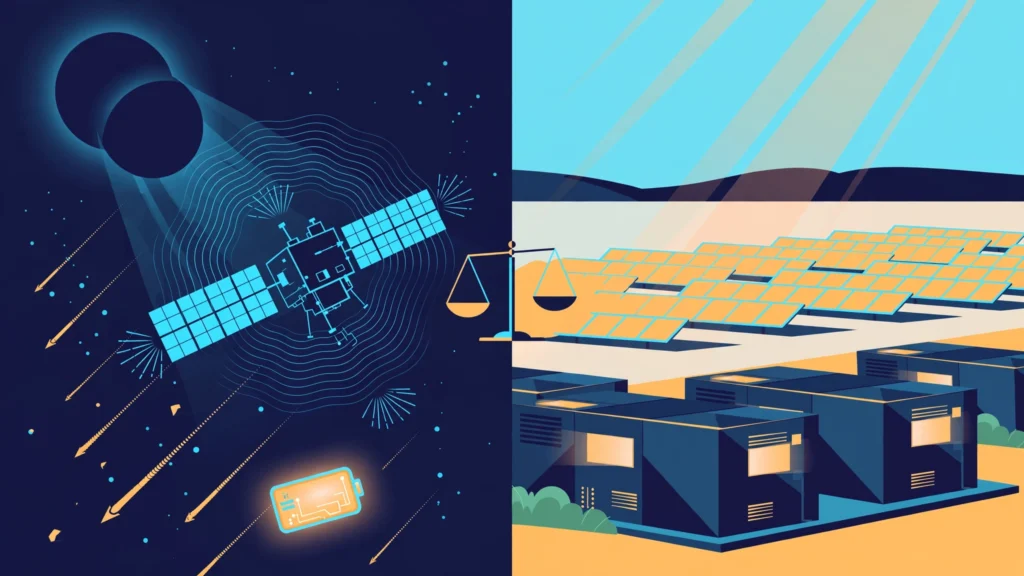
Engineering inference (labeled): the satellite column below reflects typical LEO megaconstellation practice from public industry sources — not Starlink’s undisclosed specifications. The terrestrial column reflects common industry norms for stationary LiFePO4 storage. The point of the comparison is the shape of the trade-offs, not exact numbers.
| Requirement | LEO satellite battery (typical) | Terrestrial energy storage (typical) |
|---|---|---|
| Cycle life target | ~25,000–75,000 cycles (5–15 yr at ~16 cycles/day) | 3,000–8,000 cycles (8–15 yr at ~1 cycle/day) |
| Depth of discharge | 10–30% routine (longevity discipline) | 80–100% routine (economics discipline) |
| Energy density priority | Extreme — every gram is launch cost | Moderate — cost per kWh dominates |
| Temperature environment | −40 °C to +60 °C swings, vacuum (no convection) | −20 °C to +50 °C typical, air-cooled or conditioned |
| Reliability target | No service possible; redundancy + screening | Serviceable; warranty + monitoring |
| Cost sensitivity | Mission cost dominates; cell cost secondary | Cell cost is the primary competitive lever |
| Failure consequence | Loss of a high-value asset; constellation absorbs single failures | Downtime, warranty claims, reputation |
| Qualification philosophy | Test like you fly; statistical confidence from many units | Certification + batch sampling |
LJY Energy’s view: the columns look like opposites, but the methods converge: screen the outliers, discipline the operating window, qualify the pack against the failures you can’t prevent. A buyer who understands why a satellite program tests the way it does will ask sharper questions of any terrestrial supplier — starting with the screening data behind the cells.
What We Still Don’t Know
Honesty requires listing the gaps. As of this article’s publication, the following have not been publicly disclosed by SpaceX or Starlink, and this article does not fill them in:
- The cell model (whether 21700, 4680, or another format).
- The cathode chemistry (NMC, NCA, LFP, or other) — and no, it cannot be reliably deduced from the 230 Wh/kg pack figure alone.
- The per-satellite battery capacity in Wh or Ah.
- The cell supplier(s).
- The series/parallel configuration and bus voltage.
- The actual cycle life and DOD/SoC window values Starlink flies (only the qualitative “tunable SoC windows” is disclosed).
- Which satellite generation the 230 Wh/kg design figure applies to.
- The thermal management design specifics.
If a source ever confirms any of these, this article will be updated with the attribution it deserves. Until then, they stay on this list.
Sources
- Ray Barsa and Denis Trofimov (SpaceX), “Starlink Batteries: Reliability Lessons from 10,000 LEO Satellites,” briefing presented at the NASA Aerospace Battery Workshop 2025, held January 20–22, 2026 (this presentation: Wednesday, January 21, 8:30 AM), hosted on NASA’s website: https://www.nasa.gov/wp-content/uploads/2024/01/starlink-batteries-reliability-lessons-from-10000-leo-satellites-abw-2025.pdf (accessed October 2026; note the URL path contains /2024/01/, which is NASA’s upload-path convention, not the content date; Barsa is identified on the deck’s title slide as Principal Battery Engineer, Trofimov’s title is not publicly listed).
- NASA, 2025 NASA Aerospace Battery Workshop — draft agenda (lists “Starlink Batteries: Reliability Lessons from 10,000 LEO Satellites” by Ray Barsa and Denis Trofimov, SpaceX, Wednesday, January 21, 8:30 AM): https://nasa.gov/wp-content/uploads/2025/11/2025-nasa-aerospace-battery-workshop-agenda-draft.pdf (accessed October 2026).
- Starlink official technology page, “Power System” section: https://starlink.com/pr/technology (states “dual solar array and high capacity battery”; orbit ~550 km).
- NASA, Hubble Space Telescope electrical power design: https://science.nasa.gov/mission/hubble/observatory/design/electrical-power/ (~95-minute orbit, ~36-minute eclipse; batteries power the observatory in shadow).
- EE Times, “Taking Care of Power Systems for Space Missions”: https://www.eetimes.com/taking-care-of-power-systems-for-space-missions/ (secondary power systems cover primary-source shortfalls).
- Borthomieu, “Satellite Lithium-Ion Batteries,” in Lithium-Ion Batteries, Elsevier, 2014 (LEO period 90–120 min, 12–16 orbits/day, eclipse up to ~35 min at 650 km).
- Saft, “VL10ES High Energy Space Cell Development,” NASA Aerospace Battery Workshop, Huntsville, 2019: https://www.nasa.gov/wp-content/uploads/2024/01/vl10es-high-energy-space-cell-development.pdf (>220 Wh/kg cell target; 20–30% DOD LEO design norm).
- ALE Co., briefing at NASA 2023 Battery Workshop: https://www.nasa.gov/wp-content/uploads/2024/01/nasa-2023-workshop-ppt-ale-update.pdf (20% DOD → 15k/25k/75k cycles over 3/5/15 years; ~5,000 eclipses/year).
- “The REIMEI Li-ion Batteries After More Than 13 Years of Operation,” NASA Battery Workshop, 2018: https://www.nasa.gov/wp-content/uploads/2024/01/the-reimei-li-ion-batteries-after-more-than-13-years-of-operation.pdf (10–20% DOD, >60,000 cycles, >12 years on orbit).
Frequently Asked Questions
What battery chemistry do Starlink satellites use?
Not publicly disclosed. SpaceX has never confirmed the cathode chemistry, and it cannot be honestly deduced from the disclosed 230 Wh/kg pack-level design figure alone. Any source asserting a specific chemistry is speculating.
How long do Starlink satellite batteries last?
The only mission-life figure in the public briefing is the “5-year mission” that appears in the pack acceptance-test flow — a test target, not a measured lifetime. Actual on-orbit battery life has not been disclosed. For perspective, Japan’s REIMEI satellite demonstrated 60,000+ cycles over 12+ years at 10–20% depth of discharge — proof of what shallow cycling can achieve, though that is REIMEI’s record, not Starlink’s.
Why can’t satellites just use bigger solar panels instead of batteries?
Because solar panels produce nothing in Earth’s shadow. At Starlink’s ~550 km altitude, each ~95-minute orbit includes up to ~35 minutes of eclipse. The battery is the sole power source during that window — no panel size changes the physics of shadow.
Could LFP batteries work for satellites?
Engineering inference: LFP’s exceptional cycle life at shallow DOD suits the LEO cycling regime, but its lower energy density conflicts with the pack-level 230 Wh/kg design figure disclosed for Starlink — every kilogram costs launch money. The trade-off is density versus longevity, and different missions will answer it differently. This is analysis, not a statement about Starlink’s actual choice, which remains undisclosed.
What does satellite battery screening have to do with buying batteries on Earth?
The method is the same: measure the distribution of cell characteristics (voltage decay, resistance, impedance), reject the outliers, and verify homogeneity at pack level. Satellite programs do it because one bad cell can end a mission; terrestrial buyers should do it because one bad cell caps the whole pack’s usable capacity. Our Grade A vs Grade B cell verification guide applies the same screening logic to procurement.
Sourcing Batteries for Demanding Applications?
Satellite programs earn reliability through cell screening, disciplined operating windows, and rigorous acceptance testing — the same three practices behind any dependable terrestrial battery. If your project needs energy storage, mobile power, or a special-application battery with documented cell selection, a defined test plan, and OEM/ODM support, talk to our team. As a China-based LiFePO4 battery supplier and OEM/ODM partner working with a trusted manufacturing partner, LJY Energy helps distributors and project buyers specify, verify, and source battery systems with the screening data to back them up.
Share This Article