
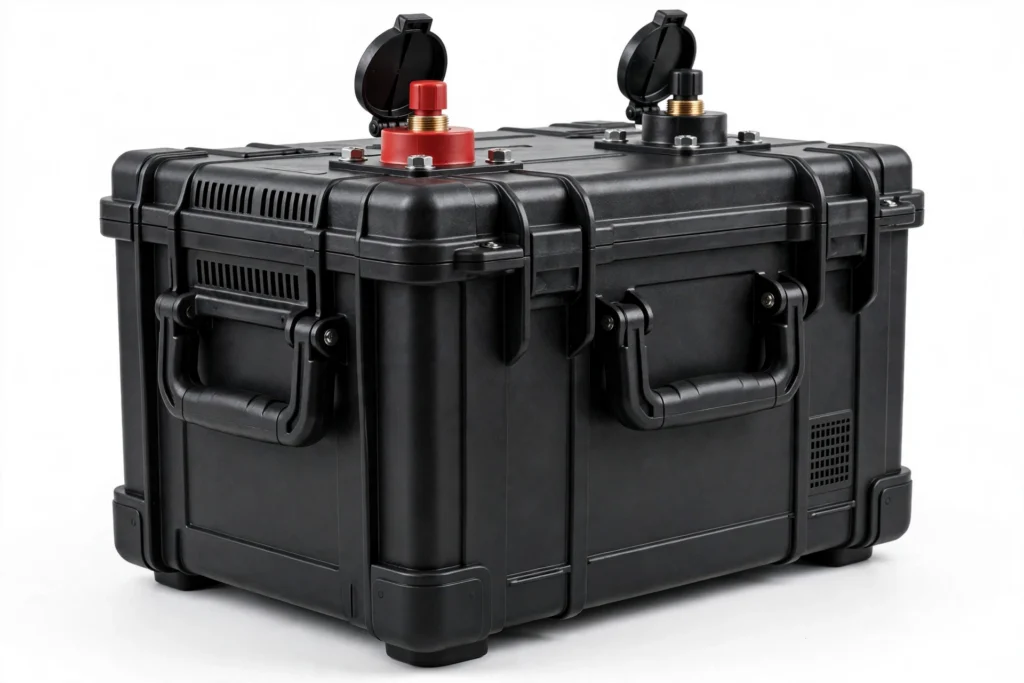
Product Overview
The 51.2V (48V class) 300Ah LiFePO4 battery stores 15.36kWh (51.2V × 300Ah = 15,360Wh) for commercial solar, large residential, and industrial backup. Single-unit high capacity reduces installation complexity.
- 15.36kWh — commercial scale in one unit
- 200A BMS reference option — about 10kW of DC power at nominal voltage; whether it carries a given 10kW-class inverter depends on the inverter and the exact BMS rating, confirmed per project (see the power check below)
- Parallel expansion — about four units reach 60kWh+ (4 × 15.36 = 61.44kWh); maximum parallel count, busbar and cable design are confirmed per project
Request a quote for the 51.2V 300Ah battery · WhatsApp: +1 404 784 1946 (backup: +86 159 8945 0735)
Technical Specifications
How to read Status: Industry reference = typical value seen in public 51.2V 300Ah-class datasheets, not an LJY test result. Optional configuration = an option LJY can coordinate. Confirmed per project = fixed in the quotation for your order.
| Group | Parameter | Value | Status |
|---|---|---|---|
| Electrical | Voltage | 51.2V nominal (16S LiFePO4, 48V class) | Industry reference |
| Electrical | Capacity | 300Ah rated | Industry reference |
| Electrical | Energy | 15.36kWh (51.2V × 300Ah = 15,360Wh) | Industry reference |
| Electrical | Charge cut-off voltage | 58.4V (16 × 3.65V) | Industry reference |
| Cells | Cell configuration | 16S1P of 300Ah-class prismatic cells (for example 302–306Ah cells rated as a 300Ah pack), or 16S2P of 150Ah cells; cell brand and format confirmed per project | Optional configuration |
| BMS | Continuous discharge current | 200A is the reference option; 100A–150A BMS options cannot carry 10kW. Final rating confirmed per project | Industry reference · Confirmed per project |
| BMS | Peak discharge current | Short-duration value set by the BMS configuration | Confirmed per project |
| BMS | Communication | CAN / RS485 inverter communication; protocol and inverter model confirmed per project | Optional configuration |
| Mechanical | Format | Floor-standing, rack or wall format, depending on project | Optional configuration |
| Mechanical | Dimensions and weight | Public 300Ah-class packs are around 120–130kg; plan lifting accordingly. LJY dimensions and weight confirmed per project | Industry reference · Confirmed per project |
| Certificates | Test reports and certificates | None claimed on this page; documents for your order and market confirmed per project | Confirmed per project |
| Supply options | Supply scope (pack, enclosure, components) | Complete 51.2V 300Ah battery pack; enclosures and components (cells, BMS, modules, harness) for customers who assemble locally; and OEM/ODM pack programs, coordinated per project. The quotation separates existing standard configuration, customizable options and items still to be confirmed. | Optional configuration · Confirmed per project |
| Commercial | Price, MOQ, lead time, warranty | Confirmed by inquiry | Confirmed per project |
Is 300Ah a real pack size? Cell options
Yes. A 300Ah pack at 51.2V is a normal 48V-class energy storage build. It can use 16 series cells of a 300Ah-class prismatic LiFePO4 cell (public cell datasheets list 302Ah, 304Ah and 306Ah cells), or 16S2P of 150Ah cells. The pack is rated 300Ah even when the cells carry slightly more. Larger 280Ah and 314Ah packs use other cell sizes; compare the 51.2V 280Ah wall-mounted battery (14.34kWh), the 51.2V 314Ah floor-standing cabinet (16.08kWh) and the 51.2V 200Ah battery (10.24kWh). Which cells and which enclosure are used is confirmed per project.
Power check: the 10kW inverter question
Battery power is voltage times current, so the BMS continuous discharge rating sets how much inverter power the battery can carry. Reference arithmetic:
- 200A × 51.2V = 10.24kW DC at nominal voltage; at 46.4V (low state of charge) the same 200A is about 9.28kW.
- A 10kW AC inverter running at full load at about 94–96% efficiency draws roughly 10.4–10.6kW from the battery, which is about 204–208A at 51.2V and more at lower voltage.
- So a 200A BMS covers 10kW-class inverters at most operating points but can sit at its limit under a sustained full 10kW load. A 100A or 150A BMS cannot support 10kW.
For a sustained 10kW load, ask for a BMS option with continuous current headroom and check cables, busbar, breaker and fuse sizing. Whether a specific 10kW inverter is supported also depends on its DC voltage window and CAN/RS485 protocol; this is confirmed per project, with the exact inverter model. See the 51.2V inverter communication guide, the inverter and battery compatibility calculator and the LiFePO4 BMS selection guide.
Applications
- Commercial solar storage
- Large residential backup
- Industrial UPS
- Microgrids
Related solutions: solar energy storage and home energy storage. Browse all models in the product catalog. Appearance, color and logo customizable per customer request.
Frequently Asked Questions
Does the 51.2V 300Ah battery support a 10kW inverter?
It can when the BMS continuous discharge rating is high enough. At 51.2V, 10kW needs roughly 195A at the battery terminals plus inverter losses, so a 200A BMS is about the minimum and 100A or 150A is not enough. The rating, cables and inverter protocol are confirmed per project with your inverter model.
Is 300Ah a standard capacity?
For a 51.2V pack, yes. It is built from 300Ah-class cells in 16S1P, or from 150Ah cells in 16S2P. Other capacities (200Ah, 280Ah, 314Ah) are available as separate models, and other capacities can be quoted per project.
Which format and what is the weight?
Floor-standing, rack or wall formats can be coordinated per project. Public 300Ah-class packs weigh around 120–130kg, so installation planning matters. LJY dimensions and weight are confirmed in the quotation.
What do you need for a quotation?
Inverter model, required continuous and peak power, number of units or target kWh, format, communication protocol, destination country and quantity. Send the request here or by WhatsApp: +1 404 784 1946.