
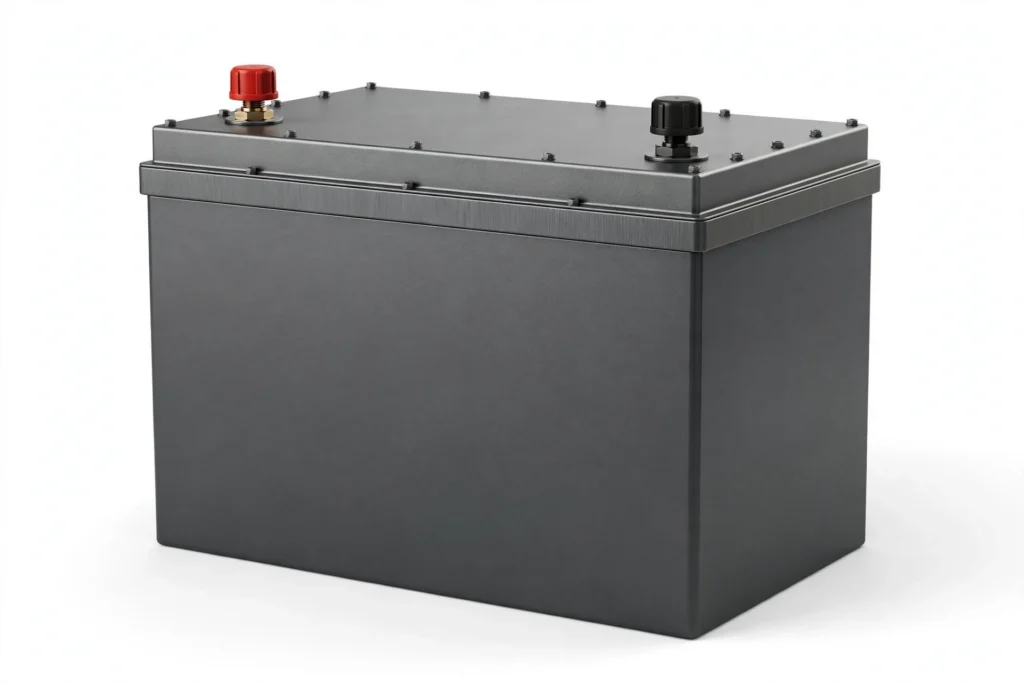
24V 100Ah LiFePO4 Battery
Product Overview
A 2.56kWh LiFePO4 battery (25.6V 100Ah) — the natural step up from 12V for small off-grid solar systems, RV upgrades and backup power. At 24V, the same power flows at half the current of a 12V system, which means thinner cables, lower losses and easier inverter matching for 1–3kW installations.
For solar installers and RV outfitters, 24V is the efficiency sweet spot for mid-size systems: simpler and cheaper than 48V, far more capable than 12V. As a China-based LiFePO4 battery supplier and OEM/ODM coordination partner, LJY Energy works with qualified manufacturing partners to configure capacity, BMS features, communication and branding to your market requirements. (Need more capacity in 24V? See our 24V 200Ah model.)
Typical Specifications
Values below are typical configurations. “Optional” items can be specified per order; “To be confirmed” items depend on the final configuration and order — contact us for the datasheet of the exact build you need.
| Parameter | Value | Status |
|---|---|---|
| Battery chemistry | LiFePO4 (lithium iron phosphate) | Typical |
| Nominal voltage | 25.6V (8S) | Typical |
| Rated capacity | 100Ah | Typical |
| Energy | 2.56kWh | Typical |
| Charge voltage (bulk/absorption) | 28.4–29.2V | Typical |
| Built-in BMS | Over-charge / over-discharge / over-current / short-circuit / temperature protection | Typical |
| Communication | RS485 for inverter / monitor integration | Optional |
| Bluetooth / app monitoring | Cell voltages, SOC, temperature on mobile app | Optional |
| Low-temperature charging protection | Charging cut-off below 0°C; self-heating pad available | Optional |
| Enclosure / branding | Custom case color, logo and labeling | Optional — OEM/ODM |
| Series / parallel expansion | 2S for 48V systems; parallel for larger banks | Optional — subject to configuration |
| Certifications | UN38.3 / MSDS / CE and others per target market | To be confirmed per order |
| Warranty terms | Subject to configuration and order agreement | To be confirmed |
| Dimensions & weight | Per final enclosure design | To be confirmed — datasheet on request |
| Lead time | Subject to order quantity and configuration | To be confirmed |
Why 24V Instead of 12V
The case for 24V is electrical, not chemical: at the same power, 24V halves the current, which quarters resistive losses and allows smaller, cheaper cabling. A 2kW inverter draws ~80A from a 24V bank versus ~160A from 12V — a meaningful difference in cable cost, fuse sizing and installation effort. For systems between roughly 1kW and 3kW, 24V is widely regarded as the practical optimum. Our LiFePO4 vs lead-acid comparison covers the chemistry economics behind the switch.
Charging & Compatibility
Typical charge profile: bulk/absorption at 28.4–29.2V, then termination — LiFePO4 needs no float stage. Scale the 12V setpoints in our charging voltage reference by ×2, and see the complete charging guide for CC/CV operation.
- Solar / MPPT: program absorption to 28.4–29.2V; disable equalization (a lead-acid routine incompatible with lithium).
- 24V inverters: confirm the inverter’s battery voltage window covers 25.6V nominal; RS485 communication is available as an option for compatible models.
- Upgrading from 12V: a 24V system needs a 24V inverter and 24V solar configuration — the battery alone does not convert an existing 12V system. Plan the full system voltage at the design stage.
- AC charging: use a 24V LiFePO4-profile charger; a 12V charger (even lithium-profile) cannot charge a 24V battery.
If the battery ever refuses to charge, work through our troubleshooting guide before assuming a fault.
Battery Lifespan
Cycle aging and calendar aging together determine real life. Typical reference for quality LiFePO4 cells: around 6,000 cycles at 80% depth of discharge (25°C, to 80% capacity retention) at cell level — pack results depend on BMS, thermal design and usage. Running daily at 80% DoD roughly doubles cycle life versus 100% DoD while sacrificing only 20% of per-cycle capacity. Our DoD vs cycle life guide explains the throughput economics, and should you charge to 100% covers the practical charge strategy.
Evaluating supplier cycle-life claims? Our procurement checklist shows how to read datasheet curves and spot inflated marketing.
Sizing & Selection
One 2.56kWh unit suits small off-grid solar (lighting, fridge, communications, device charging) and RV auxiliary systems; two to four units in parallel serve 2–3kW inverters for workshops and larger cabins. Size from daily kWh throughput and autonomy days. Installers: match the solar array voltage to a 24V MPPT controller and confirm the inverter’s surge rating against the customer’s peak loads at the quoting stage.
Applications
- Small off-grid solar systems (1–3kW)
- RV and campervan electrical upgrades
- Cabins, sheds and remote outbuildings
- Telecom and monitoring equipment
- Mobile power and field operations
- Backup power for 24V equipment
Wholesale, OEM & ODM
We support solar distributors, RV outfitters and battery brands with flexible cooperation models. New to battery importing? Start with our MOQ and sample order guide, then see the wholesale buyer’s guide for sourcing from China step by step.
- Sample / trial orders: evaluate quality before committing to volume.
- OEM branding: custom enclosure, logo, labeling and packaging for your brand.
- ODM configuration: BMS features, communication protocols and form factor matched to your application.
- Documentation support: datasheets, UN38.3/MSDS and market-specific files coordinated per order — request the current document package.
Frequently Asked Questions
Should I choose 24V or stay with 12V?
For systems above ~1kW, 24V is generally the better choice: half the current, smaller cables, easier inverter matching. Below 1kW, 12V’s component availability may win. The break-even is about installation scale, not battery quality.
What charging voltage should I set?
Typical bulk/absorption is 28.4–29.2V for the 8S system, with no float stage. See our charging voltage chart (12V values ×2) for the full reference.
Can I series two units for 48V?
Series expansion (2S for 48V) is supported subject to configuration. Confirm the maximum series count and BMS requirements for your order before designing the system.
How long will it last?
Lifespan depends on depth of discharge, temperature and usage pattern. Quality LiFePO4 cells are typically rated around 6,000 cycles at 80% DoD (cell level); real pack life varies. Our lifespan guide explains the key variables.
What inverter works with this battery?
Any quality 24V inverter whose battery voltage window covers 25.6V nominal. Confirm the range in the inverter datasheet; RS485 communication is available as an option for compatible models.
Can I get this with my own brand?
Yes. We coordinate OEM branding (enclosure, logo, labeling, packaging) and ODM configuration through our manufacturing partners. Contact us with your target specs.
Specifications are typical configurations and subject to the final order specification. Certifications, warranty, dimensions, lead time and pricing are confirmed per inquiry. Content as of October 2026.