
Share This Article
The short answer: Tesla said it outright. On the Q4 2021 earnings call, Elon Musk stated that “all stationary storage, Powerwall and Megapack, will transition to an iron-based system, basically a non-nickel system,” adding later that for stationary storage “the energy density is not as important because it’s just staying on the ground.” The engineering logic behind that sentence has five parts: cycle life that matches a decades-long daily-cycling duty, a higher thermal-runaway threshold at megawatt-hour scale, lower dollars per kWh-cycle, an iron supply chain that nickel and cobalt cannot match, and an energy-density penalty that simply does not matter for a container that never moves. This article walks through each reason with the sources behind it — and ends with what the same selection logic means for your own storage project.
Key Facts at a Glance
| Fact | Value + unit | Source | Confidence |
|---|---|---|---|
| Tesla’s stated chemistry direction (stationary) | All stationary storage → iron-based, non-nickel system | Musk, Tesla Q4 2021 earnings call transcript (fool.com) | Confirmed (Tesla’s stated plan) |
| Megapack Gen 1 (2019) nameplate | 2.6 MWh / 1 MW; 25,400 kg | Wikipedia citing Tesla datasheet | Confirmed (via secondary citation) |
| Megapack 2XL nameplate | 3.916 MWh / 1.927 MW; 38,100 kg; 3,000–5,000 cycles per tesla.com | Wikipedia citing Tesla datasheet; tesla.com | Confirmed (via secondary citation) |
| Megapack 3 (announced Sep 2025) | ~5 MWh usable AC / 2.5 MW; ~39 t; 2.8-L LFP cells; >10,000 cycles (Megablock target) | Tesla announcement via energy-storage.news / reneweconomy (Sep 2025) | Confirmed as Tesla’s stated plans/targets; production planned from late 2026, Houston |
| LFP ESS-grade cycle life @80% DoD | 6,000–10,000 cycles to 80% SOH | IEA 2023 via solartodo.com | Confirmed (third-party data) |
| NMC ESS-grade cycle life @80% DoD | 3,000–6,000 cycles to 80% SOH | IEA 2023 via solartodo.com | Confirmed (third-party data) |
| Thermal-runaway onset | LFP ~250–270 °C vs NMC ~200–220 °C | IEA 2022 via solartodo.com | Confirmed (third-party data) |
| LFP cell cost, 2025 | $80–100/kWh vs NMC $100–150/kWh | BNEF 2025 via lifepo4batteryshop.com | Indicative only (weak secondary) |
| LG LFP cell contract for Megapack 3 | $4.3B, 3 years; Lansing, Michigan from 2027 | US-govt confirmation via Electrek (Mar 2026) | Confirmed |
| US tariff context, Chinese LFP cells | Up to 82.4% combined (Section 301) | Industry reporting | Reliably-sourced |
| Grid-storage market share, 2025 | LFP ~90% of new deployments; 108 GW added (+40% YoY) | IEA Global Energy Review 2026 via ecofinagency.com / gcn.com | Confirmed (via secondary) |
| Cell supplier per Megapack generation | — | — | Not Publicly Disclosed (CATL widely reported, never Tesla-confirmed) |
Terms used in this article: LFP = lithium iron phosphate (LiFePO4), the cathode chemistry Tesla selected for stationary storage. NMC/NCA = nickel-manganese-cobalt / nickel-cobalt-aluminum, the nickel-rich chemistries common in long-range EVs. DoD = depth of discharge per cycle. C-rate = charge/discharge rate relative to capacity (1C = full capacity in one hour). LCOS = levelized cost of storage, the cost per kWh delivered over the asset’s life.
What Megapack Is, by Generation
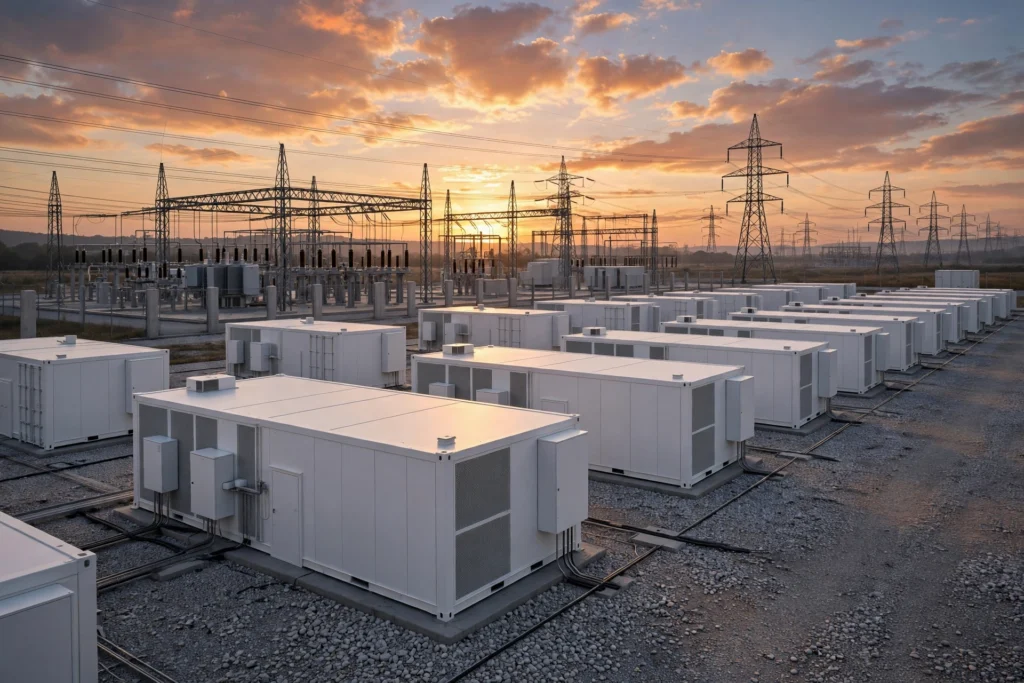
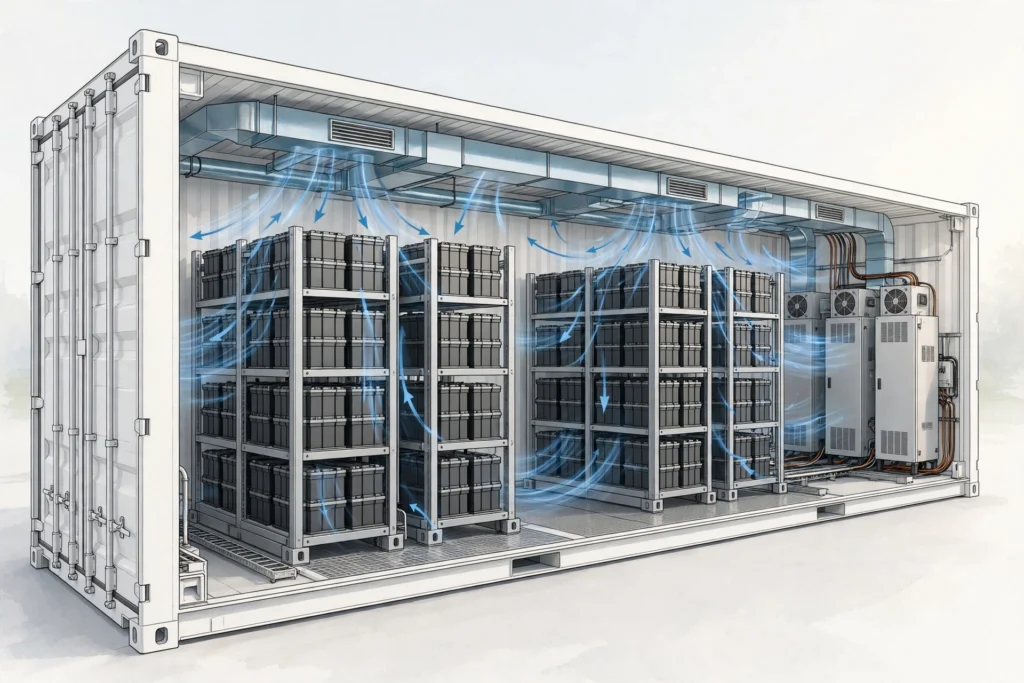
Megapack is Tesla’s containerized, utility-scale battery product: batteries, inverters, thermal management, and controls pre-integrated in a single enclosure that ships as one unit. Three product generations and one announced successor trace a clear arc — and the arc itself tells part of the chemistry story.
| Generation | Nameplate capacity | Nameplate power | Round-trip efficiency | Cycle life (as stated) | Weight | Status |
|---|---|---|---|---|---|---|
| Megapack (Gen 1, 2019) | 2.6 MWh | 1 MW | — | — | 25,400 kg (56,000 lb) | Shipped product; specs via Tesla datasheet citations |
| Megapack 2 | 3.854 MWh | 1.284 MW | 92.0% | — | 30,500 kg (67,200 lb) | Shipped product; specs via Tesla datasheet citations |
| Megapack 2XL | 3.916 MWh | 1.927 MW | 85–90% | 3,000–5,000 cycles (per tesla.com) | 38,100 kg (84,000 lb) | Shipped product; the LFP-era unit |
| Megapack 3 | ~5 MWh usable AC | 2.5 MW | 91% (medium-voltage, incl. aux loads) | >10,000 cycles — Tesla’s stated Megablock target | ~39,000 kg (86,000 lb) | Announced Sep 2025 (RE+, Las Vegas); production planned from late 2026, Houston — not yet achieved |
Two reading notes. First, these are nameplate figures (the “2.5 MW / 5 MWh” Megapack 3 nameplate implies a 0.5C rate and roughly a 2-hour duration — simple arithmetic, labeled as inference). Tesla’s public Megapack page does not state the chemistry; it markets on fleet availability guarantees. Second, the scale: Tesla’s disclosures show storage deployments growing from 4.0 GWh (2021) to 46.7 GWh (2025), with factories at Lathrop, California (40 GWh, producing), Shanghai (40 GWh, producing), and Houston, Texas (50 GWh, under construction for Megapack 3).
The 2021 Decision: Why Tesla Drew the Line at Stationary Storage
The chemistry pivot was telegraphed before it happened. In May 2021, analysts at Canaccord Genuity (reported by pv-magazine) said Tesla’s Megapack shift toward LFP was driven by lower cost and easing nickel-supply constraints. Then, on the Q4 2021 earnings call, Musk made it doctrine: confirmed — “we do think that all stationary storage, Powerwall and Megapack, will transition to an iron-based system, basically a non-nickel system… you can really expect all stationary storage to transition to iron over time.” His stated rationale was material abundance: iron and lithium are abundant enough to make scarcity a non-issue.
Engineering inference (labeled): the visible fingerprint of the switch appeared in 2022, when Tesla’s Megapack order page moved from 2.6 MWh / 1.3 MW to 3.9 MWh / 1.9 MW with roughly 64% more mass in a larger enclosure. Analysts (reneweconomy, CleanTechnica, August 2022) read this as the LFP signature: more, heavier, lower-density cells delivering more total energy in the same product class — a chemistry change visible on a spec sheet, no press release required.
Reason 1: Cycle Life That Fits the Duty Cycle
A grid battery’s job is brutally simple: charge and discharge, roughly one full equivalent cycle per day, for as many years as the asset stands. Tesla’s standard Megapack warranty runs 15 years (covering defects and energy retention), with 10- or 20-year performance guarantees available; the announced Megablock configuration carries a 25-year lifespan claim. That is the duty cycle the chemistry must survive.
Here the numbers do the arguing. Confirmed third-party data (IEA 2023, via solartodo.com): ESS-grade LFP cells deliver 6,000–10,000 cycles at 80% DoD to 80% state of health; ESS-grade NMC delivers 3,000–6,000 cycles. Calendar life: roughly 15–20 years for LFP versus 10–15 for NMC. At one cycle per day, 6,000 cycles is over 16 years of service — the full warranty window and beyond. At 3,000 cycles, the asset needs mid-life augmentation around year eight. For a 15-to-25-year grid asset, LFP avoids an entire replacement cycle that NMC would require.
One discipline note: the “3,000–5,000 cycles” figure Tesla associates with the 2XL and the “>10,000 cycles” Megablock figure are product-level statements — commercial commitments, not cell datasheets. The test conditions behind them (DoD, temperature, C-rate) have not been published. Large-format LFP cells also demand serious cell balancing to keep every cell aging together — cell-level longevity only becomes system-level longevity if the pack stays homogeneous.
Reason 2: Thermal Safety at Megawatt-Hour Scale
A Megapack sits in a container next to substations, solar farms, and sometimes neighborhoods, holding megawatt-hours of stored energy. At that scale, the failure mode you plan for matters as much as the failure rate. Confirmed third-party data (IEA 2022, via solartodo.com): LFP’s thermal-runaway onset sits around 250–270 °C, versus roughly 200–220 °C for NMC, and LFP failure events release less heat and gas. A higher threshold plus a less energetic failure means simpler fire protection, easier permitting, and less insurance friction — real line items on a utility-scale project.
Two things must be said plainly here. First: LFP can still experience thermal runaway. No honest source claims otherwise. The advantage is a higher onset temperature and a milder event — a margin, not immunity. Second: cell-chemistry safety and system safety design are different things. Chemistry sets the threshold; the system decides what happens when it is crossed. Tesla carries a dedicated fire protection system on every Megapack, and the Megapack 3 announcement describes it as carried over. LFP does not replace that system — it reduces what the system must contain. For buyers, the takeaway is a two-part question: what is the cell’s thermal behavior, and what does the pack do about it? The battery management system and the thermal and protection architecture deserve as much scrutiny as the cathode chemistry.
Reason 3: Dollars per kWh-Cycle
Upfront cost per kWh is only half the economics; the other half is how many kWh the system delivers before it is replaced. Indicative third-party data (BNEF 2025, via a weak secondary — treat as a range, not a quote): LFP cells at $80–100/kWh versus NMC at $100–150/kWh. The engineering inference is directional, not a computed LCOS: lower upfront $/kWh multiplied by roughly double the cycle life points to a substantially lower levelized cost per kWh of lifetime throughput. No invented LCOS figures are needed to see the direction — and none are offered here.
The stronger evidence is Tesla’s own behavior. The 2021 analyst note explicitly named cost as a driver of the Megapack LFP shift, and the March 2026 $4.3 billion LG Energy Solution deal — a three-year contract for LFP prismatic cells built in Lansing, Michigan from 2027 for Megapack 3, confirmed via US government statements — is a cost-and-supply-chain commitment at industrial scale. If you are evaluating storage quotations, run the same directional math on your own numbers: our LiFePO4 vs lead-acid total cost of ownership calculator shows the method — compare chemistries on cost per delivered kWh over the full service life, not on the sticker price.
Reason 4: Iron Is Abundant; Nickel and Cobalt Are Not
Musk’s framing on the 2021 call was deliberately geological: iron is abundant on Earth in a way that makes scarcity a non-issue, and pairing it with abundant lithium removes the two metals — nickel and cobalt — whose supply chains carry price volatility, concentration risk, and ethical baggage. That was a statement of direction. The tariff story of 2025–2026 turned it into an operational necessity.
Confirmed: Tesla’s CFO has warned that tariffs have an “outsized” impact on the energy business because it relies on Chinese LFP cells — and Chinese LFP cells face up to 82.4% in combined US tariffs under Section 301. Tesla’s answer, confirmed via US government statements reported by Electrek in March 2026: Tesla is the buyer behind LG Energy Solution’s $4.3 billion, three-year contract for LFP prismatic cells, to be built in Lansing, Michigan from 2027 for Megapack 3 units assembled in Houston — “American-made cells will power Tesla’s Megapack 3,” per the US Department of the Interior. Tesla’s Nevada LFP cell factory (multi-GWh scale; reported 7–10 GWh, precise capacity unconfirmed) is nearing completion.
The lesson for buyers is that supply chain is an engineering variable, not a footnote. A chemistry decision that looks right on cycle life and cost can still fail if the cells behind it sit on the wrong side of a tariff wall. When you evaluate a storage quotation, ask where the cells are made, what trade exposure they carry, and whether the supplier has a credible path to domestic or diversified supply. Iron’s abundance is a 50-year advantage; tariff shielding is this decade’s.
Reason 5: The Density Penalty That Isn’t
LFP’s genuine weakness is energy density. Cell-level comparisons put LFP at roughly 90–160 Wh/kg versus 150–250 Wh/kg for NMC — the gap is real, and it is exactly why nickel chemistries still dominate long-range EVs, where every kilogram costs range. Musk’s one-sentence doctrine disposes of it for storage: reliably-sourced — “the energy density is not as important because it’s just staying on the ground.”
Engineering inference (labeled): run the system-level arithmetic from Tesla’s own published specs. The 2XL carries 3.916 MWh at 38,100 kg — roughly 103 Wh/kg at system level; Megapack 3: ~5 MWh at ~39,000 kg — roughly 128 Wh/kg. A container that never moves pays almost no penalty for heavier cells; it just needs a bigger, stronger box, which is exactly what Tesla built — the 2XL enclosure grew about six feet longer than Gen 1’s. Weight is a shipping and foundation line item, not a performance ceiling. For stationary assets, the right question is not “how many Wh per kg” but “how many Wh per dollar of installed system” — and on that metric, LFP’s density deficit never gets to matter.
LFP vs NMC for Storage: The Objective Table
Every figure below comes from a verifiable source. The market has already voted with purchase orders: per the IEA’s Global Energy Review 2026 (via secondary reporting), 2025 saw 108 GW of new battery storage deployed — up 40% year over year, eleven times the 2021 level — with roughly 80% utility-scale and LFP claiming about 90% of deployments, “because they cost less and handle repeated cycles more efficiently.”
| Parameter | LFP (ESS-grade) | NMC (ESS-grade) | Source |
|---|---|---|---|
| Cycle life @80% DoD, 25 °C (to 80% SOH) | 6,000–10,000 | 3,000–6,000 | IEA 2023 via solartodo.com |
| Calendar life (typical spec) | 15–20 yr | 10–15 yr | IEA 2023 via solartodo.com |
| Capacity retention @10 yr (typical) | 70–80% | 60–75% | IEA 2023, Lazard 2024 via solartodo.com |
| Thermal-runaway onset | ~250–270 °C | ~200–220 °C | IEA 2022 via solartodo.com |
| Cell energy density | 90–160 Wh/kg | 150–250 Wh/kg | bslbatt.com / ecoflow.com comparisons |
| Cell cost, 2025 | $80–100/kWh | $100–150/kWh | BNEF 2025 via lifepo4batteryshop.com — indicative only |
| Cobalt / nickel content | None | Present | Chemistry fact |
| Nominal cell voltage | 3.2 V | 3.6–3.7 V | Chemistry fact |
| Grid-storage market share, 2025 | ~90% | ~10% (other chemistries) | IEA Global Energy Review 2026 via ecofinagency.com / gcn.com |
Megapack 3 Deepens the Bet
Announced at RE+ Las Vegas in September 2025, Megapack 3 is Tesla’s statement that the LFP decision was not a stopgap. Confirmed as Tesla’s announcements (via reputable press — not field-verified; production planned from late 2026): new 2.8-liter LFP cells co-developed with Tesla’s cell team, sourced from the US, Southeast Asia, and China; a “drastically simplified” thermal bay with 78% fewer connections; a scaled-up Model Y heat pump; Tesla’s SiC inverter and dedicated fire protection carried over; −40 °C to +60 °C ambient envelope; front access, no roof penetrations. Battery cells are roughly 75% of the unit’s mass.
The product architecture also changed: the Megablock bundles up to four Megapack 3 units with transformer and switchgear into a 20 MWh block, with Tesla claiming 23% faster installation, 40% lower construction costs, a 25-year lifespan, and optimization for up to 8-hour applications. Every one of those figures is Tesla’s claim, reported September 2025 — stated targets for a product not yet in volume production, not measured field data. What the announcement signals is direction, not delivery: bigger LFP cells, simpler thermal paths, longer-duration applications.
What Tesla Hasn’t Disclosed
Honesty requires the other list. The following have not been publicly disclosed, and this article does not fill the gaps with guesses:
- The exact cell supplier for each Megapack generation. CATL is widely reported as the 2XL-era LFP supplier; Tesla has never confirmed it. LG Energy Solution is confirmed only for Megapack 3 (the $4.3B Michigan contract). Do not treat press speculation as Tesla’s supplier list.
- Cell-level specifications: amp-hour rating, exact dimensions of the “2.8-liter” cell, and the test conditions (DoD, temperature, C-rate) behind the “3,000–5,000” and “>10,000” cycle figures.
- Warranty curve specifics: the actual energy-retention percentage thresholds in the 15-year warranty and the terms of the optional 10-/20-year performance guarantees.
- Current pricing: the often-cited ~$1.39M 2XL figure comes from older Tesla order-page data and should be treated as historical, not current.
- Megapack 3 dispatch details beyond the 2.5 MW / 5 MWh nameplate.
- Nevada LFP factory capacity: reported at 7–10 GWh by different outlets; Tesla has not confirmed a precise figure.
What Can Smaller Energy Storage Projects Learn from Tesla Megapack?
You do not need a 40 GWh factory to use Tesla’s selection logic. The five reasons above compress into a decision framework any buyer — home storage, commercial and industrial, off-grid, or a distributor quoting projects — can apply at any scale:
1. Match cycle life to the duty cycle, not the brochure. Count your real cycles per day, multiply by the years you need, and demand the test conditions (DoD, temperature, C-rate) behind any cycle-life claim. Tesla sized LFP to a 15–25-year daily-cycling asset; size your chemistry to your actual duty.
2. Separate cell safety from system safety. Ask two questions, not one: what is the cell’s thermal behavior — and what does the pack do about it? Thermal design, fusing, isolation, and the battery management system are where a good cell becomes a safe system or a bad one stays dangerous.
3. Price the lifetime, not the sticker. Divide total project cost by lifetime delivered kWh. A cheaper-per-kWh battery that dies twice as fast is the expensive option — the same directional LCOS math that favors LFP at grid scale favors it in a home or C&I cabinet. And verify what you are buying: our Grade A vs Grade B cell verification guide shows how to check cell consistency before a pack is built, because one weak cell caps the whole string’s usable capacity.
4. Treat density as a constraint, not a goal. For anything that does not move — a garage wall, a commercial container, an off-grid shed — stop optimizing Wh/kg and start optimizing Wh per dollar of installed system. The density race belongs to EVs and aircraft; stationary projects win on longevity and cost per cycle.
5. Audit the supply chain behind the quote. Where are the cells made? What tariff or logistics exposure do they carry? A quotation that looks unbeatable today can become undeliverable tomorrow if its supply chain sits on the wrong side of a trade barrier — the lesson of Tesla’s Michigan pivot, at any scale.
The same engineering discipline scales down as faithfully as it scales up. (For the other end of the scale spectrum — where every gram costs launch money — see the first article in this series, on SpaceX’s Starlink satellite battery engineering.)
Sources
- Elon Musk, Tesla Q4 2021 earnings call transcript (iron-based stationary storage statement): https://www.fool.com/earnings/call-transcripts/2022/01/27/tesla-tsla-q4-2021-earnings-call-transcript/ (accessed October 2026).
- Tesla official Megapack page: https://www.tesla.com/megapack (accessed October 2026; chemistry not stated on the public page).
- Tesla Q4 2025 Update deck (deployment figures 2021–2025): https://electrek.co/wp-content/uploads/sites/3/2026/01/TSLA-Q4-2025-Update.pdf (accessed October 2026).
- Tesla Megapack 3 / Megablock announcement, RE+ Las Vegas, September 2025, via energy-storage.news: https://www.energy-storage.news/under-the-hood-inside-teslas-megapack-3-as-texas-production-begins/ (accessed October 2026).
- Tesla Megapack 3 / Megablock announcement via reneweconomy: https://reneweconomy.com.au/tesla-unveils-megapack-3-and-new-megablock-says-they-will-be-40-pct-cheaper-to-build/ (accessed October 2026).
- Tesla Megapack 3 / Megablock announcement via teslanorth: https://teslanorth.com/2025/09/09/tesla-unveils-megapack-3-and-megablock-giant-grid-batteries-for-cities/ (accessed October 2026).
- US-government-confirmed $4.3B LG Energy Solution LFP deal (Tesla buyer, Michigan from 2027), via Electrek, March 2026: https://electrek.co/2026/03/17/tesla-lg-energy-solution-4-3-billion-lfp-battery-deal-megapack-confirmed/ (accessed October 2026).
- Tesla energy output / Nevada LFP factory reporting, pv-magazine, October 2025: https://www.pv-magazine.com/2025/10/28/tesla-energy-output-rises-84-to-43-5-gwh-with-record-deployments/ (accessed October 2026).
- Canaccord Genuity analyst note on the 2021 Megapack LFP shift, via pv-magazine, May 2021: https://www.pv-magazine.com/2021/05/10/tesla-shifts-battery-chem-for-its-megapack-energy-storage-system/ (accessed October 2026).
- 2022 Megapack order-page change (2.6→3.9 MWh) as LFP fingerprint, via reneweconomy: https://reneweconomy.com.au/tesla-boosts-size-and-rating-of-megapack-battery-module-by-50-per-cent/ (accessed October 2026).
- Musk 2022 “energy density” statement + 2022 LFP Megapack reporting, via CleanTechnica: https://cleantechnica.com/2022/08/14/new-tesla-lfp-megapack-is-big-really-big-with-video/ (accessed October 2026).
- IEA 2022/2023 technical figures (cycle life, calendar life, thermal onset) via solartodo.com: https://solartodo.com/knowledge/lfp-vs-nmc-battery-comparison-energy-storage-2026 (accessed October 2026).
- IEA Global Energy Review 2026 (108 GW, ~90% LFP) via ecofinagency.com: https://www.ecofinagency.com/news-industry/2104-54878-global-battery-storage-capacity-jumps-40-in-2025-iea-reports (accessed October 2026).
- IEA figures via gcn.com: https://gcn.com/lfp-batteries-now-claim-new-grid/21749/ (accessed October 2026).
- BNEF 2025 cell-cost figures (indicative) via lifepo4batteryshop.com: https://www.lifepo4batteryshop.com/blogs/nmc-vs-lfp-vs-lto-batteries-comparison.html (accessed October 2026).
- Tesla FY2025 energy segment results summary (10-K via bessmanufacturers.com): https://bessmanufacturers.com/resources/tesla-energy-2025-annual-results-energy-storage/ (accessed October 2026).
- Tesla Megapack generations and datasheet citations: https://en.wikipedia.org/wiki/Tesla_Megapack (accessed October 2026).
Frequently Asked Questions
What battery chemistry does Tesla Megapack use?
Tesla has committed all of its stationary storage — Powerwall and Megapack — to an iron-based, non-nickel system, stated by Elon Musk on the Q4 2021 earnings call. The Megapack 3 announcement (September 2025) specifies new 2.8-liter LFP cells. Tesla’s public Megapack page does not name the chemistry.
Why doesn’t Tesla use NMC batteries for Megapack?
Four compounding reasons, all sourced in this article: LFP delivers roughly double the cycle life at 80% DoD (6,000–10,000 vs 3,000–6,000 cycles, IEA 2023), a higher thermal-runaway onset temperature (~250–270 °C vs ~200–220 °C, IEA 2022), lower indicative cell cost, and freedom from nickel/cobalt supply chains. Energy density — NMC’s main advantage — does not matter for a stationary container.
How long does a Tesla Megapack last?
Tesla’s standard warranty covers 15 years (no-defect plus energy retention), with 10- or 20-year performance guarantees available at extra cost; the announced Megablock configuration carries a 25-year lifespan claim. These are product-level commitments — distinguish them from cell cycle-life figures. The warranty’s exact retention thresholds have not been published.
Can LFP batteries catch fire?
Yes — LFP cells can experience thermal runaway; no honest source claims otherwise. LFP’s advantage is a higher onset temperature (~250–270 °C vs ~200–220 °C for NMC, IEA 2022) and a less energetic failure event. System-level protection — thermal design, fusing, fire suppression, and the BMS — is what turns a safer cell into a safe system.
What should I check before buying LFP batteries for a storage project?
Match cycle life to your real daily duty cycle (and demand the DoD/temperature/C-rate test conditions behind the claim), verify cell consistency with a documented screening method like our Grade A vs Grade B guide, scrutinize the BMS and thermal design, price the lifetime cost per delivered kWh, and audit the cells’ manufacturing origin and trade exposure. If you want help applying this framework, talk to our team.
Applying LFP Battery Selection Principles to Your Own Project?
Tesla’s Megapack decision framework — cycle life matched to duty, thermal margin at scale, dollars per kWh-cycle, and supply-chain sanity — is the same framework any serious storage buyer should apply. Whether you are a distributor quoting commercial projects, an installer sizing home storage, or an integrator building custom systems, the questions are identical; only the scale changes. As a China-based LiFePO4 battery supplier and OEM/ODM partner working with a trusted manufacturing partner, LJY Energy helps buyers specify cells, verify quality with documented screening methods, and source LiFePO4 cells and custom packs for their projects.
Share This Article