
Share This Article
Content type: B2B technical guide — explains why identically rated LiFePO4 batteries perform differently and how wholesale buyers verify capacity claims. This article distinguishes standards facts (IEC/GB/UL scope), industry experience (buyer and installer communities), and LJY Energy’s recommendations; each is labeled where it appears. No test data, factory audits, certifications, or customer cases are presented. All supplier comparison data is explicitly marked hypothetical.
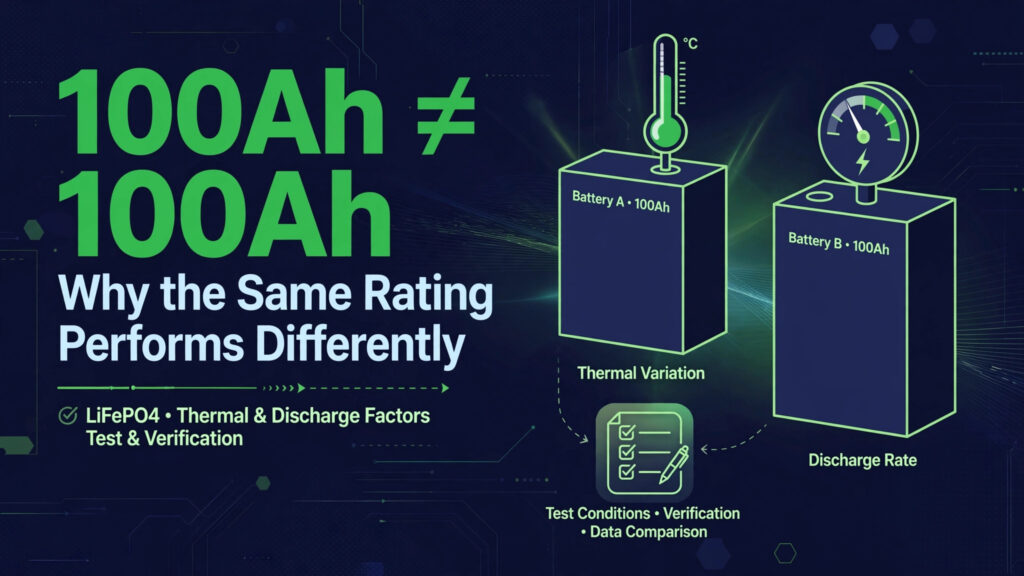
The short answer: “100Ah” printed on a battery is a name, not a promise. It tells you which model you’re looking at — not how many amp-hours you will actually get in your application. Two batteries carrying the same Ah rating can deliver noticeably different usable energy because the rated number was measured under specific conditions (discharge rate, temperature, cut-off voltage, charge method) that may differ between suppliers — and because cell consistency, internal resistance, and BMS current limits shape what comes out in real use.
This guide explains the five variables behind the difference, how to read a supplier’s capacity test report, and includes a procurement evidence checklist for verifying capacity claims before you order.
“100Ah” Is a Name, Not a Promise
Standards fact: The International Electrotechnical Vocabulary (IEC 60050, Part 482), as quoted in the IEC 60896-22 preview, defines three different things people casually call “capacity”: nominal capacity (an approximate value used to identify the cell or battery), rated capacity (the value declared by the manufacturer as deliverable under specified conditions after a full charge), and actual capacity (what is measured when you discharge at a specified rate, to a specified end voltage, at a specified temperature). The full IEV text was not accessed; these definitions are cited as quoted in the standard preview.
Read that again: the number on the label is the nominal capacity — an identifier. The number you get in your hands is the actual capacity — a measurement that only exists together with its test conditions. When two suppliers both write “100Ah” but tested under different conditions, they are not describing the same thing.
Put plainly: “100Ah” on a datasheet means the battery delivered 100 amp-hours when the manufacturer tested it under their stated conditions. It does not mean 100Ah at every discharge rate, every temperature, or every cut-off voltage. Any comparison of two “100Ah” batteries that ignores the test conditions is comparing two different measurements as if they were one.
In procurement language, keep four terms apart: cell capacity (what a cell delivers in a cell-level test), pack rated capacity (what the manufacturer declares for the finished pack under stated conditions), actual usable capacity (what you measure at the pack terminals in your application), and energy (Wh — capacity × voltage). Problems start when a cell capacity number is quoted as if it were the pack’s usable capacity.
Five variables explain nearly every “same Ah, different performance” case this guide covers:
- Test conditions behind the rated number (discharge rate, temperature, cut-off voltage, charge method)
- Cell-to-cell consistency inside the pack
- Internal resistance and its spread across cells
- BMS current limits (often mistaken for a capacity problem)
- Operating temperature in your application
Ah vs Wh vs Usable Energy: What Each Number Actually Means
Buyers routinely compare three numbers as if they were interchangeable. They are not:
- Amp-hours (Ah) — capacity. How much electric charge the battery can deliver. This is the number on the label, and it is meaningless without test conditions.
- Watt-hours (Wh) — energy. How much work the battery can do: Wh = Ah × nominal voltage (a straightforward arithmetic identity). A “100Ah” 12.8V battery stores roughly 1280Wh under its rated conditions — change the conditions, and both numbers move together.
- Usable energy — what your application actually gets. This is the energy delivered between your system’s charge and discharge limits, at your temperature, at your discharge rate. It is always less than the rated Wh, and the gap varies by application.
- Power (W or A) — a separate dimension entirely. How fast energy can be drawn. A battery can have ample capacity yet be unable to start a large inverter — that is a power/BMS limit, not a capacity shortfall. Never diagnose a power problem as a capacity problem.
Standards fact: Rated capacity is defined as deliverable under conditions specified by the manufacturer (IATA/PRBA Lithium Battery Guidance, consistent with IEC methodology). There is no single universal test condition for “100Ah” — which is exactly why the conditions must be stated in writing. Every Ah number you compare should carry four companions: discharge rate, ambient temperature, cut-off voltage, and charge method. A number without them cannot be compared to anything.
A note on standards scope (so you cite the right one): IEC 62620 covers secondary lithium cells and batteries for industrial applications — including stationary energy storage and golf carts, excluding road vehicles — and applies to both cells and batteries. IEC 61960, often quoted for capacity-test method (0.2ItA at 20°C), covers portable applications only and should not be presented as governing 100Ah storage cells. GB/T 36276 covers lithium-ion batteries for electrical energy storage (GB/T = recommended, not mandatory). UL 1973 is a safety standard for stationary and auxiliary-power batteries — it verifies safety design; it does not certify a capacity number.
What’s Inside: Cell Capacity, Consistency, Internal Resistance, and BMS Limits
Even when two batteries were rated under identical conditions, their internals can differ in four ways that change real-world performance:
Cell capacity and the weakest-cell principle
Industry experience (general lithium-ion principle): In a series-connected pack, the weakest cell is the limiting factor for usable pack capacity — discharge stops when the first cell reaches the cut-off voltage, even if other cells still hold charge. But do not equate the two numbers directly: the weakest cell’s cell-level capacity is not automatically the pack’s usable capacity. BMS cut-off thresholds, wiring and connection losses, temperature, and discharge rate all apply on top, so the pack delivers whatever is measured at the pack terminals under the pack’s own conditions. Treat the weakest cell as the ceiling and the pack-level test as the verdict. Two packs built from “100Ah” cells can therefore deliver different usable capacity if one pack’s cells are less consistent. This is also why cell matching matters more as pack voltage rises: more cells in series means more chances for one weak cell to set the limit. For background on how cell quality is graded before packs are built, see our guide on Grade A vs Grade B LiFePO4 cells.
Internal resistance and voltage sag
Industry experience: Internal resistance (IR) converts some discharge energy into heat and causes voltage sag under load — the terminal voltage dips while current flows. A pack with higher or more uneven IR hits the BMS low-voltage cut-off earlier at the same discharge current, delivering fewer amp-hours before the BMS stops the discharge. The cells didn’t “lose” capacity; the voltage sag consumed the usable window. IR also rises as temperature falls, which is one reason winter performance drops (see next section). When comparing IR figures between suppliers, confirm the method (ACIR vs DCIR), temperature, and state of charge — values from different test conditions cannot be directly compared.
BMS current limits are not capacity
Industry experience: This is the most common misdiagnosis in the trade. A BMS rated “100A” limits the rate of discharge (current), not the amount of stored energy (amp-hours). A 100Ah battery with a 100A BMS can still deliver its full 100Ah — it just cannot deliver it faster than 100A. If your inverter demands 150A and the BMS cuts out, the battery isn’t “really 60Ah”; it’s a 100Ah battery whose BMS is undersized for your load.
Illustrative example (not a product specification): a 50Ah pack built with 1.5C-rated cells can sustain about 75A continuously based on the cells — regardless of whether the BMS label says 100A or 150A. Always check the continuous (not just peak) discharge current rating of both the cells and the BMS, and match them to your application’s maximum sustained load. BMS specifications vary by product; treat any specific amp figure as an example unless tied to a named product’s datasheet.
The Three Test Conditions That Move the Measured Number
Standards-grounded direction (Battery Council International glossary): actual capacity is not a constant — it decreases with increasing discharge rate and decreasing temperature, in addition to age and usage. Capacity is conventionally measured at constant current to a terminal (cut-off) voltage, typically near 25°C. The table below shows the direction of each effect. No fixed percentages are given — published retention figures conflict across sources, so treat any specific percentage you see elsewhere as unverified unless tied to a named test standard and product.
| Condition change | Direction of effect on measured Ah | Why |
|---|---|---|
| Higher discharge rate | Lower | Voltage sag reaches the cut-off sooner; less charge extracted before termination |
| Lower temperature | Lower | Internal resistance rises; usable voltage window shrinks |
| Higher cut-off voltage | Lower | Discharge terminates earlier by definition |
| Lower cut-off voltage | Higher measured Ah | More charge extracted — but not necessarily usable in your system |
Industry experience: Cold deserves special attention for buyers in northern markets. Charging LiFePO4 cells below roughly 0°C risks lithium plating (permanent capacity loss), which is why quality BMS units block charging below about 0°C. A battery that “loses capacity in winter” may be perfectly healthy — it is operating outside the temperature window its rating assumed. If your application runs cold, ask the supplier for the rated temperature range and the BMS low-temperature protection thresholds in writing, rather than comparing winter field results against 25°C lab ratings.
LJY Energy recommends: When a supplier quotes capacity, ask for the four conditions (rate, temperature, cut-off voltage, charge method) before comparing the number to anything. Two “100Ah” batteries rated at different cut-off voltages were never comparable in the first place.
How to Read a Supplier’s Capacity Test Report
A capacity test report is only as good as its protocol section. Work through this anatomy checklist:
- Test object: cell or pack? A cell-level test does not prove pack-level performance (BMS cut-offs, wiring losses, and cell mismatch all subtract at pack level). Make sure the report tests the same thing you are buying.
- Charge protocol. How was the battery charged before the test (CC/CV? to what voltage? rest time)? An incomplete charge at the start invalidates everything after it.
- Discharge rate and temperature. The two conditions that move the number most. If either is missing, the report’s headline figure is unverifiable.
- Cut-off voltage. Confirm it matches a voltage your system can actually use — a report discharged to an unusually low cut-off may flatter the Ah figure beyond practical relevance.
- Equipment and method. What tester was used, and was IR measured by ACIR or DCIR? (See our note on IR comparability above.)
- Sample size and batch linkage. How many units were tested, and can the report be tied to your production batch (date codes, batch numbers, QR codes)? A report for a different batch is a different product’s report.
Red flags: no test conditions stated anywhere; a single sample presented as batch proof; the report’s batch or date doesn’t match the batch you’re buying; safety certifications (e.g., UL 1973) presented as if they certified the capacity figure — they didn’t, they certified safety design.
A Hypothetical Comparison: Two “100Ah” Quotes Side by Side
All data in this section is hypothetical — invented to show how to compare quotes, not to describe any real product. Imagine you receive two quotes, both labeled “12V 100Ah LiFePO4”:
| Datasheet line | Supplier A (hypothetical) | Supplier B (hypothetical) |
|---|---|---|
| Rated capacity | 100Ah | 100Ah |
| Discharge rate used for the rating | 0.2C | 1C |
| Test temperature | 25°C | 25°C |
| Cut-off voltage (pack) | 10.0V | 10.0V |
| BMS continuous current | 100A | 50A |
| Capacity test report | Batch-linked | No batch link stated |
Reading it as a buyer:
- Supplier A’s 100Ah and Supplier B’s 100Ah are different measurements. Rated at 1C instead of 0.2C, Supplier B’s figure was obtained under harsher conditions — you cannot conclude B’s battery equals A’s from the label alone.
- Check your load against the BMS, not the Ah. If your inverter draws 80A continuously, Supplier B’s 50A BMS is undersized for the job regardless of its 100Ah label — a specification mismatch, not a capacity defect.
- Evidence quality differs. A batch-linked report can be tied to your shipment; a report with no batch link cannot. The cheaper quote may simply carry less evidence.
LJY Energy’s view: before comparing prices, normalize both quotes onto the same test conditions — or ask each supplier to re-state their figure under your conditions. If you are comparing quotes like these, LJY Energy can help you review the test conditions behind each number and identify the risks before you commit.
Choosing the protection to match is a separate discipline — see our BMS selection guide: how to size and verify a LiFePO4 battery BMS.
What to Demand Before You Order: The Procurement Evidence Checklist
LJY Energy recommends: Put these six items in your RFQ or purchase contract. A supplier who answers all six clearly is a supplier you can build on.
- The four conditions in writing — discharge rate, ambient temperature, cut-off voltage, and charge method behind the rated Ah figure, for the exact model you’re buying.
- Cell vs pack identification — is the rated capacity a cell-level or pack-level figure? What are the BMS continuous/peak current ratings and low-voltage cut-off?
- Batch-identified test evidence — a capacity test report traceable to the production batch (batch numbers, date codes), not a generic PDF.
- IR data with method stated — ACIR or DCIR, with temperature and state of charge, so figures can actually be compared.
- Temperature ratings — rated charge/discharge temperature ranges and BMS low-temperature protection behavior, in writing.
- Acceptance threshold tied to stated conditions — agree before ordering what measured result counts as a pass (e.g., “≥95% of rated Ah when tested at the supplier’s stated conditions”), not after the goods arrive.
Questions to Ask Your Supplier
Copy these into your next RFQ. A supplier who answers all eight precisely is a supplier you can build on:
Capacity checks are one part of vetting a supplier. For the wider process — company verification, document review, and quote comparison — see our guide to verifying a LiFePO4 battery supplier in China before placing an order.
- Under what exact test conditions was the rated capacity measured — discharge rate, ambient temperature, cut-off voltage, and charge method?
- Is the rated figure a cell-level or a pack-level measurement?
- What are the BMS continuous and peak current ratings, and the BMS low-voltage cut-off?
- Can you provide a capacity test report traceable to my production batch — with batch numbers and date codes?
- How was internal resistance measured — ACIR or DCIR, at what temperature and state of charge?
- What are the rated charge and discharge temperature ranges, and how does the BMS handle low-temperature charging?
- What measured result counts as a pass in my incoming inspection, when tested under your stated conditions?
- If my incoming test disagrees with your report, what is the re-test and dispute procedure?
Designing Your Incoming Inspection
Industry experience: Your incoming inspection is the only capacity evidence fully under your control. Design it to replicate the supplier’s stated conditions — testing under different conditions than the rating and then disputing the result proves nothing.
- Sampling: test a defined sample of the shipment (illustrative example: 5–10%, or per an agreed AQL plan) — never judge a batch by a single unit.
- Discharge test: illustrative example: 0.2C–0.5C constant-current discharge at ~25°C to the agreed cut-off voltage, after a full charge per the agreed method. Confirm the actual rate against the cell manufacturer’s datasheet for that model.
- IR spot-check: measure a sample with a stated method (ACIR or DCIR) and compare against the report’s figures and against consistency across your sample — a wide spread within one shipment is itself a finding.
- Batch verification: confirm date codes and batch numbers match the report before testing; mixed batches invalidate batch-level conclusions.
- Dispute clause: agree in advance how disagreements are re-tested, which lab arbitrates, and who bears the cost — the same discipline as our cell-grade due-diligence checklist.
For buyers who want to understand how rated capacity translates into years of service (as opposed to a single discharge test), our guide on how long LiFePO4 batteries last connects cell quality to service life.
Frequently Asked Questions
My 100Ah battery tested at 95Ah. Is it defective?
Not necessarily — it depends on the conditions. If the supplier’s rating assumed a 0.2C discharge at 25°C to a 2.5V-per-cell cut-off and you tested at 1C in a cold garage to a higher cut-off, 95Ah may be exactly what the physics predicts. Compare your result against the stated test conditions, not against the bare “100Ah” label. If you replicated the stated conditions and still fall short of the agreed acceptance threshold, then you have a claim.
Does a 100A BMS mean I get 100Ah of usable capacity?
No — amps and amp-hours measure different things. The 100A BMS rating limits how fast you can draw energy (current); the 100Ah rating describes how much energy is stored. A 100Ah battery with a 100A BMS delivers its full capacity as long as your load stays within 100A. If you need 150A continuous, you need a bigger BMS (and wiring) — not a bigger Ah number.
Why does my battery deliver less capacity in winter?
Cold raises internal resistance, increasing voltage sag and shrinking the usable voltage window — so fewer amp-hours come out before the BMS cut-off. This is expected behavior, not necessarily a defect. Separately, charging below roughly 0°C risks permanent lithium plating, which is why BMS units typically block low-temperature charging. Size your winter expectations against the rated temperature range, not the 25°C lab figure.
Should I trust the cell test report, or test the pack myself?
Do both, for different reasons. The cell report tells you about cell quality and consistency; your own pack-level incoming test tells you what your order actually delivers after BMS cut-offs, wiring, and assembly. A cell report never proves pack performance — and a pack test never diagnoses which cell caused a shortfall. Use the report for supplier qualification and your own test for acceptance.
What if the supplier’s report doesn’t state test conditions?
Then the capacity figure is unverifiable — treat it as a marketing number, not a specification. Ask for the four conditions (rate, temperature, cut-off voltage, charge method) in writing before ordering. A supplier unwilling to state them is telling you something about their testing discipline.
Is a higher Ah rating always the better buy?
No. What matters is usable energy in your application at a verified evidence level, at a price that reflects that evidence. A well-documented 100Ah battery with verified test conditions and a clear warranty beats a bare “120Ah” label with no test evidence — the same principle as buying cell grades by documentation, not by letter.
Technical Sources and Verification Notes
This article’s standards references were verified as follows. Where the full standard text could not be accessed, only the verified scope is cited — no specific clause is claimed.
- IEV capacity definitions (nominal / rated / actual): verified as quoted in the IEC 60896-22 preview (standards.iteh.ai), citing IEV 486-03-021 and 486-03-22. The full IEV (IEC 60050) text was not accessed.
- IEC 62620: scope verified via the IEC webstore listing — secondary lithium cells and batteries for industrial applications, including stationary energy storage and golf carts, excluding road vehicles. The full test procedure was not accessed; only scope is cited.
- IEC 61960: scope verified via standard previews — secondary lithium cells and batteries for portable applications. Not applied to storage cells in this article.
- GB/T 36276: title and scope (lithium-ion batteries for electrical energy storage; GB/T = recommended) verified via standards-catalog descriptions. Full text not accessed.
- UL 1973: scope verified via UL/GlobalSpec/TÜV SÜD previews — a safety standard for stationary and auxiliary-power batteries, not a capacity-rating standard.
- Industry and technical sources: Battery Council International glossary (capacity vs rate/temperature), EE Times (weakest-cell principle, general lithium-ion), EngineersEdge (capacity measurement basics), IATA/PRBA Lithium Battery Guidance (rated capacity definition).
- All product figures in this article (0.2C/0.5C test rates, 5–10% sampling, the 50Ah worked example, and the Supplier A/B comparison) are labeled illustrative or hypothetical.
Comparing Specifications?
Comparing LiFePO4 battery specifications from different suppliers? LJY Energy can help you review test conditions, BMS limits, and the specifications that matter for your application.
Evaluating cell quality too? Read our Grade A vs Grade B buyer’s guide or browse wholesale LiFePO4 cells.
Share This Article